
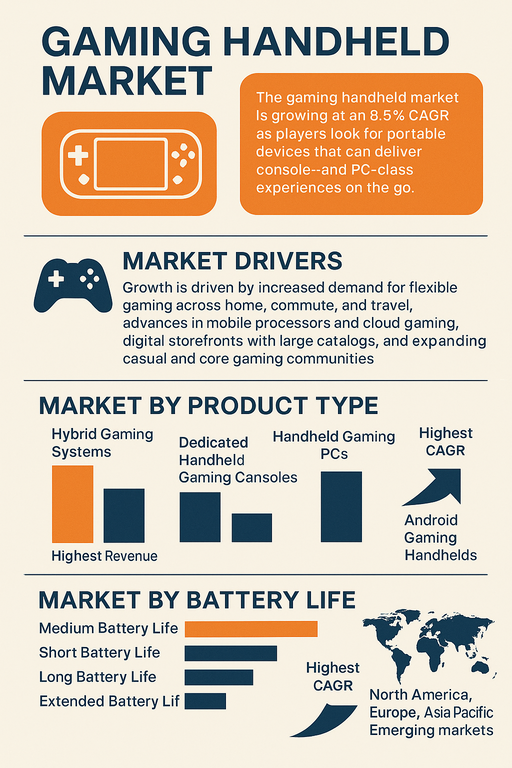
The gaming handheld market is growing at an 8.5% CAGR as players look for portable devices that can deliver console- and PC-class experiences on the go. Strong broadband, cloud gaming, and digital storefronts allow users to access large game libraries across locations, while advances in mobile CPUs, GPUs, displays, and cooling make high-performance handheld form factors more practical. Within product types, hybrid gaming systems generate the highest revenue because they serve as both home and portable consoles and benefit from strong first-party game ecosystems, while handheld gaming PCs and Android gaming handhelds are expected to post the highest CAGR as PC and mobile ecosystems push deeper into handheld formats. By battery life segment, medium battery life devices account for the largest share due to balanced performance and portability, whereas extended battery life devices are set to record the highest CAGR as users prioritize endurance for cloud gaming, long trips, and competitive play away from chargers.
Market Drivers
Growth is driven by increased demand for flexible gaming experiences that span home, commute, and travel environments. Many players want to continue console or PC sessions without being tied to a fixed screen, which supports adoption of hybrid systems and handheld PCs that can run the same libraries as stationary devices. Improvements in mobile processors, power management, and high-refresh displays enable modern handhelds to run AAA and indie titles with acceptable frame rates, while Wi-Fi 6, 5G, and better cloud gaming platforms make streaming high-end games on compact devices more practical. Digital storefronts and subscription services provide large catalogs via a single account, reducing the friction of buying and carrying physical media and supporting cross-platform play. Strong growth in casual and core gaming communities, combined with social and streaming features built into handhelds, also expands the addressable user base beyond traditional console buyers. In parallel, accessory ecosystems such as controllers, docks, and audio solutions improve the overall value of handheld platforms and encourage longer engagement.
Market Restraints
Adoption is restrained by price sensitivity, software optimization issues, and competition from smartphones and other gaming formats. High-performance handheld gaming PCs and premium hybrid systems often carry price points that overlap with or exceed those of home consoles and entry-level laptops, which limits uptake among budget-conscious users. Battery life remains a challenge when running demanding games at high frame rates and brightness, especially for handheld PCs; users may experience short play sessions between charges if performance settings are not managed carefully. Some PC games and older titles are not fully optimized for small displays or handheld control layouts, which reduces the perceived value of certain devices. Software ecosystems are fragmented, with different platforms, stores, and exclusive content that make it hard for users to choose a long-term device. In many markets, advanced smartphones paired with game controllers or cloud gaming apps already cover a large portion of mobile gaming use cases, creating strong competition for dedicated handheld hardware. Limited retail presence, supply chain constraints, and perception that handhelds are secondary devices can also slow expansion in some regions.
Market by Product Type
Dedicated handheld gaming consoles focus on closed ecosystems and curated game libraries, often with strong first-party titles and straightforward user interfaces. They appeal to families, younger players, and users who want a simple, gaming-only device with reliable performance. Hybrid gaming systems combine docked and portable modes, allowing users to play on a TV or in handheld mode using the same hardware; this flexibility, combined with strong exclusive content and broad third-party support, means hybrid systems generate the highest revenue in the handheld segment. Handheld gaming PCs run full desktop-class operating systems and access existing PC game libraries, including large back catalogs and PC storefronts. They attract enthusiasts who value graphics options, mod support, and cross-play with desktop rigs; this segment is expected to post one of the highest CAGRs as hardware becomes more efficient and form factors improve. Android gaming handhelds rely on mobile chipsets, app stores, and cloud gaming services, serving users who want access to mobile titles, subscription services, and streaming platforms in a form factor built around physical controls. As cloud gaming and mobile ecosystems expand, Android handhelds are also expected to see strong growth, especially in cost-sensitive segments and regions with robust mobile networks.
Market by Battery Life
Short battery life devices offer high performance in compact designs but may only support relatively brief gaming sessions between charges when running demanding titles. They often target enthusiasts who prioritize frame rates and visual settings over endurance and are willing to manage power profiles or stay near outlets. Medium battery life devices strike a balance between performance, thermals, and capacity, handling several hours of typical gameplay in mixed use; this category accounts for the largest share because it serves both casual and core users with acceptable endurance and cost. Long battery life devices use efficient components, optimized displays, and power management strategies to extend playtime for less demanding titles, retro games, and streaming sessions, which makes them attractive for commuters and frequent travelers. Extended battery life devices push endurance further through larger batteries, aggressive optimization, or lower-power modes tuned for cloud gaming and online play; as cloud gaming platforms and portable internet access improve, extended battery life devices are expected to record the highest CAGR, supported by users who view handhelds as their primary platform for long sessions away from home.
Regional Insights
North America represents a major market due to strong console and PC gaming cultures, high disposable income, and wide adoption of subscription and cloud gaming services. Consumers in this region adopt hybrid systems, handheld PCs, and accessory ecosystems at an early stage, and retailers actively promote new devices through bundles and promotions. Europe is another important region, with demand driven by both dedicated handheld consoles and hybrid systems, and growing interest in handheld PCs among core PC players; regional regulations and consumer expectations for quality and support favor well-established brands. Asia Pacific is expected to be one of the fastest-growing regions, supported by large mobile gaming user bases, high broadband penetration in markets such as Japan, South Korea, and parts of China, and strong interest in portable formats that fit dense urban lifestyles. Local manufacturing and component supply chains also help reduce costs and accelerate product refresh cycles. Latin America and the Middle East & Africa show increasing interest as broadband access improves and regional distributors expand availability of hybrid and cloud-focused devices, although price sensitivity remains high. Regions with strong digital infrastructure, active e-sports and streaming communities, and established gaming cultures will see faster adoption of advanced handheld devices.
Competitive Landscape
Anbernic focuses on retro-style handheld consoles that emphasize classic and indie gaming, appealing to users who value nostalgia and compact designs. ASUS, AYANEO, GPD Technology, OneXPlayer, and Lenovo are active in the handheld gaming PC segment, offering Windows- or PC-based devices with high-performance chipsets, advanced cooling, and integration with major PC game storefronts. AYN Odin 2 and Android-focused devices from companies such as Logitech Europe and Razer serve the Android gaming handheld segment, blending mobile game access, cloud gaming platforms, and physical controls for more comfortable long sessions. Nintendo of Europe and Sony Interactive Entertainment represent major console brands, with Nintendo leading hybrid system concepts and Sony focusing on ecosystem integration, remote play, and premium content. Microsoft Gaming, NVIDIA Corporation (GeForce Now), and Valve Corporation (Steam Deck) play key roles in cloud and PC ecosystems, combining hardware, storefronts, and streaming services; Valve also anchors the handheld PC market through its own device line and software platform. SteelSeries builds out the accessory and controller space, supporting better handheld and cloud gaming experiences through audio and input devices. As the market develops, companies that can balance performance, battery life, and price, while offering strong game libraries, ecosystem services, and reliable after-sales support, are expected to lead revenue, while brands that innovate in handheld PC form factors, Android streaming devices, and extended battery life platforms are positioned to capture the highest CAGR in the gaming handheld market.
Historical & Forecast Period
This study report represents analysis of each segment from 2024 to 2034 considering 2025 as the base year. Compounded Annual Growth Rate (CAGR) for each of the respective segments estimated for the forecast period of 2026 to 2034.
The current report comprises of quantitative market estimations for each micro market for every geographical region and qualitative market analysis such as micro and macro environment analysis, market trends, competitive intelligence, segment analysis, porters five force model, top winning strategies, top investment markets, emerging trends and technological analysis, case studies, strategic conclusions and recommendations and other key market insights.
Research Methodology
The complete research study was conducted in three phases, namely: secondary research, primary research, and expert panel review. key data point that enables the estimation of Gaming Handheld Market By Product Type, By Battery Life, By Form, By Technology, By Age Group, By Display Size, By Price Range market are as follows:
Market forecast was performed through proprietary software that analyzes various qualitative and quantitative factors. Growth rate and CAGR were estimated through intensive secondary and primary research. Data triangulation across various data points provides accuracy across various analyzed market segments in the report. Application of both top down and bottom-up approach for validation of market estimation assures logical, methodical and mathematical consistency of the quantitative data.
| ATTRIBUTE | DETAILS |
|---|---|
| Research Period | 2024-2034 |
| Base Year | 2025 |
| Forecast Period | 2026-2034 |
| Historical Year | 2024 |
| Unit | USD Million |
| Segmentation | |
Product Type
|
|
Battery Life
|
|
Form
|
|
Technology
|
|
Age Group
|
|
Display Size
|
|
Price Range
|
|
Application
|
|
Distribution Channel
|
|
|
Region Segment (2024-2034; US$ Million)
|
Key questions answered in this report


