
The green building market is projected to grow at a CAGR of 10.0% during the forecast period 2026–2034, driven by increasing focus on energy efficiency, carbon emission reduction, and sustainable construction practices. Green buildings emphasize efficient use of energy, water, and materials while minimizing environmental impact across the building lifecycle. Market growth is supported by tightening building energy regulations, rising awareness of climate change, and long-term cost savings associated with green construction. Residential and commercial sectors are key demand contributors, while retrofit projects are gaining momentum as governments push for decarbonization of existing building stock.
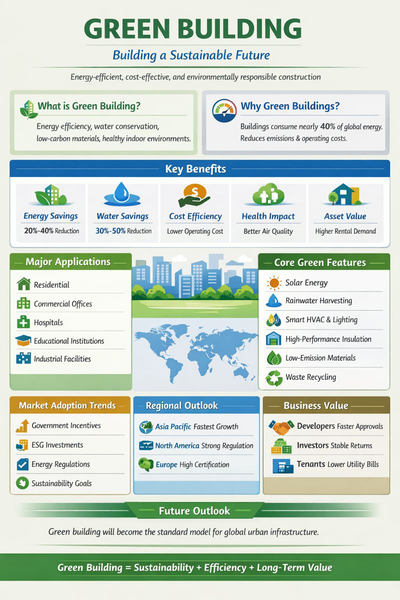
Market growth is primarily driven by stringent government regulations and building codes aimed at reducing energy consumption and greenhouse gas emissions. Rising energy costs are encouraging developers and building owners to adopt energy-efficient systems, smart building controls, and sustainable materials. Growing corporate commitments toward ESG targets and net-zero buildings are further supporting adoption, particularly in commercial and industrial facilities. Technological advances in building automation, HVAC efficiency, lighting systems, and digital energy management platforms are also accelerating green building penetration across regions.
Despite strong growth prospects, the green building market faces challenges related to higher upfront construction and material costs compared to conventional buildings. Limited availability of skilled professionals and standardized green construction practices can delay project execution. In emerging economies, lack of awareness and limited access to green financing options may restrict adoption. Retrofit projects also face technical complexity when integrating new systems into older building structures, increasing implementation time and costs.
By end use, the market is segmented into residential, commercial, and industrial buildings. The residential segment accounts for a substantial share due to rising demand for energy-efficient housing and supportive government incentives. Commercial buildings represent a major growth segment driven by office spaces, retail complexes, healthcare facilities, and data centers adopting sustainability targets. Industrial buildings are increasingly adopting green standards to reduce operational energy costs and comply with environmental regulations.
Based on project type, the market is segmented into new construction and retrofit projects. New green building projects dominate current demand due to easier integration of sustainable design and technologies at the planning stage. However, retrofit projects are expected to witness strong growth as governments and building owners focus on upgrading existing infrastructure to meet energy efficiency and carbon reduction goals.
North America represents a significant share of the green building market, supported by strict energy efficiency standards, mature certification systems, and high adoption of smart building technologies. Europe follows closely, driven by aggressive decarbonization policies and large-scale retrofit initiatives across residential and commercial buildings. Asia Pacific is expected to register the fastest growth during the forecast period, led by rapid urbanization, expanding construction activity, and government-backed green building programs in countries such as China, India, and Southeast Asia. Emerging markets in Latin America and the Middle East & Africa are also showing gradual adoption supported by sustainable urban development initiatives.
The competitive landscape of the green building market includes global building material suppliers, automation and energy management solution providers, and technology companies. Key players focus on energy-efficient building materials, smart building systems, HVAC optimization, lighting solutions, and digital platforms for building performance monitoring. Strategic partnerships with construction firms, real estate developers, and government agencies are common to expand market reach. Continuous innovation, regional expansion, and integration of digital and automation technologies remain core strategies across the market.
Key companies operating in the market include ABB, Alleguard, Alumasc Building Products, BASF, Bauder, Binderholz, Bosch Sicherheitssysteme, BSW GROUP, CEMEX, CertainTeed, Daikin, DuPont, Forbo, General Electric Company, HOLCIM, IBM, Interface, Johnson Controls, Kingspan Group, Owens Corning, RedBuilt, Schneider Electric, Siemens, and Signify Holding.
Historical & Forecast Period
This study report represents analysis of each segment from 2024 to 2034 considering 2025 as the base year. Compounded Annual Growth Rate (CAGR) for each of the respective segments estimated for the forecast period of 2026 to 2034.
The current report comprises of quantitative market estimations for each micro market for every geographical region and qualitative market analysis such as micro and macro environment analysis, market trends, competitive intelligence, segment analysis, porters five force model, top winning strategies, top investment markets, emerging trends and technological analysis, case studies, strategic conclusions and recommendations and other key market insights.
Research Methodology
The complete research study was conducted in three phases, namely: secondary research, primary research, and expert panel review. key data point that enables the estimation of Green Building Market By End Use, By Project Type, By Product, By Material Type, By Sales Channel - Growth, Share, Opportunities & Competitive Analysis, 2026 - 2034 market are as follows:
Market forecast was performed through proprietary software that analyzes various qualitative and quantitative factors. Growth rate and CAGR were estimated through intensive secondary and primary research. Data triangulation across various data points provides accuracy across various analyzed market segments in the report. Application of both top down and bottom-up approach for validation of market estimation assures logical, methodical and mathematical consistency of the quantitative data.
| ATTRIBUTE | DETAILS |
|---|---|
| Research Period | 2024-2034 |
| Base Year | 2025 |
| Forecast Period | 2026-2034 |
| Historical Year | 2024 |
| Unit | USD Million |
| Segmentation | |
End Use
|
|
Project Type
|
|
Product
|
|
Material Type
|
|
Sales Channel
|
|
|
Region Segment (2024-2034; US$ Million)
|
Frequently Asked Questions
What is the growth outlook for the green building market?
The market is expected to grow at a CAGR of 10.2% during 2026–2034, driven by energy efficiency regulations, sustainability goals, and rising energy costs.
Which end-use segments drive market demand?
Residential and commercial buildings are the primary demand drivers, supported by increasing adoption of energy-efficient housing and sustainable commercial infrastructure.
Which project type shows higher growth potential?
While new construction dominates current demand, retrofit projects are expected to grow strongly due to decarbonization of existing buildings.
Which regions lead the market?
North America and Europe hold significant shares, while Asia Pacific is expected to witness the fastest growth during the forecast period.
What are the key challenges in this market?
Higher upfront costs, skill gaps, and retrofit complexity are the main challenges affecting market adoption.


