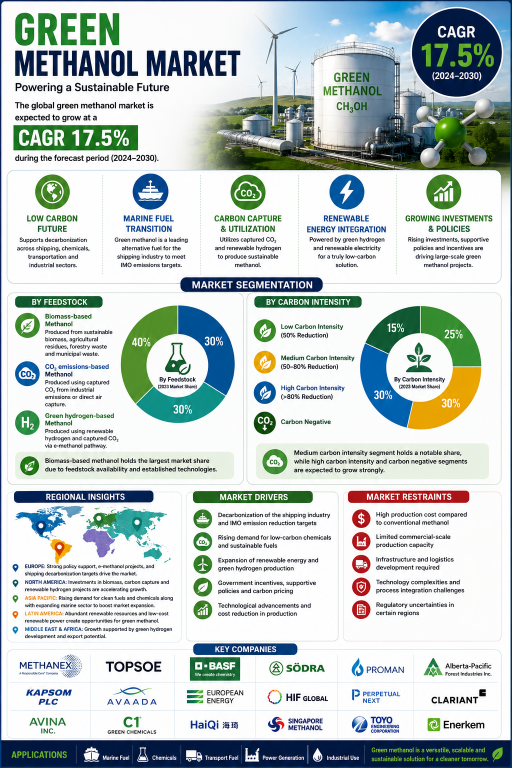
The global green methanol market is expected to grow at a CAGR of 17.5% during the forecast period. Market growth is being driven by rising demand for low-carbon fuels, decarbonization of shipping, increasing use of renewable chemicals, and growing investment in carbon capture and green hydrogen projects. Green methanol is produced from sustainable feedstocks such as biomass, captured CO₂, and renewable hydrogen, making it an important fuel and chemical solution for reducing carbon emissions across transport, marine, and industrial sectors.
Market Drivers
Rising Demand for Low-Carbon Marine Fuel
The shipping industry is increasingly adopting cleaner fuels to reduce greenhouse gas emissions. Green methanol is gaining strong attention as a practical marine fuel because it can be used in methanol-ready engines and supports lower lifecycle emissions compared to conventional fuels. Investments by shipping companies, fuel producers, and energy firms are increasing demand for large-scale green methanol production.
Market Restraints
High Production Cost and Limited Supply
Green methanol production remains costlier than conventional methanol due to the high cost of green hydrogen, carbon capture, renewable power, and biomass processing. Limited commercial-scale production capacity and supply chain constraints may slow near-term adoption. Infrastructure development for storage, handling, and distribution also requires further investment.
Green Methanol Market Trends
The market is witnessing rapid growth in e-methanol projects using captured CO₂ and renewable hydrogen. Biomass-based methanol is gaining demand in regions with strong forestry, agricultural, and waste biomass availability. Companies are also developing carbon-negative methanol pathways by combining sustainable biomass with carbon capture technologies. Strategic partnerships between fuel producers, shipping companies, technology providers, and renewable energy developers are increasing globally.
Market Segmentation
By Feedstock
Based on feedstock, the market is segmented into Biomass-based Methanol, CO₂ Emissions-based Methanol, and Green Hydrogen-based Methanol. Biomass-based methanol holds a significant market share due to the availability of forestry residues, municipal waste, and agricultural biomass. CO₂ emissions-based methanol is expected to witness strong growth as carbon capture and utilization projects expand. Green hydrogen-based methanol is expected to grow rapidly due to increasing renewable hydrogen capacity and rising demand for synthetic low-carbon fuels.
By Carbon Intensity
Based on carbon intensity, the market is segmented into Low Carbon Intensity (50% Reduction), Medium Carbon Intensity (50–80% Reduction), High Carbon Intensity (>80% Reduction), and Carbon Negative. Medium carbon intensity methanol currently holds a notable share as many projects focus on measurable emission reduction using renewable feedstocks and captured carbon. High carbon intensity reduction methanol is expected to witness strong growth as green hydrogen and renewable energy integration improves. Carbon-negative methanol is an emerging segment supported by biomass conversion and carbon capture technologies.
Regional Insights
Europe represents a leading market due to strong climate policies, shipping decarbonization targets, renewable fuel mandates, and large-scale e-methanol project development. North America is witnessing increasing investment in biomass-based methanol, carbon capture, and renewable hydrogen projects. Asia Pacific is expected to grow strongly due to rising demand for clean fuels, expanding chemical production, and marine fuel adoption in China, Japan, South Korea, Singapore, and India. Latin America is gaining attention for renewable power-based methanol projects, while the Middle East & Africa may benefit from low-cost renewable energy and green hydrogen development.
Competitive Landscape
The green methanol market is highly dynamic, with companies focusing on commercial-scale project development, renewable hydrogen integration, carbon capture utilization, biomass gasification, and long-term fuel supply agreements. Partnerships with shipping companies, chemical producers, and renewable energy developers remain key growth strategies. Market participants are also investing in technology platforms that improve conversion efficiency and reduce production cost.
Key companies operating in the market include Methanex Corporation, Topsoe, BASF SE, Sodra, Proman, Alberta-Pacific Forest Industries Inc., KAPSOM plc, Avaada, European Energy, HIF GLOBAL, Perpetual Next, Clariant AG, Avina Inc., C1 Green Chemicals AG, HaiQI Inc., Singapore Methanol, Toyo Engineering Corporation, and Enerkem.
Green Methanol Industry News
The industry is witnessing increasing announcements of e-methanol and bio-methanol projects across Europe, North America, and Asia Pacific. Shipping companies are signing fuel supply agreements to secure green methanol for future methanol-powered vessels. Technology providers are also expanding solutions for biomass gasification, CO₂ utilization, renewable hydrogen integration, and methanol synthesis to support commercial-scale production.
Historical & Forecast Period
This study report represents analysis of each segment from 2024 to 2034 considering 2025 as the base year. Compounded Annual Growth Rate (CAGR) for each of the respective segments estimated for the forecast period of 2026 to 2034.
The current report comprises of quantitative market estimations for each micro market for every geographical region and qualitative market analysis such as micro and macro environment analysis, market trends, competitive intelligence, segment analysis, porters five force model, top winning strategies, top investment markets, emerging trends and technological analysis, case studies, strategic conclusions and recommendations and other key market insights.
Research Methodology
The complete research study was conducted in three phases, namely: secondary research, primary research, and expert panel review. key data point that enables the estimation of Green Methanol market are as follows:
Market forecast was performed through proprietary software that analyzes various qualitative and quantitative factors. Growth rate and CAGR were estimated through intensive secondary and primary research. Data triangulation across various data points provides accuracy across various analyzed market segments in the report. Application of both top down and bottom-up approach for validation of market estimation assures logical, methodical and mathematical consistency of the quantitative data.
| ATTRIBUTE | DETAILS |
|---|---|
| Research Period | 2024-2034 |
| Base Year | 2025 |
| Forecast Period | 2026-2034 |
| Historical Year | 2024 |
| Unit | USD Million |
| Segmentation | |
Feedstock
|
|
Carbon Intensity
|
|
product by end use
|
|
|
Region Segment (2024-2034; US$ Million)
|
Frequently Asked Questions
What is the expected growth rate of the green methanol market?
The market is expected to grow at a CAGR of 17.5% during the forecast period.
Which feedstock segment holds a significant market share?
Biomass-based methanol holds a significant share due to the availability of forestry residues, agricultural waste, and municipal waste feedstocks.
Which feedstock segment is expected to grow strongly?
Green hydrogen-based methanol is expected to grow strongly due to increasing renewable hydrogen production and rising demand for synthetic low-carbon fuels.
What are the major growth drivers?
Major growth drivers include shipping decarbonization, demand for low-carbon fuels, carbon capture adoption, renewable hydrogen development, and rising investment in sustainable chemicals.
Who are the major companies operating in the market?
Major companies include Methanex Corporation, Topsoe, BASF SE, Södra, Proman, European Energy, HIF GLOBAL, Perpetual Next, Clariant AG, Toyo Engineering Corporation, and Enerkem.