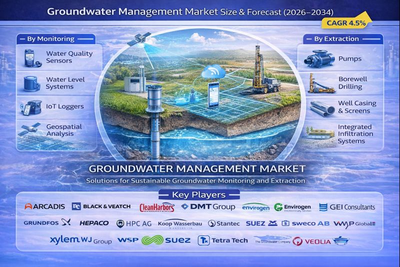
The groundwater management market is expected to grow at a CAGR of 4.5% during 2026–2034, driven by rising groundwater stress in urban and agricultural regions, stricter water regulation and compliance monitoring, and growing investment in smart monitoring to reduce non-revenue water and contamination risk. Groundwater management solutions help utilities, industries, and public agencies track aquifer health, control extraction, improve recharge planning, and maintain safe water quality through data-driven decision-making. Growth is also supported by climate variability impacting recharge cycles, expansion of industrial water reuse programs, and increasing use of digital tools that combine sensor data with geospatial analysis for early warning and long-term planning.
Market Drivers
Market growth is driven by declining groundwater tables and higher dependence on borewells for domestic, industrial, and irrigation needs, which increases demand for monitoring and extraction optimization. Rising concern over contamination (nitrates, salinity, industrial pollutants) is supporting adoption of water quality sensors and continuous monitoring to reduce public health risk and improve compliance reporting. Utilities and industrial users are investing in IoT loggers and remote water level systems to reduce field inspection cost and improve response time in drought periods. Increasing need for aquifer mapping, well inventory management, and recharge planning is expanding demand for geospatial analysis, particularly where groundwater governance is shifting toward basin-level management. Infrastructure upgrades and water security programs are also supporting spending on improved pumps, well integrity solutions, and integrated infiltration systems that support recharge and stormwater capture.
Market Restraints
The market faces restraints related to fragmented groundwater governance, variable permitting rules, and slow project approvals in many regions, which can delay deployments. Data quality remains a challenge where well records are incomplete, monitoring networks are sparse, or calibration and maintenance are inconsistent, reducing confidence in analytics outputs. Smaller municipalities and rural agencies often have limited budgets and technical capacity, slowing adoption of advanced monitoring and geospatial tools. High upfront cost for network-scale deployments, along with ongoing O&M requirements for sensors and loggers, can reduce near-term purchasing. In addition, integration issues across legacy SCADA, GIS, and asset systems, along with cybersecurity concerns for connected monitoring networks, influence procurement decisions.
Market Segmentation
By Monitoring
By monitoring, the market is segmented into water quality sensors, water level systems, IoT loggers, and geospatial analysis. Water level systems hold a major share due to their direct role in tracking depletion, managing abstraction limits, and supporting drought response at wellfield and basin levels. Water quality sensors are gaining adoption as regulators and utilities prioritize continuous detection of contamination and salinity intrusion, especially near coastal aquifers and intensive agriculture zones. IoT loggers are expanding steadily as users move toward remote telemetry, automated alarms, and data continuity across dispersed wells. Geospatial analysis is witnessing strong growth as groundwater programs increasingly require aquifer mapping, recharge zone identification, source tracking, and decision support that combines satellite, hydrogeology, and monitoring network data.
By Extraction
By extraction, the market is segmented into pumps, borewell drilling, well casing & screens, and integrated infiltration systems. Pumps represent a major share due to replacement demand, energy efficiency upgrades, and optimization of pumping operations for utilities, agriculture, and industry. Borewell drilling demand is supported by expansion of groundwater access in water-stressed regions and by new well development for industrial and municipal supply, although permitting constraints can limit growth in regulated basins. Well casing & screens remain critical for well integrity, yield stability, and contamination prevention, supporting steady demand through refurbishment and rehabilitation cycles. Integrated infiltration systems are growing faster as governments and cities invest in managed aquifer recharge, stormwater infiltration, and recharge basins to improve long-term water security and reduce flood-runoff losses.
Regional Insights
North America represents a major market due to established groundwater regulation in several states, high adoption of monitoring networks, and ongoing remediation and wellfield management programs. Europe shows steady demand supported by strong environmental compliance requirements, basin planning, and increasing focus on water resilience and drought management. Asia Pacific is growing steadily as groundwater dependency remains high in several countries, urban water demand rises, and governments expand monitoring and recharge initiatives, especially in industrial corridors and agricultural regions. Latin America is an emerging growth area supported by increasing municipal water projects and mining/industrial water management needs in water-scarce zones. The Middle East & Africa is developing as desalination, reuse, and groundwater security programs expand, with demand rising for monitoring, well integrity, and recharge projects in arid and semi-arid areas.
Competitive Landscape
The market is competitive, with players focusing on expanding monitoring coverage, improving field-to-dashboard data reliability, and strengthening modeling and geospatial decision support. Key strategies include integrating sensor telemetry with GIS platforms, offering end-to-end groundwater programs (assessment, design, implementation, and O&M), and partnering with utilities and public agencies for long-term monitoring contracts. Differentiation is driven by field deployment capability, data management and analytics strength, hydrogeology expertise, ability to execute remediation and recharge infrastructure, and proven performance in compliance-led programs. Vendors are also investing in secure connectivity, standardized reporting outputs, and faster deployment models that lower lifecycle cost for large monitoring networks. Key companies operating in the market include Arcadis, Black & Veatch, Clean Harbors Environmental Services, DMT Group, Envirogen Technologies, GEI Consultants, Grundfos, HEPACO, HPC AG, iFLUX, INDUS Environmental Services, Koop Wasserbau, Minetek, Remedial Construction Services, Sensoil Innovations, Stantec, SUEZ, Sweco AB, Tetra Tech, The Groundwater Company, Veolia, WJ Group, WSP Global, and Xylem Water Solutions.
Historical & Forecast Period
This study report represents analysis of each segment from 2024 to 2034 considering 2025 as the base year. Compounded Annual Growth Rate (CAGR) for each of the respective segments estimated for the forecast period of 2026 to 2034.
The current report comprises of quantitative market estimations for each micro market for every geographical region and qualitative market analysis such as micro and macro environment analysis, market trends, competitive intelligence, segment analysis, porters five force model, top winning strategies, top investment markets, emerging trends and technological analysis, case studies, strategic conclusions and recommendations and other key market insights.
Research Methodology
The complete research study was conducted in three phases, namely: secondary research, primary research, and expert panel review. key data point that enables the estimation of Groundwater Management market are as follows:
Market forecast was performed through proprietary software that analyzes various qualitative and quantitative factors. Growth rate and CAGR were estimated through intensive secondary and primary research. Data triangulation across various data points provides accuracy across various analyzed market segments in the report. Application of both top down and bottom-up approach for validation of market estimation assures logical, methodical and mathematical consistency of the quantitative data.
| ATTRIBUTE | DETAILS |
|---|---|
| Research Period | 2024-2034 |
| Base Year | 2025 |
| Forecast Period | 2026-2034 |
| Historical Year | 2024 |
| Unit | USD Million |
| Segmentation | |
Monitoring
|
|
Extraction
|
|
Recharge
|
|
Treatment
|
|
End Use
|
|
|
Region Segment (2024-2034; US$ Million)
|
Frequently Asked Questions
What is the growth outlook for the groundwater management market?
The market is expected to grow at a CAGR of 4.5% during 2026–2034, supported by groundwater stress, tighter compliance needs, and rising investment in monitoring and recharge programs.
Which monitoring segment is growing fastest?
Geospatial analysis and IoT loggers are growing strongly due to rising demand for basin-scale planning, remote telemetry, and continuous, audit-ready monitoring.
Which extraction segment has the largest share?
Pumps hold a major share due to replacement demand, efficiency upgrades, and ongoing wellfield pumping optimization needs across utilities, agriculture, and industry.
Which regions are key demand centers?
North America and Europe are major markets, while Asia Pacific is a key growth region; Latin America and Middle East & Africa are emerging as recharge and resilience programs expand.
What are the key challenges in this market?
Fragmented regulation, data quality gaps, integration with legacy systems, budget constraints for smaller agencies, and cybersecurity concerns for connected monitoring networks are major challenges.