
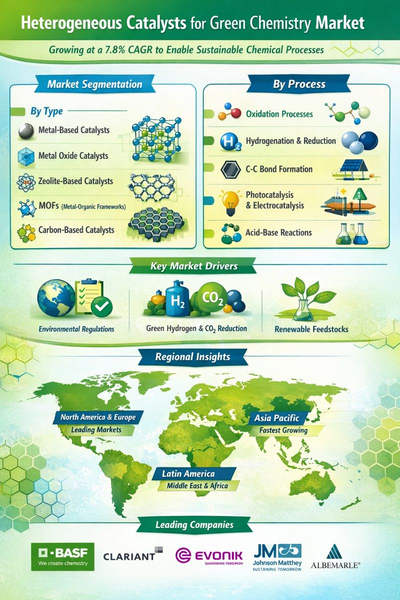
The heterogeneous catalysts for green chemistry market is expanding at a 7.8% CAGR, driven by regulatory mandates for sustainable chemical synthesis, rising adoption of green processes across fine chemicals, pharmaceuticals, and petrochemicals, and the shift from homogeneous systems to more recyclable, selective, and scalable catalytic platforms. Heterogeneous catalysts are critical to achieving higher atom economy, reduced waste, and improved energy efficiency, aligning with green chemistry principles. The market is shaped by growing industrial pressure to lower environmental impact and transition to continuous, solvent-free, or lower-emission catalytic routes—supported by technological innovation in catalyst design and nanostructuring.
Market Drivers
Growth is primarily fueled by the increasing emphasis on environmental sustainability and regulatory compliance, including REACH, EPA, and green chemistry policies globally, which push manufacturers to adopt cleaner synthesis pathways. Heterogeneous catalysts offer recyclability, low toxicity, and high thermal stability, making them suitable for green process intensification in oxidation, hydrogenation, and C-C coupling reactions. Advancements in catalyst design, such as tunable pore structures in zeolites, high surface area MOFs, and selective metal oxide nanocatalysts, are enhancing catalytic activity, selectivity, and product yield. Additionally, renewable feedstocks and biomass conversion processes rely heavily on solid catalysts for achieving industrial scalability, further widening their application scope. The growing investments in green hydrogen, CO₂ reduction technologies, and electrocatalysis also support demand for next-generation heterogeneous catalysts.
Market Restraints
Key restraints include high development and screening costs, as heterogeneous catalyst design often involves complex surface chemistry and iterative testing. Lower reaction rates or reduced selectivity in some solid-supported systems compared to homogeneous alternatives can hinder adoption in processes with narrow efficiency margins. Integration into existing reactor setups may require redesign or retrofitting, particularly in legacy chemical plants. Additionally, supply chain constraints for rare metals (e.g., platinum, palladium) and the cost volatility of critical raw materials impact price stability. Regulatory pressures around metal leaching, catalyst regeneration, and disposal also create compliance hurdles, especially in regions with stringent environmental regulations.
Market by Type
By type, metal-based catalysts generate the highest revenue share due to their widespread use across oxidation and hydrogenation reactions, supported by established formulations involving palladium, platinum, nickel, and copper that deliver high catalytic activity and thermal stability across green industrial applications. Zeolite-based catalysts and metal oxide catalysts are gaining prominence due to their low toxicity, acid–base functionality, and tunable porosity, supporting strong uptake in petrochemical and fine chemical synthesis. Metal-organic frameworks (MOFs) are expected to register the highest CAGR, as they offer unprecedented surface area, customizable pore environments, and emerging utility in CO₂ capture, biomass conversion, and photocatalysis. Carbon-based catalysts, including doped graphene and activated carbon variants, provide sustainable alternatives in redox and electrocatalytic reactions, with steady growth driven by their cost-effectiveness and recyclability.
Market by Process
By process, oxidation processes account for the highest revenue due to their widespread role in industrial synthesis and environmental remediation, with heterogeneous catalysts enabling selective oxidation under mild conditions. Hydrogenation and reduction reactions form another major segment, where metal-based systems dominate applications in pharmaceutical and agrochemical synthesis. C-C bond formation reactions, including Suzuki and Heck coupling, benefit from solid palladium catalysts that offer recyclable alternatives to traditional homogeneous systems. Photocatalytic and electrocatalytic processes are projected to post the highest CAGR, driven by R&D in solar-to-chemical conversion, CO₂ reduction, and water splitting, where semiconducting oxides and doped carbon catalysts are gaining momentum. Acid-base catalyzed reactions continue to grow steadily with applications in biodiesel synthesis, dehydration, and condensation reactions.
Regional Insights
Europe and North America lead the heterogeneous catalysts for green chemistry market, underpinned by strict regulatory compliance, early adoption of green synthesis mandates, and strong R&D infrastructure. Both regions show high integration of catalysts in pharmaceutical, specialty, and fine chemical production. Asia Pacific is expected to post the fastest growth, led by China, Japan, and India, as local chemical manufacturers align with global ESG targets and expand sustainable production capacities. Rapid industrialization, government-led clean manufacturing incentives, and increasing academic–industry collaboration in catalyst research further support regional market acceleration. Latin America and Middle East & Africa are emerging markets, with green process adoption gradually increasing across petrochemical and agricultural chemical sectors. Regional growth will be influenced by investment in sustainable infrastructure, regulatory shifts, and integration of green chemistry modules in higher education and industry training programs.
Competitive Landscape
BASF SE maintains strong leadership in metal oxide and zeolite-based heterogeneous catalysts for oxidation and hydrogenation processes, leveraging its global catalyst business and R&D investments in sustainable chemistries. Clariant AG offers a broad portfolio across petrochemical and fine chemical sectors, focusing on recyclable solid catalysts and process intensification technologies. Evonik Industries AG specializes in silica and alumina-based catalysts and functionalized supports tailored for selective hydrogenation and green oxidation, with a growing focus on bio-based feedstock compatibility. Johnson Matthey plc remains a key innovator in platinum group metal catalysts, expanding into electrocatalysis and circular solutions, including catalyst recycling and reuse. Albemarle Corporation brings core expertise in metal-based systems and catalytic materials used in clean fuels, olefin production, and environmental applications, with ongoing efforts in MOFs and carbon-based catalyst innovation. As the market evolves, players that can deliver modular, recyclable, and high-efficiency catalyst systems compatible with continuous and low-emission processing will gain the strongest competitive edge.
Historical & Forecast Period
This study report represents analysis of each segment from 2024 to 2034 considering 2025 as the base year. Compounded Annual Growth Rate (CAGR) for each of the respective segments estimated for the forecast period of 2026 to 2034.
The current report comprises of quantitative market estimations for each micro market for every geographical region and qualitative market analysis such as micro and macro environment analysis, market trends, competitive intelligence, segment analysis, porters five force model, top winning strategies, top investment markets, emerging trends and technological analysis, case studies, strategic conclusions and recommendations and other key market insights.
Research Methodology
The complete research study was conducted in three phases, namely: secondary research, primary research, and expert panel review. key data point that enables the estimation of Heterogeneous Catalysts for Green Chemistry Market By Type, By Process, By End Use - Global Market Analysis & Forecast, 2025 to 2033 market are as follows:
Market forecast was performed through proprietary software that analyzes various qualitative and quantitative factors. Growth rate and CAGR were estimated through intensive secondary and primary research. Data triangulation across various data points provides accuracy across various analyzed market segments in the report. Application of both top down and bottom-up approach for validation of market estimation assures logical, methodical and mathematical consistency of the quantitative data.
| ATTRIBUTE | DETAILS |
|---|---|
| Research Period | 2024-2034 |
| Base Year | 2025 |
| Forecast Period | 2026-2034 |
| Historical Year | 2024 |
| Unit | USD Million |
| Segmentation | |
Type
|
|
Process
|
|
End Use
|
|
|
Region Segment (2024-2034; US$ Million)
|
Key questions answered in this report


