Increasing demand for advanced imaging technologies, industrial automation, and high-speed motion analysis is driving adoption of high-speed cameras worldwide.
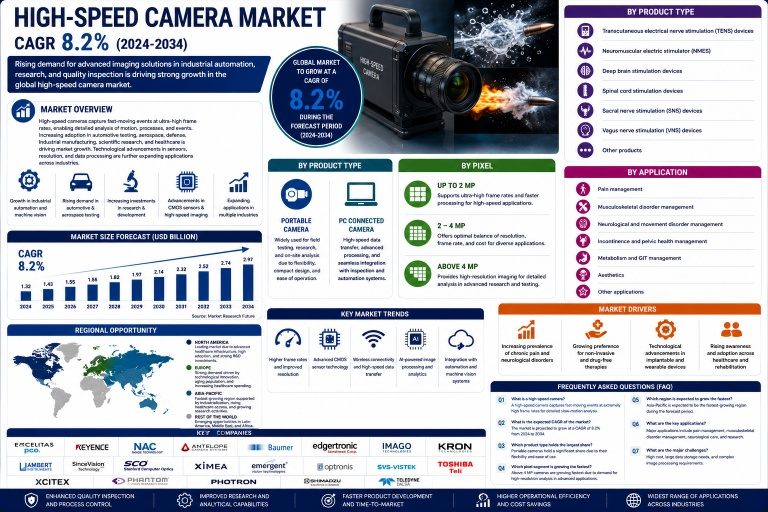
The global High-Speed Camera Market is witnessing strong growth as industries increasingly require precise image capture solutions for research, manufacturing, automotive testing, aerospace, healthcare, and scientific applications. High-speed cameras capture rapid events at extremely high frame rates, enabling detailed analysis of processes that cannot be observed using conventional imaging systems. Rising adoption of machine vision, quality inspection systems, automation technologies, and advancements in sensor capabilities are further supporting market expansion. The market is projected to register a CAGR of 8.2% during the forecast period.
Key Growth Driver
Growing adoption of industrial automation and advanced testing applications is accelerating market growth globally.
Manufacturers and research organizations are increasingly utilizing high-speed cameras for process monitoring, product testing, motion analysis, and failure detection. These cameras enable improved operational efficiency, reduced production errors, and enhanced product development capabilities. Increasing investments in automotive safety testing, aerospace engineering, robotics, and scientific research, along with advancements in CMOS sensors, image processing, and high-resolution imaging technologies, continue to strengthen market demand.
Segment Highlight
Technological advancements in imaging performance and portability are creating new opportunities across industrial and research applications.
Based on product type, Portable Cameras account for a significant share of the market due to their flexibility, ease of deployment, and increasing usage in field testing, research environments, and industrial troubleshooting applications. PC Connected Cameras continue to witness steady demand due to their ability to provide high-speed data transfer, advanced image processing, and integration with automated inspection and machine vision systems.
By pixel resolution, 2–4 MP Cameras represent a significant market segment owing to their balance between image quality, processing speed, and cost efficiency across multiple applications. Up to 2 MP Cameras continue to support applications requiring ultra-high frame rates and faster image processing. Above 4 MP Cameras are gaining adoption in advanced research, precision manufacturing, and applications requiring higher image clarity and detailed visual analysis.
Regional Opportunity
North America and Europe remain major technology markets, while Asia-Pacific is expected to witness strong growth.
North America maintains a significant position in the High-Speed Camera Market due to strong investments in aerospace, defense, automotive testing, scientific research, and industrial automation technologies. Europe continues to experience steady demand supported by advanced manufacturing industries, automotive innovation, and increasing adoption of machine vision solutions. Meanwhile, Asia-Pacific is expected to witness rapid growth driven by expanding electronics manufacturing, industrial automation, automotive production, and increasing research and development activities across China, Japan, South Korea, and India.
Competitive Landscape
Market participants are focusing on sensor innovation, higher frame rates, improved resolution, and advanced imaging software to strengthen their competitive position.
Leading companies are investing in CMOS sensor technologies, compact camera designs, enhanced data processing capabilities, AI-based image analysis, and high-performance imaging platforms. Strategic partnerships with industrial automation providers, research organizations, and technology companies continue to influence market competition. Companies are also emphasizing product reliability, customization capabilities, and application-specific solutions to address evolving customer requirements.
Key companies operating in the market include Excelitas PCO, Keyence, NAC Image Technology, Antelope Camera Systems, Baumer, Edgertronic / Sanstreak Corp., IMAGO Technologies, Kron Technologies, Lambert Instruments, SinceVision Technology, Stanford Computer Optics, XIMEA, Emergent Vision Technologies, Optronis, SVS-Vistek, Toshiba Teli, Xcitex, Phantom, Photron, Shimadzu, and Teledyne DALSA.
Historical & Forecast Period
This study report represents analysis of each segment from 2024 to 2034 considering 2025 as the base year. Compounded Annual Growth Rate (CAGR) for each of the respective segments estimated for the forecast period of 2026 to 2034.
The current report comprises of quantitative market estimations for each micro market for every geographical region and qualitative market analysis such as micro and macro environment analysis, market trends, competitive intelligence, segment analysis, porters five force model, top winning strategies, top investment markets, emerging trends and technological analysis, case studies, strategic conclusions and recommendations and other key market insights.
Research Methodology
The complete research study was conducted in three phases, namely: secondary research, primary research, and expert panel review. key data point that enables the estimation of High-Speed Camera market are as follows:
Market forecast was performed through proprietary software that analyzes various qualitative and quantitative factors. Growth rate and CAGR were estimated through intensive secondary and primary research. Data triangulation across various data points provides accuracy across various analyzed market segments in the report. Application of both top down and bottom-up approach for validation of market estimation assures logical, methodical and mathematical consistency of the quantitative data.
| ATTRIBUTE | DETAILS |
|---|---|
| Research Period | 2024-2034 |
| Base Year | 2025 |
| Forecast Period | 2026-2034 |
| Historical Year | 2024 |
| Unit | USD Million |
| Segmentation | |
Product Type
|
|
Pixel
|
|
Frame Rates
|
|
Light Sensitivity
|
|
End Use Application
|
|
Distribution Channel
|
|
|
Region Segment (2024-2034; US$ Million)
|
Frequently Asked Questions
Q1. What is driving the growth of the High-Speed Camera Market?
The market is primarily driven by increasing adoption of industrial automation, machine vision systems, scientific research applications, and demand for advanced motion analysis technologies.
Q2. What is the expected growth rate of the High-Speed Camera Market?
The global High-Speed Camera Market is projected to expand at a CAGR of 8.2% during the forecast period.
Q3. What is a high-speed camera?
A high-speed camera is an imaging device capable of capturing fast-moving events at very high frame rates, enabling detailed analysis of motion, processes, and events that occur too quickly for standard cameras.
Q4. Which product type accounts for a significant market share?
Portable Cameras account for a significant market share due to their flexibility, ease of use, and growing adoption in field testing, research, and industrial applications.
Q5. Which pixel segment is witnessing strong market demand?
The 2–4 MP segment is witnessing strong demand because it provides an effective balance between image resolution, frame rate performance, and cost efficiency.
Q6. Which region is expected to witness strong market growth?
Asia-Pacific is expected to witness strong growth due to expanding industrial automation, increasing electronics manufacturing, growing automotive production, and rising research investments.
Q7. What trends are influencing the High-Speed Camera Market?
Major trends include higher resolution sensors, compact camera designs, AI-based image processing, machine vision integration, faster data transfer technologies, and improved imaging software solutions.
Q8. What challenges could affect market expansion?
High equipment costs, large data storage requirements, complex image processing needs, and technical limitations in certain high-speed applications may affect market growth.
Q9. Who are the leading companies operating in the High-Speed Camera Market?
Major companies include Excelitas PCO, Keyence, NAC Image Technology, Antelope Camera Systems, Baumer, Edgertronic / Sanstreak Corp., IMAGO Technologies, Kron Technologies, Lambert Instruments, SinceVision Technology, Stanford Computer Optics, XIMEA, Emergent Vision Technologies, Optronis, SVS-Vistek, Toshiba Teli, Xcitex, Phantom, Photron, Shimadzu, and Teledyne DALSA.
Q10. What opportunities are expected to shape the future of the High-Speed Camera Market?
Growing adoption of AI-enabled imaging, expansion of automated inspection systems, increasing demand from automotive and aerospace testing, advancements in sensor technologies, and rising investments in scientific research are expected to create substantial growth opportunities during the forecast period.