
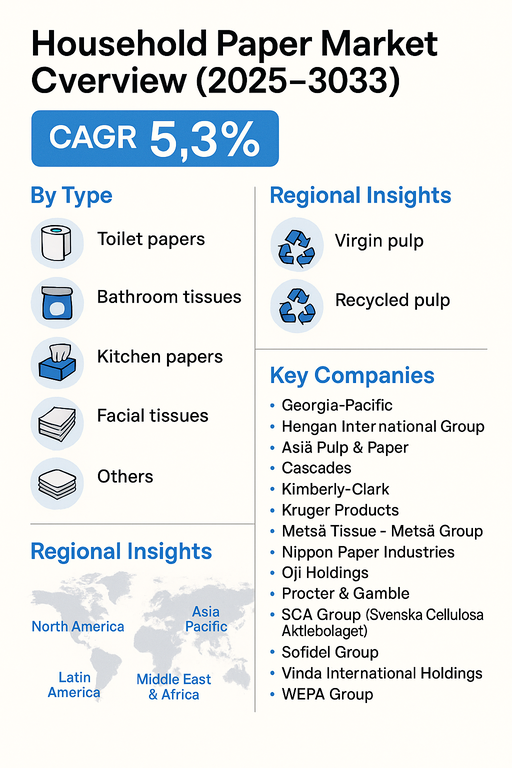
The global household paper market is projected to grow at a CAGR of 5.3% from 2026 to 2034, driven by rising hygiene awareness, urbanization, and increasing consumption of disposable paper products across both developed and emerging economies. Household paper products, including tissues, toilet papers, and kitchen rolls, have become essential consumer goods, supported by shifting lifestyles, population growth, and rising disposable incomes. The expansion of organized retail channels, online grocery platforms, and private label brands is also broadening market access and fueling steady demand worldwide.
Rising Hygiene Awareness and Consumer Convenience
The market growth is closely tied to the increasing emphasis on hygiene, especially following heightened consumer awareness post-pandemic. Household paper products are valued for their convenience, disposability, and role in maintaining daily cleanliness standards. Kitchen papers and bathroom tissues are witnessing higher adoption in both residential and hospitality sectors, while facial tissues continue to grow in demand across urban populations. The global shift toward premium, soft, and multi-layered products is further shaping consumer preferences, especially in North America and Europe.
Challenges: Environmental Concerns and Raw Material Costs
The household paper market faces challenges linked to sustainability and cost pressures. Environmental concerns about deforestation and landfill waste are prompting consumers and regulators to demand eco-friendly alternatives. Manufacturers are increasingly shifting toward recycled pulp, biodegradable packaging, and sustainable forestry certifications to address these concerns. Additionally, volatility in raw material prices, particularly pulp, creates cost pressures for producers. Intense competition, coupled with the growth of private label brands, is putting further pressure on margins. However, ongoing innovation in sustainable materials and process efficiencies is expected to support long-term resilience.
Market Segmentation by Type
By type, toilet papers and bathroom tissues account for the largest market share, supported by their essential nature and widespread use across households globally. Kitchen papers are growing rapidly, driven by increasing demand for convenience in food preparation and household cleaning. Facial tissues continue to capture demand among urban consumers, while niche products under the “others” category, including napkins and specialty wipes, are expanding steadily with lifestyle diversification.
Market Segmentation by Material
By material, virgin pulp remains dominant due to its softness, strength, and quality attributes, making it preferred in premium product categories. However, recycled pulp is growing significantly, driven by sustainability trends, cost-effectiveness, and supportive government regulations. The balance between quality and sustainability is becoming an important driver of consumer and corporate procurement decisions.
Regional Insights
North America leads the household paper market, supported by high per capita consumption, strong retail penetration, and consumer preference for premium multi-ply products. Europe follows closely, driven by sustainability initiatives, eco-certifications, and high adoption of recycled pulp-based products. Asia Pacific is the fastest-growing region, led by China, India, and Southeast Asia, where rising urbanization, population growth, and improving living standards are fueling increased consumption. Latin America shows steady growth with rising hygiene awareness and expanding middle-class populations in countries such as Brazil and Mexico. The Middle East & Africa is emerging as a promising region, with growing disposable incomes and expanding modern retail driving household paper demand.
Competitive Landscape
The 2025 household paper market was characterized by strong competition among multinational corporations and regional players. Procter & Gamble, Kimberly-Clark, and Essity remain global leaders, leveraging extensive product portfolios and strong distribution networks. Georgia-Pacific and Cascades maintain significant positions in North America, while SCA Group and Sofidel Group dominate in Europe with sustainability-driven product offerings. In Asia, Hengan International Group, Asia Pulp & Paper, Vinda International Holdings, and Nippon Paper Industries are key players driving large-scale production and regional expansion. Companies such as Kruger Products, Metsa Tissue (Metsa Group), Oji Holdings, and WEPA Group strengthen the market with regional competitiveness and innovation in eco-friendly solutions. Competitive differentiation is being shaped by sustainability initiatives, product innovation in softness and absorbency, pricing strategies, and branding. With rising consumer awareness, the market is expected to see a continuous shift toward recycled, biodegradable, and premium household paper solutions.
Historical & Forecast Period
This study report represents analysis of each segment from 2024 to 2034 considering 2025 as the base year. Compounded Annual Growth Rate (CAGR) for each of the respective segments estimated for the forecast period of 2026 to 2034.
The current report comprises of quantitative market estimations for each micro market for every geographical region and qualitative market analysis such as micro and macro environment analysis, market trends, competitive intelligence, segment analysis, porters five force model, top winning strategies, top investment markets, emerging trends and technological analysis, case studies, strategic conclusions and recommendations and other key market insights.
Research Methodology
The complete research study was conducted in three phases, namely: secondary research, primary research, and expert panel review. key data point that enables the estimation of Household Paper Market By Type, By Material, By Pricing, By Distribution Channel - Growth, Share, Opportunities & Competitive Analysis, 2026 - 2034 market are as follows:
Market forecast was performed through proprietary software that analyzes various qualitative and quantitative factors. Growth rate and CAGR were estimated through intensive secondary and primary research. Data triangulation across various data points provides accuracy across various analyzed market segments in the report. Application of both top down and bottom-up approach for validation of market estimation assures logical, methodical and mathematical consistency of the quantitative data.
| ATTRIBUTE | DETAILS |
|---|---|
| Research Period | 2024-2034 |
| Base Year | 2025 |
| Forecast Period | 2026-2034 |
| Historical Year | 2024 |
| Unit | USD Million |
| Segmentation | |
Type
|
|
Material
|
|
Pricing
|
|
Distribution Channel
|
|
|
Region Segment (2024-2034; US$ Million)
|
Key questions answered in this report


