
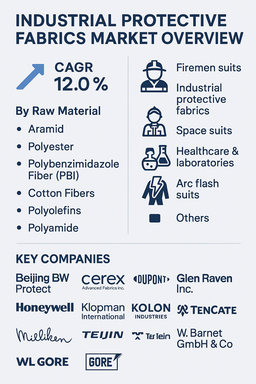
The global industrial protective fabrics market is projected to grow at a CAGR of 12.0% between 2026 and 2034, driven by stringent workplace safety regulations, increased focus on worker protection, and rising demand from industries such as oil & gas, chemical, construction, defense, and healthcare. Industrial protective fabrics are engineered to withstand extreme environments, offering flame resistance, chemical resistance, durability, and high-performance protection in specialized applications such as firefighting, arc flash prevention, and hazardous material handling.
Rising Demand from High-Risk Applications
The market is witnessing growing demand for protective fabrics used in firemen suits, arc flash suits, and industrial uniforms due to heightened emphasis on worker safety and regulatory compliance. Healthcare and laboratory applications are also driving uptake, especially after the COVID-19 pandemic, which highlighted the importance of protective textiles in medical and research environments. Additionally, the aerospace sector is fueling demand for space suits and advanced protective fabrics capable of withstanding extreme conditions. Integration of lightweight, breathable, and ergonomic materials is improving worker comfort while maintaining high performance standards.
Challenges: High Costs and Raw Material Constraints
Despite promising growth, the market faces certain challenges. High production costs of advanced fibers such as aramid, PBI, and polyolefins limit affordability in price-sensitive markets. Raw material availability and supply chain disruptions can impact production continuity. Moreover, the market faces competition from counterfeit or low-grade fabrics, which compromise safety. However, continuous innovation in fiber technology, along with government-backed occupational safety programs, is expected to address these challenges and sustain long-term demand.
Market Segmentation by Raw Material
By raw material, the market includes aramid, polyester, polybenzimidazole fiber (PBI), cotton fibers, polyolefins, and polyamide. Aramid dominates the segment, widely used in fire-resistant and high-strength applications such as firefighting and defense. Polyester and cotton fibers are preferred for cost-effective and breathable solutions in general industrial uniforms. PBI and polyolefins are adopted for premium, high-heat applications including arc flash suits and aerospace suits, while polyamide is used for durability and versatility across protective applications.
Market Segmentation by Application
By application, the market is segmented into firemen suits, industrial protective fabrics, space suits, healthcare & laboratories, arc flash suits, and others. Firemen suits account for the largest share, given strict fire safety regulations and consistent demand from municipalities worldwide. Industrial protective fabrics are widely used across oil & gas, chemical, and construction sectors, while arc flash suits are critical in electrical and utility industries. Space suits represent a niche but growing segment, supported by increasing investments in aerospace and space exploration. Healthcare and laboratory applications continue to expand due to safety protocols and the need for contamination control.
Regional Insights
In 2025, North America led the industrial protective fabrics market, driven by OSHA safety regulations, strong demand from firefighting and defense, and innovation in advanced textiles. Europe followed, with countries like Germany, France, and the UK leading adoption due to strict EU workplace safety standards and investments in industrial innovation. Asia Pacific is expected to be the fastest-growing region, led by China, India, and Japan, where industrial expansion, construction activities, and rising safety awareness are creating high growth potential. Latin America and Middle East & Africa (MEA) are emerging regions, with growing oil & gas, mining, and manufacturing industries contributing to increased demand for protective fabrics.
Competitive Landscape
The 2025 market landscape was competitive, featuring a mix of global giants and regional players. DuPont De Nemours, Honeywell International Inc., Teijin Ltd, and WL Gore & Associates dominate the market with advanced fiber technologies and strong distribution networks. Milliken & Company, Glen Raven Inc., TenCate Fabrics EU, and Tex Tech Industries are key innovators offering a broad portfolio of protective textile solutions. Klopman International, KOLON Industries, and Loyal Textiles Mills Ltd. strengthen the market with region-specific manufacturing and cost-effective solutions. Beijing BW Protect and Cerex Advanced Fabrics Inc. are expanding their presence in Asia and the U.S. through specialized products. W. Barnet GmbH & Co contributes as a significant supplier of technical fibers. Competitive differentiation is being shaped by innovation in lightweight, ergonomic, and multi-functional fabrics, sustainability practices, and expansion into emerging high-growth markets.
Historical & Forecast Period
This study report represents analysis of each segment from 2024 to 2034 considering 2025 as the base year. Compounded Annual Growth Rate (CAGR) for each of the respective segments estimated for the forecast period of 2026 to 2034.
The current report comprises of quantitative market estimations for each micro market for every geographical region and qualitative market analysis such as micro and macro environment analysis, market trends, competitive intelligence, segment analysis, porters five force model, top winning strategies, top investment markets, emerging trends and technological analysis, case studies, strategic conclusions and recommendations and other key market insights.
Research Methodology
The complete research study was conducted in three phases, namely: secondary research, primary research, and expert panel review. key data point that enables the estimation of Industrial Protective Fabrics Market By Raw Material, By Application - Growth, Share, Opportunities & Competitive Analysis, 2026 - 2034 market are as follows:
Market forecast was performed through proprietary software that analyzes various qualitative and quantitative factors. Growth rate and CAGR were estimated through intensive secondary and primary research. Data triangulation across various data points provides accuracy across various analyzed market segments in the report. Application of both top down and bottom-up approach for validation of market estimation assures logical, methodical and mathematical consistency of the quantitative data.
| ATTRIBUTE | DETAILS |
|---|---|
| Research Period | 2024-2034 |
| Base Year | 2025 |
| Forecast Period | 2026-2034 |
| Historical Year | 2024 |
| Unit | USD Million |
| Segmentation | |
Raw Material
|
|
Application
|
|
|
Region Segment (2024-2034; US$ Million)
|
Key questions answered in this report


