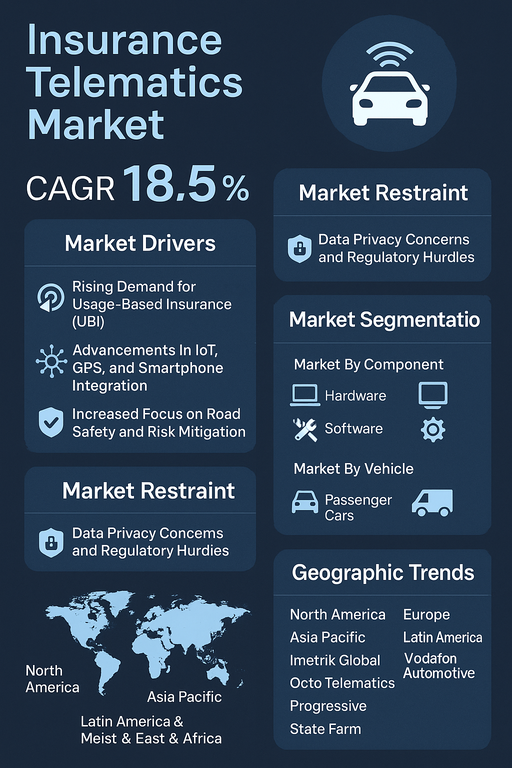
The insurance telematics market is projected to grow at a CAGR of 18.5% from 2026 to 2034, fueled by the increasing adoption of usage-based insurance (UBI), rising focus on driver behavior analytics, and the rapid digitization of the insurance sector. Insurance telematics involves the use of embedded systems or mobile-based platforms to collect driving data, which is then analyzed to assess risk and customize policy premiums. Telematics is transforming traditional underwriting practices by enabling real-time, data-driven decision-making and enhancing policyholder engagement through personalized insights.
Market Drivers
Rising Demand for Usage-Based Insurance (UBI)
The shift from conventional fixed-rate auto insurance to behavior-based models such as Pay-As-You-Drive (PAYD) and Pay-How-You-Drive (PHYD) is accelerating the adoption of telematics. These models leverage vehicle data to reward safe drivers with lower premiums and help insurers reduce fraud, leading to better underwriting accuracy and customer retention.
Advancements in IoT, GPS, and Smartphone Integration
The evolution of in-vehicle sensors, GPS tracking, and mobile apps has made it easier for insurers to collect and process real-time vehicle usage data. This integration allows for continuous monitoring of speed, braking patterns, mileage, and location, which enhances transparency and allows dynamic policy adjustments. Smartphone-based telematics apps are gaining popularity due to ease of deployment and cost-effectiveness.
Increased Focus on Road Safety and Risk Mitigation
Governments, regulators, and insurance companies are prioritizing initiatives that improve road safety and minimize accident-related claims. Telematics enables proactive risk management by identifying unsafe driving habits and promoting corrective actions through driver feedback. This contributes to fewer claims, lower loss ratios, and improved profitability for insurers.
Market Restraint
Data Privacy Concerns and Regulatory Hurdles
The collection and analysis of sensitive driving and location data raises significant concerns around user privacy and data security. Inadequate data protection frameworks can lead to misuse or breaches, affecting consumer trust. Additionally, compliance with regional regulations such as GDPR in Europe and evolving data governance norms in North America can present integration challenges for insurers operating in multiple jurisdictions.
Market Segmentation by Component
The component segment comprises Hardware, Software, and Services. In 2025, hardware including OBD-II devices, black boxes, and embedded modems held a significant market share due to their use in fleet vehicles and large-scale telematics deployment. However, software is expected to record the highest CAGR from 2026 to 2034, supported by advancements in data analytics, cloud platforms, and AI-powered risk scoring. Services, including installation, data interpretation, and customer support, are critical for both insurers and policyholders, with increasing demand for white-labeled telematics-as-a-service platforms.
Market Segmentation by Vehicle
By vehicle type, the market is segmented into Passenger Cars and Commercial Vehicles. In 2025, passenger cars dominated the market, driven by the popularity of mobile telematics solutions for individual policyholders and growing preference for personalized insurance products. Commercial vehicles, however, are expected to experience the fastest growth due to the rising need for fleet monitoring, fuel optimization, and driver accountability. Insurers are increasingly partnering with fleet operators to deliver tailored policies based on real-time vehicle performance and driver behavior.
Geographic Trends
North America led the insurance telematics market in 2025, with strong penetration of UBI programs in the U.S. and Canada and favorable regulatory environments supporting innovation. Europe followed, driven by widespread adoption in the UK, Italy, and Germany where road safety campaigns and insurer-led education programs have accelerated market maturity. Asia Pacific is projected to witness the highest CAGR from 2026 to 2034, supported by growing vehicle ownership, insurance penetration, and government-backed road safety programs in China, India, and Japan. Latin America and Middle East & Africa are gradually expanding their telematics footprint through partnerships between insurers and telecom operators, especially in urban centers.
Competitive Trends
In 2025, the insurance telematics market featured a mix of insurers, telematics technology providers, and platform integrators competing on data accuracy, customer engagement tools, and analytics capabilities. Progressive, State Farm, GEICO, and Allstate Insurance led the U.S. market with proprietary UBI programs such as Drivewise and Snapshot, offering customized discounts and digital policy management. Octo Telematics, Imetrik Global, and Cambridge Mobile Telematics provided advanced hardware, scoring algorithms, and analytics dashboards to insurers globally. Verizon Connect and Vodafone Automotive focused on fleet-based telematics, offering GPS tracking, fuel analytics, and driver coaching modules. Startups like TrueMotion expanded mobile-first telematics adoption with app-based driver scoring and engagement features. Strategic priorities across the sector include integration with electric and autonomous vehicles, enhancements in AI/ML-powered risk models, and expansion into mobility-as-a-service ecosystems.
Historical & Forecast Period
This study report represents analysis of each segment from 2024 to 2034 considering 2025 as the base year. Compounded Annual Growth Rate (CAGR) for each of the respective segments estimated for the forecast period of 2026 to 2034.
The current report comprises of quantitative market estimations for each micro market for every geographical region and qualitative market analysis such as micro and macro environment analysis, market trends, competitive intelligence, segment analysis, porters five force model, top winning strategies, top investment markets, emerging trends and technological analysis, case studies, strategic conclusions and recommendations and other key market insights.
Research Methodology
The complete research study was conducted in three phases, namely: secondary research, primary research, and expert panel review. key data point that enables the estimation of Insurance Telematics market are as follows:
Market forecast was performed through proprietary software that analyzes various qualitative and quantitative factors. Growth rate and CAGR were estimated through intensive secondary and primary research. Data triangulation across various data points provides accuracy across various analyzed market segments in the report. Application of both top down and bottom-up approach for validation of market estimation assures logical, methodical and mathematical consistency of the quantitative data.
| ATTRIBUTE | DETAILS |
|---|---|
| Research Period | 2024-2034 |
| Base Year | 2025 |
| Forecast Period | 2026-2034 |
| Historical Year | 2024 |
| Unit | USD Million |
| Segmentation | |
Component
|
|
Vehicle
|
|
Deployment mode
|
|
Enterprise Size
|
|
Insurance
|
|
|
Region Segment (2024-2034; US$ Million)
|
Key questions answered in this report