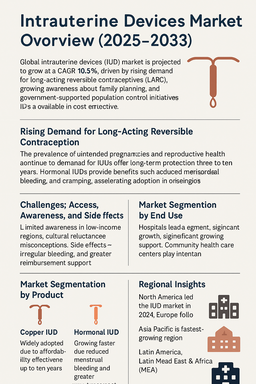
The global intrauterine devices (IUD) market is projected to grow at a CAGR of 10.5% from 2025 to 2033, driven by rising demand for long-acting reversible contraceptives (LARC), increasing awareness about family planning, and supportive government initiatives for population control. IUDs, available in copper-based and hormonal variants, are highly effective contraceptive options that offer long-term protection with minimal maintenance. Their cost-effectiveness, reversibility, and reduced need for daily compliance compared to oral contraceptives are fueling global adoption. Expanding women’s healthcare services and large-scale awareness campaigns are further enhancing market penetration across both developed and emerging economies.
Rising Demand for Long-Acting Reversible Contraception
The increasing prevalence of unintended pregnancies and growing focus on reproductive health are key factors supporting the adoption of IUDs. Compared to short-term methods, IUDs provide long-lasting protection ranging from three to ten years, depending on the device type, making them highly convenient and reliable. Hormonal IUDs are gaining preference due to their added benefits such as reducing menstrual bleeding and alleviating cramping, which broadens their therapeutic value. Supportive initiatives from governments and non-governmental organizations, along with favorable reimbursement programs, are further accelerating adoption in both urban and rural populations.
Challenges: Access, Awareness, and Side Effects
Despite the strong growth trajectory, the market faces certain limitations. Awareness remains relatively low in price-sensitive and rural regions, and cultural reluctance continues to act as a barrier in some geographies. Patient concerns regarding side effects, including irregular bleeding, cramping, and the risk of device expulsion, can hinder widespread acceptance. The requirement of professional insertion also restricts accessibility in areas with limited healthcare infrastructure. Nevertheless, continuous innovations in device design to improve comfort and safety, broader educational initiatives, and greater integration of women’s health programs are expected to address these issues over time and sustain market momentum.
Market Segmentation by Product
By product, the market is segmented into copper IUDs and hormonal IUDs. Copper IUDs remain widely adopted due to their affordability, hormone-free mechanism, and effectiveness lasting up to ten years. They are particularly popular in emerging markets where affordability plays a critical role in contraceptive choices. Hormonal IUDs are witnessing faster growth in developed regions, largely due to their therapeutic benefits in reducing menstrual bleeding and their wider acceptance under insurance and reimbursement schemes.
Market Segmentation by End Use
In terms of end use, hospitals dominate the market as they provide professional expertise, specialized gynecological care, and greater patient trust. Gynecology clinics are gaining traction due to the convenience and personalized care they offer to women seeking reproductive health solutions. Community health care centers play a crucial role in emerging economies, where family planning programs supported by governments and NGOs ensure the availability of affordable IUDs to women in underserved areas.
Regional Insights
Regionally, North America held the leading share of the intrauterine devices market in 2024, supported by high contraceptive awareness, favorable reimbursement frameworks, and the presence of established manufacturers. Europe followed closely, with France, Germany, and the UK driving growth through robust family planning policies and strong adoption of long-acting contraceptives. Asia Pacific is expected to be the fastest-growing region during the forecast period, led by India, China, and Japan, where government population initiatives, rising awareness campaigns, and expanding access to modern healthcare systems are strengthening demand. Latin America, particularly Brazil and Mexico, is gradually adopting IUDs as women’s healthcare infrastructure improves, while the Middle East & Africa represent emerging markets where cultural barriers and limited healthcare access still challenge penetration but also present significant untapped opportunities.
Competitive Landscape
The 2024 competitive landscape was dominated by multinational pharmaceutical and medical device companies with broad contraceptive portfolios. Bayer maintained its leadership with its Mirena and Kyleena hormonal IUDs, benefiting from strong clinical validation and global reach. CooperSurgical and AbbVie also played prominent roles in expanding product access and innovation. Companies such as DKT International, PREGNA, and HLL Lifecare Limited focused on supplying affordable IUDs to developing countries through partnerships with governments and NGOs. Emerging regional players like Meril, MONA LISA, and Prosan are expanding their market footprint with cost-effective solutions tailored for specific geographies. The market is highly competitive, with differentiation increasingly based on device innovation, affordability, duration of effectiveness, and strong distribution networks that enhance accessibility across both developed and developing regions.
Historical & Forecast Period
This study report represents analysis of each segment from 2023 to 2033 considering 2024 as the base year. Compounded Annual Growth Rate (CAGR) for each of the respective segments estimated for the forecast period of 2025 to 2033.
The current report comprises of quantitative market estimations for each micro market for every geographical region and qualitative market analysis such as micro and macro environment analysis, market trends, competitive intelligence, segment analysis, porters five force model, top winning strategies, top investment markets, emerging trends and technological analysis, case studies, strategic conclusions and recommendations and other key market insights.
Research Methodology
The complete research study was conducted in three phases, namely: secondary research, primary research, and expert panel review. key data point that enables the estimation of Intrauterine Devices market are as follows:
Market forecast was performed through proprietary software that analyzes various qualitative and quantitative factors. Growth rate and CAGR were estimated through intensive secondary and primary research. Data triangulation across various data points provides accuracy across various analyzed market segments in the report. Application of both top down and bottom-up approach for validation of market estimation assures logical, methodical and mathematical consistency of the quantitative data.
| ATTRIBUTE | DETAILS |
|---|---|
| Research Period | 2023-2033 |
| Base Year | 2024 |
| Forecast Period | 2025-2033 |
| Historical Year | 2023 |
| Unit | USD Million |
| Segmentation | |
Product
| |
Age Group
| |
End Use
| |
|
Region Segment (2023-2033; US$ Million)
|
Key questions answered in this report