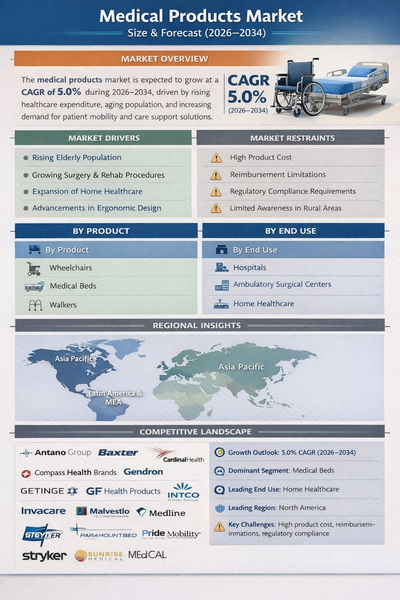
The medical products market is expected to grow at a CAGR of 5.0% during 2026–2034, driven by rising healthcare expenditure, aging population, and increasing demand for patient mobility and care support solutions. Growth in chronic disease prevalence and post-surgical rehabilitation needs is supporting continuous demand for medical equipment. Expansion of home healthcare and long-term care facilities is further strengthening market growth. Hospitals and care providers are increasingly focusing on patient safety, comfort, and operational efficiency, which supports product replacement and technology upgrades.
Market Drivers
Market growth is driven by the rapid growth of the elderly population and rising incidence of mobility-related disorders. Increasing number of surgeries and rehabilitation procedures is boosting demand for wheelchairs, medical beds, and walkers. Expansion of home healthcare services is encouraging adoption of compact and user-friendly medical products. Government healthcare infrastructure investments and insurance coverage improvements are supporting procurement. Technological advancements in ergonomic design, lightweight materials, and infection control features are also contributing to market growth.
Market Restraints
The market faces restraints from high product cost, pricing pressure from healthcare providers, and reimbursement limitations in some regions. Maintenance and replacement costs can restrict adoption in low-income settings. Regulatory compliance requirements and certification processes increase the product development time and cost. Limited awareness in rural areas and uneven distribution networks also affect market penetration.
Market Segmentation
By Product
By product, the market is segmented into wheelchairs, medical beds, and walkers. Medical beds hold a significant share due to high hospital and long-term care usage. Wheelchairs represent strong demand driven by aging population and disability support. Walkers are widely used in rehabilitation and home care settings due to affordability and ease of use.
By End Use
Based on end use, the market is segmented into hospitals, ambulatory surgical centers, home healthcare, and other end use. Hospitals dominate the market due to high patient volume and infrastructure spending. Home healthcare is the fastest-growing segment due to preference for home-based recovery and long-term care. Ambulatory surgical centers show steady growth due to rising outpatient procedures.
Regional Insights
North America leads the medical products market due to advanced healthcare infrastructure, high healthcare spending, and strong adoption of mobility and patient care equipment. Europe follows with aging population support programs and hospital modernization initiatives. Asia Pacific is witnessing rapid growth due to healthcare expansion, rising income levels, and improving medical access. Latin America and the Middle East & Africa show emerging growth supported by public healthcare investments.
Competitive Landscape
The market is moderately competitive, with companies focusing on product quality, ergonomic design, infection prevention, and after-sales service. Strategic partnerships with hospitals, distributors, and home healthcare providers are common. Expansion into emerging markets and development of cost-effective product lines are key growth strategies.
Key companies operating in the market include Antano Group, Baxter, Cardinal Health, Compass Health Brands, Gendron, Getinge AB, GF Health Products, INTCO Medical Technology, Invacare Corporation, Malvestio Spa, Medline, Paramount Bed, Pride Mobility Products, Stryker Corporation, and Sunrise Medical.
Historical & Forecast Period
This study report represents analysis of each segment from 2024 to 2034 considering 2025 as the base year. Compounded Annual Growth Rate (CAGR) for each of the respective segments estimated for the forecast period of 2026 to 2034.
The current report comprises of quantitative market estimations for each micro market for every geographical region and qualitative market analysis such as micro and macro environment analysis, market trends, competitive intelligence, segment analysis, porters five force model, top winning strategies, top investment markets, emerging trends and technological analysis, case studies, strategic conclusions and recommendations and other key market insights.
Research Methodology
The complete research study was conducted in three phases, namely: secondary research, primary research, and expert panel review. key data point that enables the estimation of Medical Products market are as follows:
Market forecast was performed through proprietary software that analyzes various qualitative and quantitative factors. Growth rate and CAGR were estimated through intensive secondary and primary research. Data triangulation across various data points provides accuracy across various analyzed market segments in the report. Application of both top down and bottom-up approach for validation of market estimation assures logical, methodical and mathematical consistency of the quantitative data.
| ATTRIBUTE | DETAILS |
|---|---|
| Research Period | 2024-2034 |
| Base Year | 2025 |
| Forecast Period | 2026-2034 |
| Historical Year | 2024 |
| Unit | USD Million |
| Segmentation | |
Product
|
|
End Use
|
|
|
Region Segment (2024-2034; US$ Million)
|
Frequently Asked Questions
What is the growth outlook for the medical products market?
The market is expected to grow at a CAGR of 5.0% during 2026–2034, supported by aging population and healthcare expansion.
Which product segment dominates the market?
Medical beds dominate due to high usage in hospitals and long-term care facilities.
Which end-use segment is growing fastest?
Home healthcare is growing fastest due to preference for home-based treatment.
Which region leads the market?
North America leads the market, followed by Europe and Asia Pacific.
What are the key challenges in this market?
High product cost, reimbursement limitations, and regulatory compliance are major challenges.