
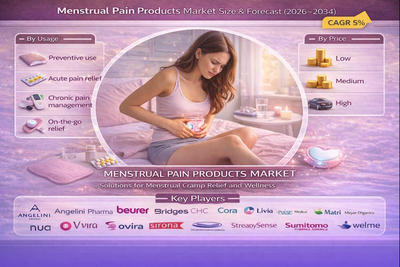
The menstrual pain products market is expected to grow at a CAGR of 5.0% during 2026–2034, driven by rising awareness of menstrual health, growing demand for non-drug and drug-free pain relief options, and increasing retail and online availability of specialized period care products. Menstrual pain products include OTC pain-relief solutions and device-based approaches such as heat therapy, wearable stimulators, and wellness-focused products designed to reduce cramps and improve daily functioning. Growth is also supported by higher participation of women in the workforce, increasing preference for discreet and portable solutions, and broader acceptance of menstrual wellness as part of preventive healthcare.
Market Drivers
Market growth is driven by higher consumer awareness and willingness to spend on targeted menstrual pain relief, especially among urban and digitally engaged buyers. Demand is rising for drug-free options such as wearable heat patches and stimulation-based devices, supported by preference for fewer systemic side effects and repeat-use value. Expansion of direct-to-consumer brands and e-commerce is improving product discovery, subscription models, and access in regions where retail penetration is limited. Employers and institutions are increasingly supporting menstrual wellness initiatives, indirectly improving adoption of convenient on-the-go relief products. Innovation in wearable form factors, battery life, and app-enabled personalization is also supporting premiumization and higher usage frequency, especially for chronic pain management needs.
Market Restraints
The market faces restraints related to varied pain causes and severity, which makes product efficacy perception inconsistent across users and can increase returns or switching. Device-based products often have higher upfront cost, limiting adoption in price-sensitive segments and emerging markets. Limited clinical validation visibility for some products and varying regulatory pathways across countries can slow institutional adoption and broader medical endorsement. Social stigma in certain regions reduces open purchasing and can limit distribution effectiveness. In addition, competition from low-cost OTC analgesics and home remedies can constrain value growth, particularly in the low-price segment.
Market Segmentation
By Usage
By usage, the market is segmented into preventive use, acute pain relief, chronic pain management, and on-the-go relief. Acute pain relief holds a major share due to high frequency of cramps and immediate need for fast symptom reduction during the first days of menstruation. On-the-go relief is growing strongly as consumers prefer discreet, portable formats such as heat patches, compact devices, and quick-application products that fit office, travel, and school routines. Chronic pain management is expanding steadily as awareness increases around recurring severe dysmenorrhea and related conditions, supporting demand for repeat-use devices, multi-day solutions, and personalized approaches. Preventive use is growing as wellness positioning increases, with users adopting pre-emptive heat therapy or planned-use products to reduce intensity and improve comfort before symptoms peak.
By Price
By price, the market is segmented into low, medium, and high. The low-price segment holds a major share in volume due to wide access and strong reliance on basic solutions, including low-cost heat products and OTC options sold through mass retail and pharmacies. The medium-price segment represents a significant share as branded heat patches, improved comfort designs, and reliable performance products gain traction among repeat buyers. The high-price segment is growing faster, supported by wearable technology, rechargeable stimulation-based devices, premium materials, app-enabled controls, and higher willingness to pay for convenience and longer-term value, especially among consumers managing recurring pain.
Regional Insights
North America represents a major market due to strong OTC adoption, higher penetration of wearable wellness devices, and strong DTC brand presence supported by e-commerce. Europe shows steady growth supported by pharmacy-led distribution, strong consumer preference for non-invasive solutions, and growing acceptance of menstrual wellness products. Asia Pacific is expected to grow at a healthy pace due to expanding online retail, rising awareness among younger consumers, and increasing availability of local period-care brands, although price sensitivity remains important. Latin America is emerging as awareness and organized retail access improve, with growth supported by e-commerce and pharmacy chains. The Middle East & Africa shows selective growth in urban markets where modern retail and online channels expand, while social stigma and affordability constraints can limit broader penetration.
Competitive Landscape
The market is competitive, with players focusing on convenience, comfort, and repeat-use solutions that build strong brand loyalty. Key strategies include product innovation in wearable heat and stimulation devices, expansion of distribution through pharmacies and online marketplaces, and stronger brand education on usage benefits and safety. Differentiation is driven by comfort and fit, duration of relief, portability, device reliability, and product aesthetics that support discreet usage. Companies are also investing in subscription models, bundled period-care offerings, and targeted positioning for chronic pain management versus quick relief. Partnerships with women’s health communities, clinics, and wellness platforms are being used to improve trust and accelerate adoption. Key companies operating in the market include Angelini Pharma, Beurer, Bridges CHC, Chiaro Technology, Cora, Livia by iPulse Medical, Matri, Meyer Organics, Nua, Ovira, Sirona Hygiene, SteadySense, Sumitomo Pharma America, ThermaCare, Thermaissance, and Welme.
Historical & Forecast Period
This study report represents analysis of each segment from 2024 to 2034 considering 2025 as the base year. Compounded Annual Growth Rate (CAGR) for each of the respective segments estimated for the forecast period of 2026 to 2034.
The current report comprises of quantitative market estimations for each micro market for every geographical region and qualitative market analysis such as micro and macro environment analysis, market trends, competitive intelligence, segment analysis, porters five force model, top winning strategies, top investment markets, emerging trends and technological analysis, case studies, strategic conclusions and recommendations and other key market insights.
Research Methodology
The complete research study was conducted in three phases, namely: secondary research, primary research, and expert panel review. key data point that enables the estimation of Menstrual Pain Products Market By Product Type, By Usage, By Usage, By Age Group, By Distribution Channel - Growth, Share, Opportunities & Competitive Analysis, 2026 - 2034 market are as follows:
Market forecast was performed through proprietary software that analyzes various qualitative and quantitative factors. Growth rate and CAGR were estimated through intensive secondary and primary research. Data triangulation across various data points provides accuracy across various analyzed market segments in the report. Application of both top down and bottom-up approach for validation of market estimation assures logical, methodical and mathematical consistency of the quantitative data.
| ATTRIBUTE | DETAILS |
|---|---|
| Research Period | 2024-2034 |
| Base Year | 2025 |
| Forecast Period | 2026-2034 |
| Historical Year | 2024 |
| Unit | USD Million |
| Segmentation | |
Usage
|
|
Price
|
|
Age Group
|
|
Distribution Channel
|
|
|
Region Segment (2024-2034; US$ Million)
|
Frequently Asked Questions
What is the growth outlook for the menstrual pain products market?
The market is expected to grow at a CAGR of 5.0% during 2026–2034, supported by rising menstrual health awareness and higher adoption of convenient and drug-free pain relief options.
Which usage segment dominates the market?
Acute pain relief dominates due to frequent need for immediate symptom reduction during menstruation.
Which usage segment is growing fastest?
On-the-go relief is growing strongly due to demand for discreet, portable solutions suitable for work, travel, and daily routines.
Which price segment is growing fastest?
The high-price segment is growing faster, driven by wearable technology, rechargeable devices, and premium features that support repeat use and personalization.
What are the key challenges in this market?
Efficacy variability across users, higher device costs, limited clinical validation visibility for some products, regional stigma, and competition from low-cost OTC analgesics are major challenges.


