
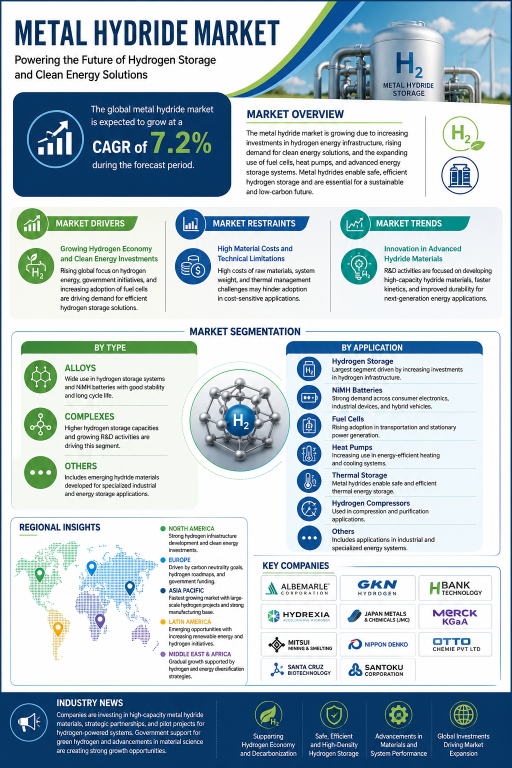
The global metal hydride market is expected to grow at a CAGR of 7.2% during the forecast period. Market growth is being supported by increasing investments in hydrogen energy infrastructure, rising focus on clean energy storage technologies, growing adoption of fuel cell systems, and expanding demand for efficient thermal energy storage solutions. Metal hydrides play a critical role in hydrogen storage and transportation due to their ability to absorb and release hydrogen safely under controlled conditions. As governments and industries accelerate the transition toward low-carbon energy systems, metal hydrides are gaining importance across hydrogen storage, battery technologies, heat management systems, and industrial hydrogen applications. The structure and style of this collateral follows the reference format provided by the user.
Market Drivers
Growing Hydrogen Economy and Clean Energy Investments
The rapid development of the global hydrogen economy is a major factor driving demand for metal hydrides. Governments across North America, Europe, and Asia Pacific are investing heavily in hydrogen production, storage, transportation, and utilization infrastructure to support decarbonization targets. Metal hydrides offer high volumetric hydrogen storage density and enhanced safety compared to conventional compressed gas storage systems. Increasing deployment of hydrogen-powered transportation, stationary fuel cells, renewable energy integration projects, and industrial hydrogen applications is creating significant opportunities for metal hydride technologies.
Market Restraints
High Material Costs and Technical Limitations
Despite their advantages, metal hydride systems face challenges related to material costs, weight, and thermal management requirements. Several advanced hydride materials rely on rare or expensive metals, increasing overall system costs. Additionally, hydrogen absorption and desorption processes often require precise temperature control, which can increase system complexity. These factors may limit adoption in certain cost-sensitive applications and slow commercialization in large-scale energy storage projects.
Metal Hydride Market Trends
The market is witnessing increasing research and development activities focused on advanced hydrogen storage materials with improved storage capacity, faster charging and discharging rates, and enhanced durability. Companies are developing next-generation metal hydride systems for renewable energy storage, hydrogen refueling infrastructure, and industrial energy management applications. Integration of metal hydride technologies with fuel cells, heat pumps, and thermal storage systems is also emerging as a key industry trend. Furthermore, growing investments in green hydrogen projects are expected to accelerate commercialization of innovative hydride-based storage solutions.
Market Segmentation
By Type
Based on type, the market is segmented into Alloys, Complexes, and Others. Alloy-based metal hydrides account for a significant market share due to their widespread use in hydrogen storage systems and nickel-metal hydride batteries. These materials offer favorable hydrogen absorption characteristics, operational stability, and long service life. Complex hydrides are expected to witness the fastest growth owing to their higher hydrogen storage capacities and increasing research efforts aimed at improving performance for advanced energy applications. The Others segment includes emerging hydride materials developed for specialized industrial and energy storage applications.
By Application
Based on application, the market is segmented into Hydrogen Storage, NiMH Batteries, Fuel Cells, Heat Pumps, Thermal Storage, Hydrogen Compressors, and Others. Hydrogen storage represents the largest application segment due to growing investments in hydrogen infrastructure and clean energy projects worldwide. NiMH batteries continue to maintain a substantial market presence across consumer electronics, industrial equipment, and hybrid vehicles. Fuel cells are expected to experience strong growth as hydrogen-powered transportation and stationary power generation expand globally. Heat pumps, thermal storage systems, and hydrogen compressors are also gaining traction as industries seek efficient energy management and decarbonization solutions.
Regional Insights
North America holds a significant share of the metal hydride market due to increasing investments in hydrogen infrastructure, clean energy initiatives, and advanced energy storage technologies. Europe remains a major market supported by ambitious carbon neutrality targets, hydrogen roadmaps, and government funding programs. Asia Pacific is expected to register the fastest growth during the forecast period, driven by substantial hydrogen economy investments in China, Japan, South Korea, and India. The region benefits from strong manufacturing capabilities, expanding renewable energy deployment, and growing adoption of fuel cell technologies. Latin America and the Middle East & Africa are gradually emerging as potential markets as hydrogen projects and renewable energy investments continue to increase.
Competitive Landscape
The metal hydride market is moderately consolidated, with leading companies focusing on advanced material development, hydrogen storage innovations, strategic partnerships, and capacity expansion initiatives. Market participants are investing in research programs to improve hydrogen storage efficiency, reduce costs, and enhance material performance. Collaboration with hydrogen infrastructure developers, fuel cell manufacturers, and renewable energy companies remains a key strategy for expanding market presence.
Key companies operating in the market include Albemarle Corporation, GKN Hydrogen, HBank Technology, Hydrexia, Japan Metals & Chemicals (JMC), Merck KGaA, Mitsui Mining & Smelting, Nippon Denko, Otto Chemie Pvt Ltd, Santa Cruz Biotechnology, Santoku Corporation, others.
Metal Hydride Industry News
The industry is witnessing growing collaboration between hydrogen technology developers, renewable energy providers, and industrial manufacturers to commercialize advanced hydrogen storage systems. Companies are investing in high-capacity metal hydride materials for stationary energy storage, mobility applications, and hydrogen transportation. Several pilot projects involving hydrogen-powered energy systems and renewable energy integration are creating new opportunities for metal hydride technology providers. Increasing government support for green hydrogen development is expected to further strengthen market growth over the coming years.
Historical & Forecast Period
This study report represents analysis of each segment from 2024 to 2034 considering 2025 as the base year. Compounded Annual Growth Rate (CAGR) for each of the respective segments estimated for the forecast period of 2026 to 2034.
The current report comprises of quantitative market estimations for each micro market for every geographical region and qualitative market analysis such as micro and macro environment analysis, market trends, competitive intelligence, segment analysis, porters five force model, top winning strategies, top investment markets, emerging trends and technological analysis, case studies, strategic conclusions and recommendations and other key market insights.
Research Methodology
The complete research study was conducted in three phases, namely: secondary research, primary research, and expert panel review. key data point that enables the estimation of Metal Hydride Market - Growth, Share, Opportunities & Competitive Analysis, 2026 - 2034 market are as follows:
Market forecast was performed through proprietary software that analyzes various qualitative and quantitative factors. Growth rate and CAGR were estimated through intensive secondary and primary research. Data triangulation across various data points provides accuracy across various analyzed market segments in the report. Application of both top down and bottom-up approach for validation of market estimation assures logical, methodical and mathematical consistency of the quantitative data.
| ATTRIBUTE | DETAILS |
|---|---|
| Research Period | 2024-2034 |
| Base Year | 2025 |
| Forecast Period | 2026-2034 |
| Historical Year | 2024 |
| Unit | USD Million |
| Segmentation | |
Type
|
|
Application
|
|
End User
|
|
|
Region Segment (2024-2034; US$ Million)
|
Frequently Asked Questions
What is the expected growth rate of the metal hydride market?
The metal hydride market is expected to grow at a CAGR of 7.2% during the forecast period.
Which type segment holds a significant market share?
Alloy-based metal hydrides hold a significant market share due to their extensive use in hydrogen storage systems and NiMH batteries.
Which application segment dominates the market?
Hydrogen storage accounts for the largest market share owing to growing investments in hydrogen infrastructure and clean energy projects.
What are the key growth drivers?
Major growth drivers include expansion of the hydrogen economy, increasing clean energy investments, rising fuel cell adoption, and growing demand for advanced energy storage technologies.
Who are the major companies operating in the market?
Major companies include Albemarle Corporation, GKN Hydrogen, Hydrexia, Merck KGaA, Mitsui Mining & Smelting, Nippon Denko, Santoku Corporation, HBank Technology, Otto Chemie Pvt Ltd, and Japan Metals & Chemicals (JMC).


