
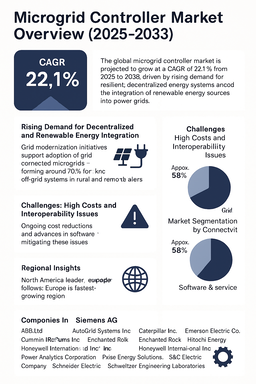
The global microgrid controller market is projected to grow at a CAGR of 22.1% from 2026 to 2034, fueled by rising demand for resilient, decentralized energy systems and the integration of renewable energy sources into power grids. Microgrid controllers serve as the central intelligence for managing distributed energy resources, balancing supply and demand, and ensuring grid stability in both connected and islanded operations. Increasing focus on energy security, rapid electrification of remote regions, and technological innovation in control systems are accelerating adoption across utilities, commercial facilities, industrial complexes, and military bases. As governments and corporations pursue net-zero targets, microgrid controllers are emerging as a critical enabler of sustainable and flexible energy infrastructure.
Rising Demand for Decentralized and Renewable Energy Integration
The growth of renewable energy capacity, combined with the global push for electrification and energy independence, is driving demand for microgrid controllers. Grid modernization programs, particularly in North America, Europe, and Asia Pacific, are prioritizing digital control solutions that can integrate solar, wind, energy storage, and conventional generation into stable microgrid systems. Grid-connected microgrids dominate global installations, representing approximately 70% of market share in 2025, as they allow utilities and end users to strengthen reliability and reduce transmission losses. Off-grid systems remain vital in rural and remote areas, providing electricity access in regions with weak or nonexistent grid infrastructure. Increasing deployment in developing economies is further expanding adoption potential.
Challenges: High Costs and Interoperability Issues
Despite rapid growth, the market faces barriers linked to high initial investment costs for advanced control hardware and software. Integration challenges across legacy systems and varying grid standards often complicate implementation. Limited interoperability between different vendor solutions can slow adoption and increase reliance on proprietary technologies. Furthermore, regulatory frameworks for microgrid operation remain fragmented, creating uncertainties for developers and utilities. However, ongoing cost reductions in hardware, advances in open-source and standardized software, and government incentives for renewable integration are expected to mitigate these challenges and sustain market momentum.
Market Segmentation by Connectivity
By connectivity, grid-connected microgrids dominate the market with around 70% share in 2025. This dominance reflects strong adoption by utilities, municipalities, and large industrial players that prioritize energy efficiency, resilience, and renewable integration while maintaining access to the main grid. Off-grid microgrids, while smaller in share, are critical in extending reliable power to isolated communities, mining operations, and defense bases. Their growth is expected to accelerate with falling solar and storage costs, making decentralized systems increasingly cost-competitive.
Market Segmentation by Offering
By offering, hardware accounted for approximately 58% of market share in 2025, supported by demand for controllers, communication devices, and monitoring infrastructure required to operate complex microgrid systems. Software and services represent the fastest-growing category, benefiting from increasing demand for advanced energy management, predictive analytics, and cloud-based control platforms. Service providers are focusing on lifecycle management, predictive maintenance, and AI-driven optimization, which are becoming critical differentiators as end users prioritize flexibility and long-term value.
Regional Insights
In 2025, North America led the microgrid controller market, supported by strong investments in renewable integration, grid resilience projects, and favorable regulatory frameworks in the U.S. Europe followed, with leading markets such as Germany, the UK, and France implementing ambitious renewable energy policies and grid modernization programs. Asia Pacific is the fastest-growing region, driven by large-scale electrification efforts in India, China, and Southeast Asia, alongside Japan’s emphasis on energy security and resilience after natural disasters. Latin America is emerging as a promising market, particularly in Brazil and Chile, where renewable penetration is expanding. The Middle East and Africa are increasingly adopting off-grid microgrids to power remote communities, industrial facilities, and oil and gas operations, supported by growing investments in solar and hybrid energy systems.
Competitive Landscape
The microgrid controller market in 2025 was led by Siemens AG, which remains the global market leader with advanced solutions for both grid-connected and off-grid applications. Other key players include ABB Ltd, Schneider Electric, General Electric (GE), Eaton Corporation, and Emerson Electric Co., all of which leverage extensive energy portfolios and global distribution networks. AutoGrid Systems, Pxise Energy Solutions, and Heila Technologies are strengthening their presence with innovative software-driven platforms. Caterpillar Inc. and Cummins Inc. bring expertise in hybrid and backup power generation systems. Emerging companies such as Enchanted Rock, Encorp Inc., and Power Analytics Corporation are focusing on niche applications in commercial and industrial sectors. Honeywell International Inc., Tesla Energy, Hitachi Energy Ltd, S&C Electric Company, and Schweitzer Engineering Laboratories further enhance competition by combining automation, storage, and digital solutions. Competitive differentiation is increasingly shaped by integration with renewable energy, AI-driven optimization, cybersecurity features, and scalable architectures that allow seamless operation across diverse end-user environments.
Historical & Forecast Period
This study report represents analysis of each segment from 2024 to 2034 considering 2025 as the base year. Compounded Annual Growth Rate (CAGR) for each of the respective segments estimated for the forecast period of 2026 to 2034.
The current report comprises of quantitative market estimations for each micro market for every geographical region and qualitative market analysis such as micro and macro environment analysis, market trends, competitive intelligence, segment analysis, porters five force model, top winning strategies, top investment markets, emerging trends and technological analysis, case studies, strategic conclusions and recommendations and other key market insights.
Research Methodology
The complete research study was conducted in three phases, namely: secondary research, primary research, and expert panel review. key data point that enables the estimation of Microgrid Controller Market By Connectivity, By Offering, By End Use - Growth, Share, Opportunities & Competitive Analysis, 2026 - 2034 market are as follows:
Market forecast was performed through proprietary software that analyzes various qualitative and quantitative factors. Growth rate and CAGR were estimated through intensive secondary and primary research. Data triangulation across various data points provides accuracy across various analyzed market segments in the report. Application of both top down and bottom-up approach for validation of market estimation assures logical, methodical and mathematical consistency of the quantitative data.
| ATTRIBUTE | DETAILS |
|---|---|
| Research Period | 2024-2034 |
| Base Year | 2025 |
| Forecast Period | 2026-2034 |
| Historical Year | 2024 |
| Unit | USD Million |
| Segmentation | |
Connectivity
|
|
Offering
|
|
End Use
|
|
|
Region Segment (2024-2034; US$ Million)
|
Key questions answered in this report


