Space-efficient wellness solutions and multifunctional home interiors are reshaping the global fitness equipment landscape.
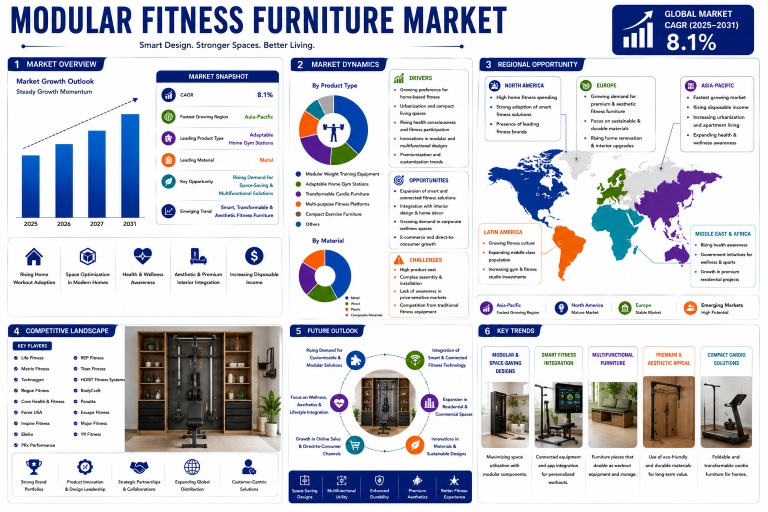
The global Modular Fitness Furniture Market is experiencing notable growth driven by increasing health awareness, rising home fitness participation, and growing demand for multifunctional living spaces. Modular fitness furniture combines exercise functionality with contemporary furniture aesthetics, enabling consumers to integrate fitness activities seamlessly into residential and commercial environments. With urban households seeking compact and adaptable solutions that maximize available space, the market is projected to register a CAGR of 8.1% during the forecast period.
Key Growth Driver
Growing preference for home-based workouts and smart living concepts is accelerating market adoption.
Consumers are increasingly investing in versatile fitness products that can be conveniently incorporated into home interiors without compromising aesthetics. The popularity of remote work, flexible lifestyles, and personalized wellness routines has increased demand for equipment that serves multiple purposes. In addition, rising disposable incomes and expanding awareness regarding preventive healthcare are supporting investments in premium home fitness solutions.
Segment Highlight
Product innovation and multifunctional designs continue to create new growth opportunities.
Based on product type, Adaptable Home Gym Stations account for a significant share of the market due to their ability to accommodate multiple exercise routines within a compact footprint. Modular Weight Training Equipment remains popular among fitness enthusiasts seeking customizable strength-training setups. Transformable Cardio Furniture is gaining traction as consumers increasingly prefer aesthetically appealing solutions that can be folded, concealed, or repurposed when not in use. Multi-purpose Fitness Platforms and Compact Exercise Furniture are also witnessing growing adoption in apartments, studios, and premium residential projects.
By material, Metal remains a dominant segment owing to its durability, load-bearing capabilities, and structural stability. Wood is increasingly utilized in premium designs due to its natural appearance and compatibility with modern interiors. Plastic components continue to support lightweight and affordable product offerings, while Composite Materials are expected to create additional opportunities through improved strength-to-weight characteristics and innovative design possibilities.
Regional Opportunity
Asia-Pacific is emerging as a high-growth market supported by urbanization and increasing investments in home wellness solutions.
North America maintains a strong market position driven by high home fitness spending, growing preference for personalized exercise experiences, and widespread adoption of smart wellness technologies. Europe benefits from increasing consumer interest in minimalist interior designs, sustainable furniture materials, and premium fitness equipment. Meanwhile, Asia-Pacific is expected to witness accelerated growth due to rising disposable incomes, expanding middle-class populations, growing apartment living trends, and increasing awareness regarding health and wellness across China, Japan, South Korea, India, and Southeast Asia.
Competitive Landscape
Manufacturers are focusing on aesthetics, functionality, and customization capabilities to strengthen market positioning.
Leading companies are investing in innovative designs, modular assembly systems, premium finishes, and connected fitness technologies to differentiate their offerings. Strategic collaborations with interior designers, expansion through e-commerce platforms, and development of customizable product configurations continue to influence the competitive environment. Companies are also emphasizing sustainable materials and compact storage solutions to meet evolving consumer expectations.
Key companies operating in the market include Life Fitness, Matrix Fitness, Technogym, Rogue Fitness, Core Health & Fitness, Force USA, Inspire Fitness, Eleiko, PRx Performance, REP Fitness, Titan Fitness, HOIST Fitness Systems, BodyCraft, Panatta, Escape Fitness, Major Fitness, and YR Fitness.
Historical & Forecast Period
This study report represents analysis of each segment from 2024 to 2034 considering 2025 as the base year. Compounded Annual Growth Rate (CAGR) for each of the respective segments estimated for the forecast period of 2026 to 2034.
The current report comprises of quantitative market estimations for each micro market for every geographical region and qualitative market analysis such as micro and macro environment analysis, market trends, competitive intelligence, segment analysis, porters five force model, top winning strategies, top investment markets, emerging trends and technological analysis, case studies, strategic conclusions and recommendations and other key market insights.
Research Methodology
The complete research study was conducted in three phases, namely: secondary research, primary research, and expert panel review. key data point that enables the estimation of Modular Fitness Furniture market are as follows:
Market forecast was performed through proprietary software that analyzes various qualitative and quantitative factors. Growth rate and CAGR were estimated through intensive secondary and primary research. Data triangulation across various data points provides accuracy across various analyzed market segments in the report. Application of both top down and bottom-up approach for validation of market estimation assures logical, methodical and mathematical consistency of the quantitative data.
| ATTRIBUTE | DETAILS |
|---|---|
| Research Period | 2024-2034 |
| Base Year | 2025 |
| Forecast Period | 2026-2034 |
| Historical Year | 2024 |
| Unit | USD Million |
| Segmentation | |
Product Type
|
|
Material
|
|
Price
|
|
End Use
|
|
|
Region Segment (2024-2034; US$ Million)
|
Frequently Asked Questions
Q1. What is driving the growth of the Modular Fitness Furniture Market?
The market is primarily driven by increasing home workout adoption, growing health awareness, urban space limitations, and rising demand for multifunctional furniture solutions.
Q2. What is the expected growth rate of the Modular Fitness Furniture Market?
The global Modular Fitness Furniture Market is projected to expand at a CAGR of 8.1% during the forecast period.
Q3. What is modular fitness furniture?
Modular fitness furniture refers to exercise equipment designed to integrate seamlessly into living spaces while serving additional furniture functions such as storage, seating, or decorative elements.
Q4. Which product segment accounts for a significant market share?
Adaptable Home Gym Stations account for a notable market share due to their ability to support multiple exercise routines within compact residential spaces.
Q5. Why are transformable cardio furniture products gaining popularity?
Transformable cardio furniture products provide convenience, space optimization, and aesthetic appeal by allowing equipment to be folded, concealed, or repurposed when not in use.
Q6. Which material segment dominates the market?
Metal remains a dominant material segment because of its strength, durability, and ability to support heavy workout loads.
Q7. Which region is expected to witness the fastest market growth?
Asia-Pacific is anticipated to emerge as the fastest-growing market due to increasing urbanization, expanding middle-class populations, and rising investments in home wellness products.
Q8. What trends are influencing the modular fitness furniture industry?
Key trends include connected fitness technologies, foldable designs, sustainable materials, smart home integration, and customized exercise solutions.
Q9. What challenges could affect market expansion?
High product prices, limited awareness among consumers, complex assembly requirements, and competition from traditional fitness equipment may influence market growth.
Q10. Who are the leading companies operating in the Modular Fitness Furniture Market?
Major companies include Life Fitness, Matrix Fitness, Technogym, Rogue Fitness, Core Health & Fitness, Force USA, Inspire Fitness, Eleiko, PRx Performance, REP Fitness, Titan Fitness, HOIST Fitness Systems, BodyCraft, Panatta, Escape Fitness, Major Fitness, and YR Fitness.
Q11. What opportunities are expected to shape the future of the market?
Growing smart home adoption, increasing demand for premium home interiors, rising preference for personalized fitness experiences, and advancements in multifunctional furniture designs are expected to create substantial growth opportunities.