
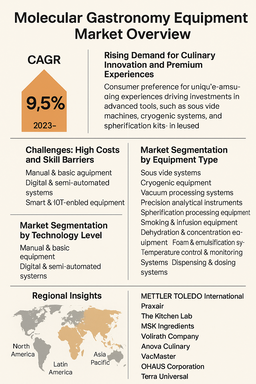
The global molecular gastronomy equipment market is projected to grow at a CAGR of 9.5% from 2026 to 2034, driven by rising consumer interest in experiential dining, culinary innovation, and the growing adoption of advanced food science techniques by restaurants, catering services, and food labs. Molecular gastronomy combines culinary artistry with scientific methods, using specialized equipment to transform flavors, textures, and presentations. Increasing demand for premium dining experiences, the influence of celebrity chefs, and the expansion of experimental gastronomy into mainstream food service are fueling rapid market adoption. Innovations in smart, IoT-enabled devices and integration with precision analytical instruments are enhancing consistency, creativity, and efficiency in culinary processes.
Rising Demand for Culinary Innovation and Premium Experiences
Consumer preference for unique and immersive dining experiences is driving investments in molecular gastronomy equipment. Chefs and food innovators are adopting advanced tools such as sous vide machines, cryogenic systems, and spherification kits to deliver visually appealing and taste-enhancing dishes. The popularity of cooking shows, culinary schools, and high-end gastronomy events has also elevated awareness and demand for these specialized tools. Food manufacturers are experimenting with gastronomy techniques for product development, particularly in premium beverages, desserts, and plant-based foods. This trend is increasingly supported by technological innovations that bring greater precision, automation, and reproducibility to molecular gastronomy applications.
Challenges: High Costs and Skill Barriers
Despite the strong growth outlook, the market faces barriers linked to high equipment costs, limited awareness among mainstream food operators, and the skill-intensive nature of molecular gastronomy techniques. Professional chefs and food technologists require specialized training to operate advanced systems effectively, limiting adoption in small and medium-scale restaurants. Maintenance requirements, particularly for cryogenic and vacuum processing equipment, add to operational costs. However, rising affordability of semi-automated systems, growing training initiatives by culinary institutes, and the introduction of user-friendly digital devices are expected to overcome these barriers and support market expansion.
Market Segmentation by Technology Level
By technology level, manual and basic equipment continues to serve small-scale restaurants, culinary schools, and hobbyists. Digital and semi-automated systems are increasingly favored by professional kitchens seeking consistency and efficiency, while smart and IoT-enabled equipment is the fastest-growing segment. These advanced systems provide real-time monitoring, remote control, and data integration, offering chefs precision and flexibility in managing complex culinary processes.
Market Segmentation by Equipment Type
By equipment type, sous vide systems remain among the most widely used, ensuring controlled temperature cooking with enhanced flavor retention. Cryogenic equipment, including liquid nitrogen systems, is used for rapid freezing and dramatic food presentations. Vacuum processing systems and precision analytical instruments are critical for professional labs and high-end kitchens. Specialized processing equipment, along with spherification and gelification tools, are used to create innovative textures and structures. Smoking and infusion systems, dehydration and concentration devices, and foam and emulsification equipment continue to broaden the range of culinary possibilities. Temperature control and monitoring systems, along with dispensing and dosing solutions, add further accuracy, making them vital for consistency in experimental and fine dining applications.
Regional Insights
In 2025, Europe led the molecular gastronomy equipment market, with strong adoption in countries such as France, Spain, and Italy where culinary innovation and fine dining traditions are deeply rooted. North America followed, driven by high-end restaurant chains, culinary schools, and widespread consumer interest in experimental dining experiences. Asia Pacific is emerging as the fastest-growing region, with rapid urbanization, rising disposable incomes, and growing interest in premium dining in countries such as Japan, South Korea, and China. Latin America and the Middle East & Africa remain niche but promising markets where tourism, luxury dining, and fusion cuisine are expanding opportunities for molecular gastronomy adoption.
Competitive Landscape
The 2025 molecular gastronomy equipment market was led by a mix of specialized equipment manufacturers and established precision instrument providers. METTLER TOLEDO International and OHAUS Corporation remain leaders in analytical and precision measurement systems used in gastronomy applications. Praxair plays a key role in cryogenic solutions for culinary applications, while The Kitchen Lab and MSK Ingredients focus on specialized gastronomy kits and supplies. Vollrath Company, Anova Culinary, and VacMaster are strengthening their positions with sous vide, vacuum, and temperature-control systems widely adopted in professional kitchens. Terra Universal provides advanced processing and laboratory-grade equipment suited for high-end food innovation labs. Competitive differentiation is being shaped by product innovation, smart connectivity, precision engineering, and partnerships with culinary schools and professional chefs to drive awareness and adoption.
Historical & Forecast Period
This study report represents analysis of each segment from 2024 to 2034 considering 2025 as the base year. Compounded Annual Growth Rate (CAGR) for each of the respective segments estimated for the forecast period of 2026 to 2034.
The current report comprises of quantitative market estimations for each micro market for every geographical region and qualitative market analysis such as micro and macro environment analysis, market trends, competitive intelligence, segment analysis, porters five force model, top winning strategies, top investment markets, emerging trends and technological analysis, case studies, strategic conclusions and recommendations and other key market insights.
Research Methodology
The complete research study was conducted in three phases, namely: secondary research, primary research, and expert panel review. key data point that enables the estimation of Molecular Gastronomy Equipment Market By Equipment Type, By Application, By Technology Level - Growth, Share, Opportunities & Competitive Analysis, 2026 - 2034 market are as follows:
Market forecast was performed through proprietary software that analyzes various qualitative and quantitative factors. Growth rate and CAGR were estimated through intensive secondary and primary research. Data triangulation across various data points provides accuracy across various analyzed market segments in the report. Application of both top down and bottom-up approach for validation of market estimation assures logical, methodical and mathematical consistency of the quantitative data.
| ATTRIBUTE | DETAILS |
|---|---|
| Research Period | 2024-2034 |
| Base Year | 2025 |
| Forecast Period | 2026-2034 |
| Historical Year | 2024 |
| Unit | USD Million |
| Segmentation | |
Equipment Type
|
|
Application
|
|
Technology Level
|
|
|
Region Segment (2024-2034; US$ Million)
|
Key questions answered in this report


