
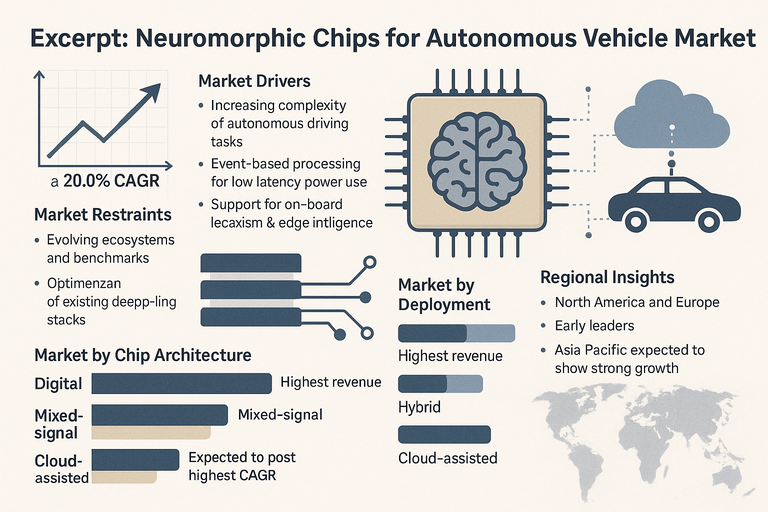
The neuromorphic chips for autonomous vehicle market is growing at a 20.0% CAGR as OEMs and Tier-1 suppliers look for ultra-low-power, high-speed processing to handle perception, sensor fusion, and decision-making at the vehicle edge. Neuromorphic architectures mimic the way biological neurons and synapses work, offering event-driven, parallel computation that can reduce latency and energy use compared with conventional GPUs and CPUs in certain tasks. Within chip architectures, digital neuromorphic chips currently generate the highest revenue because they are easier to integrate in standard CMOS flows and existing automotive electronics platforms, while mixed-signal neuromorphic chips are expected to post the highest CAGR as they combine analog efficiency with digital programmability for advanced autonomous driving workloads. By deployment, on-board (edge) processing accounts for the highest revenue today since safety-critical functions must run in the vehicle with low latency, whereas hybrid processing (combining edge and cloud) is expected to record the highest CAGR as automakers build continuous-learning and fleet-optimization loops around vehicles in the field.
Market Drivers
Market growth is driven by the increasing complexity and compute intensity of autonomous driving stacks. High-resolution cameras, radar, lidar, and in-cabin sensors generate huge volumes of data that must be processed in real time for perception, object tracking, and path planning. Traditional compute approaches push power consumption and thermal limits, especially in compact ECUs and domain controllers. Neuromorphic chips offer event-based processing that only consumes energy when relevant information is present, making them attractive for always-on perception, low-power sensing, and near-sensor processing. As vehicles move toward higher levels of autonomy and continuous over-the-air updates, OEMs also seek architectures that can support on-board learning or rapid adaptation to new environments. The growth of software-defined vehicles and zonal architectures further supports demand for edge intelligence in compact, efficient form factors. For fleets, neuromorphic-enabled edge processing can help reduce data transmission cost by pre-filtering and compressing information before sending summaries to the cloud.
Market Restraints
Adoption is constrained by the early-stage maturity of neuromorphic ecosystems compared with established GPU, CPU, and dedicated accelerator platforms. Toolchains, programming models, and standard benchmarks are still evolving, which makes OEMs cautious about committing to large-scale deployments. Integrating neuromorphic chips into safety-critical automotive environments requires rigorous functional safety concepts, explainability of behavior, and robust validation of learning methods, all of which are still developing. Many autonomous driving stacks are currently optimized for conventional deep-learning hardware, so redesigning algorithms to fully leverage neuromorphic advantages requires investment and skills that not all OEMs and Tier-1s have. Supply chain reliability, long-term availability, and automotive qualification for newer neuromorphic devices also remain key concerns. In the short term, cost per unit of compute can still be higher than mature alternatives in many use cases, limiting neuromorphic deployment to pilot programs and selected edge functions.
Market by Chip Architecture
Analog neuromorphic chips implement neuron and synapse behavior directly in analog circuitry, offering very low power and high density for spiking neural networks. They are well suited for always-on sensing, pattern detection, and low-latency trigger functions, but face challenges in process variation control, large-scale programmability, and integration with digital toolchains. Digital neuromorphic chips represent neurons and spikes in digital logic, leveraging existing CMOS design flows, verification tools, and memory technologies. Within chip architectures, digital neuromorphic chips currently generate the highest revenue because they fit more easily into automotive electronics roadmaps and can be integrated alongside existing processors and accelerators in autonomous ECUs. Mixed-signal neuromorphic chips combine analog computation blocks with digital control and interfaces, aiming to capture analog’s efficiency while retaining digital configurability and reliability. As autonomous driving tasks become more demanding and carmakers seek better energy efficiency at the edge, mixed-signal neuromorphic chips are expected to post the highest CAGR, serving roles in perception pre-processing, sensor fusion, and always-on co-processors that offload work from main SoCs.
Market by Deployment
On-board (edge) processing is central to autonomous vehicles because safety-critical decisions must be made locally, even when connectivity is weak or absent. Neuromorphic chips deployed at the edge can support real-time object detection, event-based vision, in-cabin monitoring, and anomaly detection with low power use and minimal latency; within deployment types, on-board processing currently generates the highest revenue as most neuromorphic pilots and early series programs focus on in-vehicle use. Cloud-assisted processing uses data uploaded from vehicles for training, model updates, and fleet-wide optimization, with neuromorphic principles occasionally applied in data centers or specialized cloud hardware, but direct neuromorphic chip demand here is smaller and more experimental. Hybrid processing links powerful edge neuromorphic nodes in vehicles with cloud infrastructure that retrains, refines, and distributes updated models or parameters back to the fleet. As OEMs and mobility operators build large autonomous fleets and want continuous improvement in perception and behavior, hybrid processing is expected to record the highest CAGR, turning vehicles into learning endpoints that both consume and generate intelligence.
Regional Insights
North America and Europe lead early adoption due to strong autonomous driving R&D, advanced semiconductor and AI ecosystems, and active pilot programs involving robotaxis, automated shuttles, and premium vehicles with high-end ADAS. Technology companies, start-ups, and established Tier-1s in these regions collaborate with automakers to test neuromorphic platforms in sensor modules, ECUs, and edge-AI devices. Asia Pacific, led by China, Japan, and South Korea, is expected to show strong growth as local OEMs and chipmakers accelerate investment in AI accelerators and explore neuromorphic options for next-generation electric and autonomous platforms. Regional policies promoting local semiconductor innovation and intelligent vehicles further support pilot projects. Other regions, including the Middle East and selective Latin American markets, may adopt neuromorphic technologies more gradually, mainly through imported vehicles and fleet solutions developed elsewhere. Markets that move fastest toward Level 3+ autonomy, software-defined vehicles, and dense AV fleets will show the highest demand for neuromorphic edge compute.
Competitive Landscape
IBM, Intel, Micron, NVIDIA, Qualcomm, Samsung Electronics, Sony, and Hewlett Packard Enterprise are global semiconductor and computing companies exploring neuromorphic or neuromorphic-inspired architectures, often leveraging their existing strengths in AI accelerators, memory, and sensor integration. BrainChip Holdings, Aspinity, Gyrfalcon Technology, MemryX, Mythic, Polyn Technology, Prophesee, General Vision, Grayscale AI, and Applied Brain Research focus more directly on neuromorphic hardware, event-based vision sensors, spiking neural networks, and associated development tools, targeting low-power edge AI in automotive and industrial markets. Figaro Engineering and other sensor specialists contribute sensing technologies that can pair with neuromorphic processors for ultra-low-power perception. Cadence Design Systems supports the ecosystem with EDA tools, IP, and flows needed to design and verify neuromorphic chips at automotive-grade reliability. Accenture and other consulting and systems integration firms help OEMs and Tier-1s assess where neuromorphic computing fits into their autonomous driving roadmaps and how to integrate it with existing software stacks. Companies that combine robust neuromorphic hardware with mature development frameworks, automotive safety concepts, and clear integration into autonomous driving ECUs are positioned to lead current revenue, while those that enable scalable, mixed-signal neuromorphic edge platforms tightly linked to cloud-based training and fleet analytics are likely to capture the highest CAGR in the neuromorphic chips for autonomous vehicle market.
Historical & Forecast Period
This study report represents analysis of each segment from 2024 to 2034 considering 2025 as the base year. Compounded Annual Growth Rate (CAGR) for each of the respective segments estimated for the forecast period of 2026 to 2034.
The current report comprises of quantitative market estimations for each micro market for every geographical region and qualitative market analysis such as micro and macro environment analysis, market trends, competitive intelligence, segment analysis, porters five force model, top winning strategies, top investment markets, emerging trends and technological analysis, case studies, strategic conclusions and recommendations and other key market insights.
Research Methodology
The complete research study was conducted in three phases, namely: secondary research, primary research, and expert panel review. key data point that enables the estimation of Neuromorphic Chips for Autonomous Vehicles Market By Chip Architecture, By Deployment, By Vehicle Category, By End Use - Global Market Analysis & Forecast, 2025 to 2033 market are as follows:
Market forecast was performed through proprietary software that analyzes various qualitative and quantitative factors. Growth rate and CAGR were estimated through intensive secondary and primary research. Data triangulation across various data points provides accuracy across various analyzed market segments in the report. Application of both top down and bottom-up approach for validation of market estimation assures logical, methodical and mathematical consistency of the quantitative data.
| ATTRIBUTE | DETAILS |
|---|---|
| Research Period | 2024-2034 |
| Base Year | 2025 |
| Forecast Period | 2026-2034 |
| Historical Year | 2024 |
| Unit | USD Million |
| Segmentation | |
Chip Architecture
|
|
Deployment
|
|
Vehicle Category
|
|
End Use
|
|
|
Region Segment (2024-2034; US$ Million)
|
Key questions answered in this report


