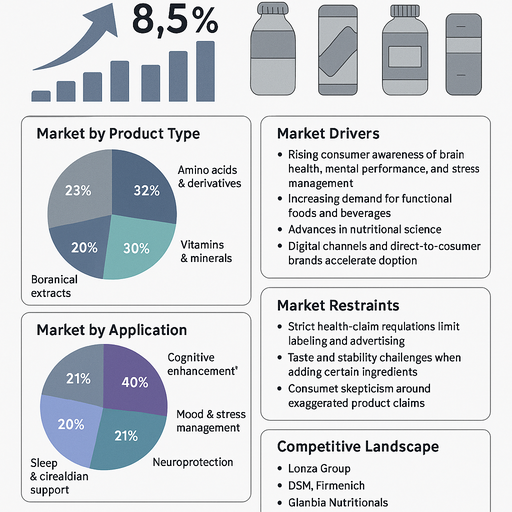
The nootropic food ingredients market is growing at an 8.5% CAGR as food, beverage, and supplement brands add brain health claims to everyday products such as drinks, snack bars, gummies, and powders. Nootropic ingredients are used to support focus, memory, mood, and stress resilience, moving from niche sports and gaming formulas into mainstream wellness and healthy aging products. Within product types, amino acids and derivatives together with vitamins and minerals currently generate the highest revenue because they are well-known, easy to formulate, and widely accepted by regulators and consumers. Botanical extracts and selected synthetic nootropics are expected to record the highest CAGR as brands seek stronger differentiation, multi-claim products, and “premium” positioning. By application, cognitive enhancement products contribute the largest share today, while mood and stress management applications are projected to grow the fastest as mental wellbeing becomes a core focus in functional nutrition.
Market Drivers
Growth is driven by rising consumer awareness of brain health, mental performance, and stress management across working professionals, students, older adults, and gamers. Urban lifestyles, screen exposure, and work pressure increase demand for products that promise better focus, memory support, and emotional balance. The shift from pill-only formats to functional foods and beverages allows brands to reach consumers who prefer “food-first” solutions rather than traditional supplements. Advances in nutritional science, clinical studies on specific ingredients, and better understanding of mechanisms such as neuroinflammation, neurotransmitter balance, and mitochondrial function support stronger marketing claims where regulations allow. Digital channels, influencers, and direct-to-consumer brands accelerate adoption by promoting brain health routines, stack concepts, and personalized nutrition.
Market Restraints
Adoption is limited by strict health-claim regulations that restrict what manufacturers can say on labels and in advertising, especially for memory and cognitive performance. Evidence requirements and differences between regions make it harder to scale one global formulation and positioning. Some synthetic nootropics and novel compounds face regulatory uncertainty or require lengthy approval processes before use in foods. Taste and stability challenges arise when adding certain amino acids or plant extracts at effective doses into beverages or snacks, often requiring masking systems and formulation adjustments. Consumer skepticism around exaggerated claims and “brain booster” marketing can slow repeat purchases if benefits are not perceived clearly. Raw material quality variability, especially for botanical extracts, creates challenges in standardization and consistent efficacy.
Market by Product Type
Amino acids and derivatives, such as L-theanine, L-tyrosine, tryptophan, and acetyl-L-carnitine, are widely used in drinks, powders, and capsules targeting focus, calm alertness, and stress support; within product types this segment currently generates a high share of revenue due to broad regulatory acceptance and flexible dosing. Botanical extracts include ingredients such as ginkgo, bacopa, ashwagandha, ginseng, and other adaptogens and cognitive herbs that offer natural positioning and multi-function benefits spanning cognition, mood, and stress. This segment is expected to post strong CAGR as consumers favor “plant-based” and “clean label” solutions. Vitamins and minerals, including B-complex, vitamin D, magnesium, zinc, and others, remain foundational components in brain health formulations because they are well-established, often supported by approved claims, and easy to include in both food and supplement formats. Synthetic nootropics cover specialty choline sources, novel derivatives, and other performance-focused compounds; while their current revenue base is smaller and often more niche or regionally restricted, they are expected to record one of the highest growth rates where regulations and brand positioning allow more advanced performance claims.
Market by Application
Cognitive enhancement is the leading application area, focusing on attention, working memory, processing speed, and overall mental performance. Products in this category are marketed to students, professionals, and gamers through beverages, powders, and ready-to-drink formats; within applications this segment currently generates the highest revenue. Mood and stress management applications emphasize emotional balance, reduced anxiety, and resilience under pressure, using adaptogens, calming amino acids, and supportive vitamins. This segment is expected to record the highest CAGR as stress and burnout become mainstream health concerns and consumers look for daily “stress-support” foods and drinks. Sleep and circadian support products use ingredients that help relaxation, sleep onset, and sleep quality, positioned for evening routines and paired with apps or sleep-tracking devices. Neuroprotection applications are emerging, focusing on long-term brain health, healthy aging, and antioxidant support, often targeting older adults and people with family history of cognitive decline; these products typically combine multiple ingredient classes to support structural and metabolic aspects of brain health.
Regional Insights
North America contributes a significant share of revenue, supported by strong supplement and functional food industries, high consumer awareness of wellness trends, and active e-commerce and direct-to-consumer brands. Europe shows steady growth under tighter health-claim rules, with manufacturers focusing on well-substantiated ingredients and conservative messaging in foods and beverages. Asia Pacific is expected to record one of the highest CAGRs, driven by large populations of students and working-age consumers, strong interest in brain development products for children, and long tradition of using botanicals and tonics for cognitive and mood support. Latin America and the Middle East & Africa are earlier stage but show rising demand through sports nutrition, energy drinks, and premium wellness categories sold in pharmacies and modern retail. Regions with clearer regulatory frameworks, strong distribution for functional foods, and high digital adoption are likely to scale nootropic food ingredient usage faster.
Competitive Landscape
Lonza Group supplies amino acids, specialty nutrients, and branded cognitive ingredients used in functional foods, beverages, and supplements, supported by formulation services and clinical data packages. DSM-Firmenich combines vitamins, carotenoids, lipids, and specialty actives with flavor and sensory expertise, enabling integrated brain health and mood-support solutions for food, drink, and supplement brands. Glanbia Nutritionals provides protein systems, bioactives, and custom premixes for sports nutrition, gaming, and active lifestyle products, integrating nootropic ingredients into bars, powders, and ready-to-drink formats. Kerry Group focuses on taste, nutrition, and functional ingredient systems, helping manufacturers overcome taste and stability challenges when adding nootropics into mainstream food and beverage applications. Ingredion Incorporated offers texturizers, starches, fibers, and specialty ingredients and partners with bioactive suppliers to deliver complete systems that balance functionality, sensory performance, and label requirements.
Historical & Forecast Period
This study report represents analysis of each segment from 2024 to 2034 considering 2025 as the base year. Compounded Annual Growth Rate (CAGR) for each of the respective segments estimated for the forecast period of 2026 to 2034.
The current report comprises of quantitative market estimations for each micro market for every geographical region and qualitative market analysis such as micro and macro environment analysis, market trends, competitive intelligence, segment analysis, porters five force model, top winning strategies, top investment markets, emerging trends and technological analysis, case studies, strategic conclusions and recommendations and other key market insights.
Research Methodology
The complete research study was conducted in three phases, namely: secondary research, primary research, and expert panel review. key data point that enables the estimation of Nootropic Food Ingredients market are as follows:
Market forecast was performed through proprietary software that analyzes various qualitative and quantitative factors. Growth rate and CAGR were estimated through intensive secondary and primary research. Data triangulation across various data points provides accuracy across various analyzed market segments in the report. Application of both top down and bottom-up approach for validation of market estimation assures logical, methodical and mathematical consistency of the quantitative data.
| ATTRIBUTE | DETAILS |
|---|---|
| Research Period | 2024-2034 |
| Base Year | 2025 |
| Forecast Period | 2026-2034 |
| Historical Year | 2024 |
| Unit | USD Million |
| Segmentation | |
Product Type
|
|
Application
|
|
End Use
|
|
|
Region Segment (2024-2034; US$ Million)
|
Key questions answered in this report