
The global oil & gas heat exchanger market is projected to grow at a CAGR of 8.2% from 2026 to 2034, supported by rising investments in onshore production facilities, refinery modernization, petrochemical expansions, and new LNG infrastructure. Heat exchangers remain essential throughout upstream, midstream, and downstream operations, enabling efficient heating, cooling, condensation, and waste-heat recovery. Increasing focus on operational efficiency, stricter emissions compliance, and reduced energy consumption is strengthening overall market demand.
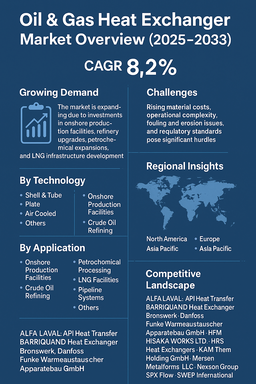
Growing Demand Driven by Refinery and LNG Expansion
Market growth is being driven by refinery debottlenecking, the addition of new petrochemical units, and efficiency upgrades in aromatics, olefins, and polymer production. LNG liquefaction and regasification facilities remain major demand contributors, requiring high-performance heat exchangers that function reliably under cryogenic conditions. Air-cooled units are gaining preference in regions facing water scarcity, while replacement demand is rising due to fouling, corrosion, scaling, and performance deterioration in older systems. The trend toward compact, high-efficiency designs and corrosion-resistant materials is further supporting adoption.
Challenges: High Material Costs and Operational Complexity
The industry faces challenges such as rising costs of duplex and super-duplex stainless steel, nickel alloys, and titanium, which significantly increase manufacturing expenses and lead times. Oil & gas operations involve high temperatures, contaminants, and corrosive environments, which result in fouling and erosion, raising maintenance needs. Additionally, compliance with strict ASME, API, and TEMA standards increases engineering complexity and project timelines. Despite these challenges, increasing interest in waste-heat recovery and high-efficiency thermal systems is creating new opportunities.
Market Segmentation by Technology
Shell & tube heat exchangers held the largest share in 2025, primarily due to their suitability for high-pressure, high-temperature, and dirty service environments common in refining and gas processing plants. Plate heat exchangers are gaining momentum for their compact footprint, high heat-transfer efficiency, and ease of maintenance in clean-fluid services. Air-cooled exchangers are expanding in remote onshore fields where water availability is limited. Other technologies such as spiral, finned-tube, and printed compact exchangers are being adopted for specialized high-efficiency applications.
Market Segmentation by Application
Onshore production facilities dominated the market in 2025, driven by the need for heat exchangers in separation, stabilization, dehydration, and gas-compression cooling. Crude oil refining generates significant demand for preheaters, condensers, reboilers, and cooling systems as refineries upgrade to improve energy efficiency and handle heavier feedstocks. Petrochemical processing relies on precise temperature control in aromatics, ethylene, and polymer production. LNG facilities represent one of the fastest-growing segments due to the thermal requirements of liquefaction and regasification processes. Pipeline systems depend on heat exchangers for pump/compressor station cooling and viscosity control. Additional applications include FPSO topsides, sulfur recovery, and gas gathering networks.
Regional Insights
The Middle East & Africa led the market in 2025 due to large-scale refining, sour-gas processing, and petrochemical expansion projects across Saudi Arabia, UAE, Qatar, and Kuwait. Asia Pacific is expected to record the fastest growth through 2034, driven by petrochemical expansion and LNG infrastructure development in China, India, and Southeast Asia. North America remains strong due to refinery optimization efforts and the rapid build-out of LNG export terminals. Europe continues to show steady demand from chemical plants and energy-efficiency retrofits, while Latin America gains traction through upstream developments and refinery modernization.
Competitive Landscape
The oil & gas heat exchanger market is competitive and fragmented, with global and regional companies focusing on advanced materials, high-efficiency thermal designs, and strong after-sales service. Key companies include ALFA LAVAL, API Heat Transfer, BARRIQUAND Heat Exchanger, Bronswerk, Danfoss, Funke Warmeaustauscher Apparatebau GmbH, HFM, HISAKA WORKS LTD., HRS Heat Exchangers, KAM Thermal Equipment LTD, Kelvion Holding GmbH, Mersen, Metalforms LLC, Nexson Group, SPX Flow, SWEP International, Thermofin, TITAN Metal Fabricators, Tranter, Turnbull & Scott Group, and Xylem. Companies are emphasizing corrosion-resistant materials, compact heat exchanger designs, fouling-resistant geometries, faster delivery timelines, and digital monitoring systems to support predictive maintenance. The long-term outlook remains positive as oil & gas operators continue investing in efficient, reliable, and low-emission process technologies.
Historical & Forecast Period
This study report represents analysis of each segment from 2024 to 2034 considering 2025 as the base year. Compounded Annual Growth Rate (CAGR) for each of the respective segments estimated for the forecast period of 2026 to 2034.
The current report comprises of quantitative market estimations for each micro market for every geographical region and qualitative market analysis such as micro and macro environment analysis, market trends, competitive intelligence, segment analysis, porters five force model, top winning strategies, top investment markets, emerging trends and technological analysis, case studies, strategic conclusions and recommendations and other key market insights.
Research Methodology
The complete research study was conducted in three phases, namely: secondary research, primary research, and expert panel review. key data point that enables the estimation of Oil & Gas Heat Exchanger Market By Technology, By Application - Growth, Share, Opportunities & Competitive Analysis, 2026 - 2034 market are as follows:
Market forecast was performed through proprietary software that analyzes various qualitative and quantitative factors. Growth rate and CAGR were estimated through intensive secondary and primary research. Data triangulation across various data points provides accuracy across various analyzed market segments in the report. Application of both top down and bottom-up approach for validation of market estimation assures logical, methodical and mathematical consistency of the quantitative data.
| ATTRIBUTE | DETAILS |
|---|---|
| Research Period | 2024-2034 |
| Base Year | 2025 |
| Forecast Period | 2026-2034 |
| Historical Year | 2024 |
| Unit | USD Million |
| Segmentation | |
Technology
|
|
Application
|
|
|
Region Segment (2024-2034; US$ Million)
|
Key questions answered in this report


