
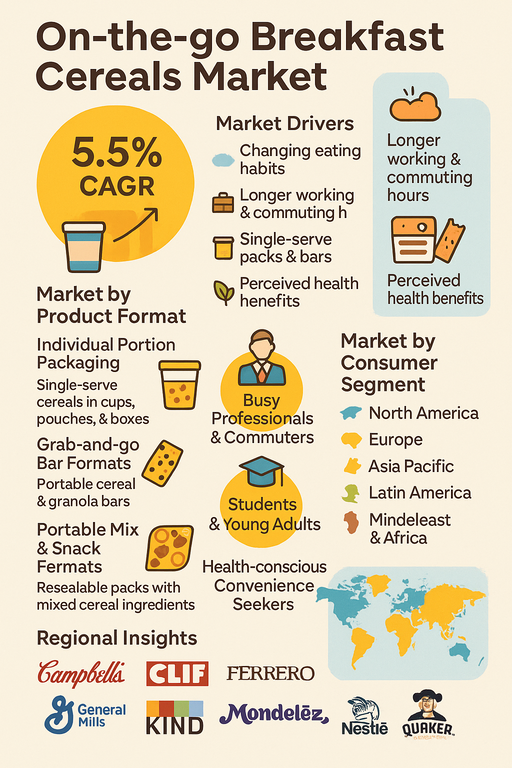
The on the go breakfast cereals market is growing at a 5.5% CAGR as consumers look for quick, portable breakfast and snack options that fit busy schedules without giving up taste or perceived health benefits. Single-serve packs, cereal bars, and ready-mixed cereal snacks are being positioned for breakfast on commutes, in offices, at schools, and after workouts. Brands are combining traditional cereal ingredients with nuts, seeds, dried fruits, and functional inclusions, and are offering formats that can be eaten straight from the pack or with minimal preparation. By product format, individual portion packaging and grab-and-go bar formats generate the highest revenue, while portable mix and snack formats are expected to record the highest CAGR as boundaries between breakfast and snacks continue to blur. Across consumer segments, busy professionals and commuters and students and young adults account for a large share of demand, while health-conscious convenience seekers and active lifestyle consumers are expected to drive premium growth.
Market Drivers
Growth is driven by changing eating habits, urbanization, and longer working and commuting hours. Many consumers skip traditional sit-down breakfasts and instead look for portable foods that can be eaten in the car, on public transport, or at the desk. On the go breakfast cereals offer a familiar taste profile and perceived nutritional value, often supported by whole grains, fiber, and added vitamins and minerals. The expansion of modern retail, convenience stores, and vending channels, along with e-commerce grocery, increases visibility and impulse purchases of single-serve cereal packs and bars. Brands are also benefiting from the shift toward snacking throughout the day, repositioning cereal products not only for breakfast but also for mid-morning and afternoon consumption. Innovation in textures, flavors, and functional ingredients such as protein, probiotics, and reduced sugar supports premium price points and attracts health-conscious users who still want speed and convenience.
Market Restraints
The market faces restraints from growing scrutiny of sugar content, competition from alternative convenient breakfast options, and price sensitivity. Many cereal-based products still rely on added sugars for taste and texture, which can deter health-focused consumers and lead to negative media coverage. Ready-to-drink smoothies, yogurts, bakery items, and savory on-the-go snacks compete for the same usage occasions, especially when they offer strong health or indulgence claims. In many regions, economic pressure and inflation make consumers more cautious about premium convenience products, pushing some buyers back to bulk cereals or homemade options. Shelf space competition in convenience and grocery channels is intense, forcing brands to invest in strong packaging and promotion to stand out. Environmental concerns about single-use packaging also create pressure for more sustainable formats, which can raise production costs and complicate packaging development.
Market by Product Format
Individual portion packaging includes single-serve cereal cups, pouches, and mini-boxes that often require only the addition of milk or can be eaten dry as a snack. This format generates a large share of revenue because it is easy to understand, familiar to consumers, and fits multiple channels from grocery and convenience to travel retail and workplace vending. Grab-and-go bar formats cover cereal bars, granola bars, and hybrid snack bars that combine grains with nuts, seeds, and coatings such as chocolate or yogurt. These bars are highly portable, do not require preparation, and are widely accepted as both breakfast replacements and between-meal snacks, making them another key revenue driver. Portable mix and snack formats include resealable pouches and snack packs that blend cereal clusters, granola, nuts, dried fruit, and sometimes savory elements. These formats support grazing behavior and flexible portioning, and are expected to record the highest CAGR as brands position them as all-day snackable cereals that can serve as breakfast, work snacks, or pre- and post-workout options.
Market by Consumer Segment
Busy professionals and commuters form a core consumer segment, relying on on the go cereals to save time during early mornings and to avoid skipping breakfast altogether. This group values portability, single-handed eating, and options that can be stored at the office or carried in bags, and is responsive to products that balance taste with simple, recognizable ingredients. Active and mobile lifestyle consumers, including gym-goers and outdoor enthusiasts, look for cereal-based products with higher protein, fiber, and energy content that can support pre- or post-exercise nutrition; they tend to favor bar formats and functional mixes. Students and young adults represent another important segment, often juggling classes, part-time work, and social activities; they respond well to affordable price points, bold flavors, and campus or vending distribution. Health-conscious convenience seekers span multiple age groups and focus on clean labels, lower sugar, whole grains, and added functional benefits such as probiotics or plant-based protein. This group is expected to drive premium growth as they look for products that fit dietary preferences but still deliver quick, portable nutrition.
Regional Insights
North America is a leading market for on the go breakfast cereals, supported by long-established cereal consumption, high penetration of convenience and mass retail formats, and strong demand for cereal bars and granola-based snacks. Europe also has a significant market, with consumers increasingly using cereals and cereal bars as part of breakfast and snacking routines, and with ongoing interest in organic, natural, and reduced-sugar options. Asia Pacific is expected to record one of the highest CAGRs as urbanization, rising incomes, and busier lifestyles in markets such as China, India, and Southeast Asia support growth in convenient packaged breakfast and snack products. Adaptation to local flavors, textures, and sweetening profiles is important in this region. Latin America shows growing demand where modern retail and convenience store channels expand and where younger consumers adopt global snacking patterns. The Middle East and parts of Africa are emerging markets for on the go breakfast cereals, with growth tied to modern trade expansion, increasing female workforce participation, and rising interest in Western-style breakfast and snack formats. Regions with strong convenience store infrastructure, high smartphone and e-commerce penetration, and a large base of working-age urban consumers will see faster adoption.
Competitive Landscape
Campbell Soup Company participates through snacking and portable meal brands that extend into cereal and granola-based formats. Clif Bar & Company focuses on energy and granola bars that appeal to active and health-oriented consumers and are often consumed as breakfast substitutes. Ferrero Group participates via sweet and snack brands that can be positioned for morning occasions, blending indulgence with convenience. General Mills, Inc. and Kellogg Company are major cereal players that extend their traditional brands into single-serve cups, cereal bars, and snack mixes tailored for on the go consumption. KIND LLC, part of Mars, emphasizes nut- and grain-based bars with clean-label positioning, appealing strongly to health-conscious convenience seekers. Mondelez International, Inc. leverages biscuit and snack brands into breakfast and morning snack propositions, including cereal-based bars. Nestlé S.A. and PepsiCo, Inc. (Quaker Oats) bring strong portfolios of cereals, oats, and granola, along with single-serve packaging and bar formats that can be consumed at home, on commute, or at work. Post Holdings, Inc. also plays a key role through branded cereals and snackable cereal innovations. Companies that successfully connect established cereal brands with convenient formats, align recipes with health and sustainability expectations, and build strong presence in convenience, e-commerce, and foodservice channels are positioned to lead revenue, while those that innovate in functional, low-sugar, and mix-and-snack formats are likely to capture the highest CAGR in the on the go breakfast cereals market.
Historical & Forecast Period
This study report represents analysis of each segment from 2024 to 2034 considering 2025 as the base year. Compounded Annual Growth Rate (CAGR) for each of the respective segments estimated for the forecast period of 2026 to 2034.
The current report comprises of quantitative market estimations for each micro market for every geographical region and qualitative market analysis such as micro and macro environment analysis, market trends, competitive intelligence, segment analysis, porters five force model, top winning strategies, top investment markets, emerging trends and technological analysis, case studies, strategic conclusions and recommendations and other key market insights.
Research Methodology
The complete research study was conducted in three phases, namely: secondary research, primary research, and expert panel review. key data point that enables the estimation of On The Go Breakfast Cereals Market By Product Format, By Consumer Segment, By Distribution Channel - Global Market Analysis & Forecast, 2025 to 2033 market are as follows:
Market forecast was performed through proprietary software that analyzes various qualitative and quantitative factors. Growth rate and CAGR were estimated through intensive secondary and primary research. Data triangulation across various data points provides accuracy across various analyzed market segments in the report. Application of both top down and bottom-up approach for validation of market estimation assures logical, methodical and mathematical consistency of the quantitative data.
| ATTRIBUTE | DETAILS |
|---|---|
| Research Period | 2024-2034 |
| Base Year | 2025 |
| Forecast Period | 2026-2034 |
| Historical Year | 2024 |
| Unit | USD Million |
| Segmentation | |
Product Format
|
|
Consumer Segment
|
|
Distribution Channel
|
|
|
Region Segment (2024-2034; US$ Million)
|
Key questions answered in this report


