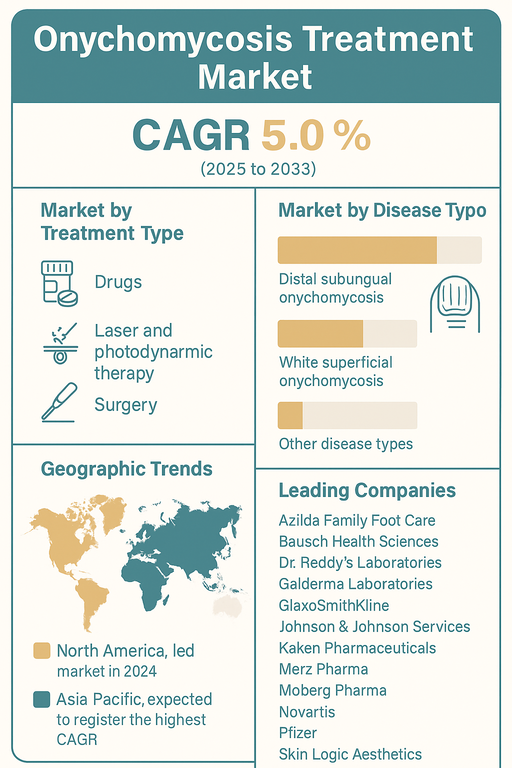
The onychomycosis treatment market is projected to grow at a Compound Annual Growth Rate (CAGR) of 5.0% from 2026 to 2034, driven by the rising incidence of fungal nail infections, growing aging population, increasing diabetes prevalence, and expanding demand for aesthetic foot care solutions. Onychomycosis, a fungal infection affecting toenails and fingernails, is increasingly being recognized as a medical and cosmetic concern, resulting in heightened demand for timely diagnosis and effective treatment interventions. Advancements in topical drug formulations, laser therapies, and patient-friendly treatment regimens are reshaping the treatment landscape.
Market Drivers
Increasing Prevalence of Onychomycosis and Comorbidities
The global prevalence of onychomycosis is growing, especially among geriatric populations, diabetic patients, and immunocompromised individuals. The infection is often associated with reduced mobility, pain, and social stigma. High recurrence rates and increasing awareness around foot hygiene have led to higher diagnosis and treatment rates, boosting the demand for antifungal therapies.
Technological Advancements in Laser Therapy
Innovations in laser and photodynamic treatment technologies have enabled non-invasive and time-efficient solutions with high efficacy. These modalities offer targeted treatment with minimal side effects, making them increasingly popular in clinical and aesthetic settings. Moreover, the integration of these technologies in dermatology clinics and medispas is expanding access to non-pharmacological treatment options.
Rising Focus on Aesthetic Dermatology
The growing popularity of aesthetic foot and nail care is contributing to higher demand for onychomycosis treatments, particularly in urban centers. Patients are opting for early-stage interventions to restore nail appearance, especially with improved availability of cosmetically elegant topical antifungals and safer systemic drugs.
Market Restraint
Prolonged Treatment Duration and Recurrence
Onychomycosis treatments often require long-term therapy lasting several months, particularly in severe or chronic cases. Additionally, high recurrence rates especially in toenails can result in patient dissatisfaction and treatment discontinuation. This limits market growth, particularly in cost-sensitive or non-adherent patient groups.
Market Segmentation by Treatment Type
The Treatment Type segment includes Drugs, Laser and Photodynamic Therapy, and Surgery. In 2025, Drugs dominated the market in revenue terms, owing to widespread availability of topical and oral antifungals such as terbinafine, itraconazole, and efinaconazole. These drugs remain the first line of treatment across primary care and dermatology practices. However, Laser and Photodynamic Therapy is expected to witness the highest growth through 2034, driven by increasing preference for non-invasive methods, fewer systemic side effects, and better patient compliance. Surgical interventions are typically reserved for severe or unresponsive cases and account for a niche share of the overall market.
Market Segmentation by Disease Type
The Disease Type segment comprises Distal Subungual Onychomycosis, Proximal Subungual Onychomycosis, White Superficial Onychomycosis, and Other Disease Types.
Distal Subungual Onychomycosis (DSO) represented the largest revenue share in 2025, as it is the most common form of fungal nail infection, affecting both fingernails and toenails. White Superficial Onychomycosis (WSO) and Proximal Subungual Onychomycosis (PSO) are less prevalent but are increasingly diagnosed due to improved clinical awareness. Other disease types, including candidal infections and total dystrophic onychomycosis, make up a smaller yet significant segment and are often seen in immunocompromised or elderly populations.
Geographic Trends
Geographically, North America led the market in 2025 in terms of revenue, supported by high awareness levels, strong healthcare infrastructure, and access to advanced dermatological treatments in the U.S. and Canada. Europe followed closely, particularly in countries like Germany, the UK, France, and Italy where dermatological care is accessible and cosmetic dermatology is well-established. The Asia Pacific region is projected to register the highest CAGR from 2026 to 2034, fueled by rising disposable incomes, growing demand for aesthetic care, and increasing healthcare access in countries such as China, Japan, South Korea, and India. Latin America and Middle East & Africa (MEA) are emerging regions, with growth driven by expanding dermatology clinics, increasing foot health awareness, and broader distribution of antifungal drugs.
Competitive Trends
The onychomycosis treatment market is highly fragmented, with a mix of pharmaceutical manufacturers, dermatology-focused firms, podiatry centers, and aesthetic service providers. In 2025, Pfizer, Novartis, GlaxoSmithKline, and Bausch Health Sciences held strong positions through their antifungal portfolios and global distribution networks. Moberg Pharma, Taro Pharmaceuticals, and Dr. Reddy's Laboratories are active in both branded and generic topical solutions. Kaken Pharmaceuticals and Galderma Laboratories continue to expand in the Japanese and global dermatology segments, with differentiated product offerings. Emerging companies such as Azilda Family Foot Care, Skin Logic Aesthetics, and South Charlotte General and Vascular Surgery are contributing through localized treatment innovations and patient care services. Merz Pharma and Johnson & Johnson Services have strategic interests in dermatology, with potential for expanded participation in antifungal therapies. The market is expected to witness consolidation and innovation through licensing agreements, R&D investments, and integration of digital dermatology platforms for patient engagement and remote diagnosis.
Historical & Forecast Period
This study report represents analysis of each segment from 2024 to 2034 considering 2025 as the base year. Compounded Annual Growth Rate (CAGR) for each of the respective segments estimated for the forecast period of 2026 to 2034.
The current report comprises of quantitative market estimations for each micro market for every geographical region and qualitative market analysis such as micro and macro environment analysis, market trends, competitive intelligence, segment analysis, porters five force model, top winning strategies, top investment markets, emerging trends and technological analysis, case studies, strategic conclusions and recommendations and other key market insights.
Research Methodology
The complete research study was conducted in three phases, namely: secondary research, primary research, and expert panel review. key data point that enables the estimation of Onychomycosis Treatment market are as follows:
Market forecast was performed through proprietary software that analyzes various qualitative and quantitative factors. Growth rate and CAGR were estimated through intensive secondary and primary research. Data triangulation across various data points provides accuracy across various analyzed market segments in the report. Application of both top down and bottom-up approach for validation of market estimation assures logical, methodical and mathematical consistency of the quantitative data.
| ATTRIBUTE | DETAILS |
|---|---|
| Research Period | 2024-2034 |
| Base Year | 2025 |
| Forecast Period | 2026-2034 |
| Historical Year | 2024 |
| Unit | USD Million |
| Segmentation | |
Treatment Type
|
|
Disease Type
|
|
Gender
|
|
End Use
|
|
|
Region Segment (2024-2034; US$ Million)
|
Key questions answered in this report