
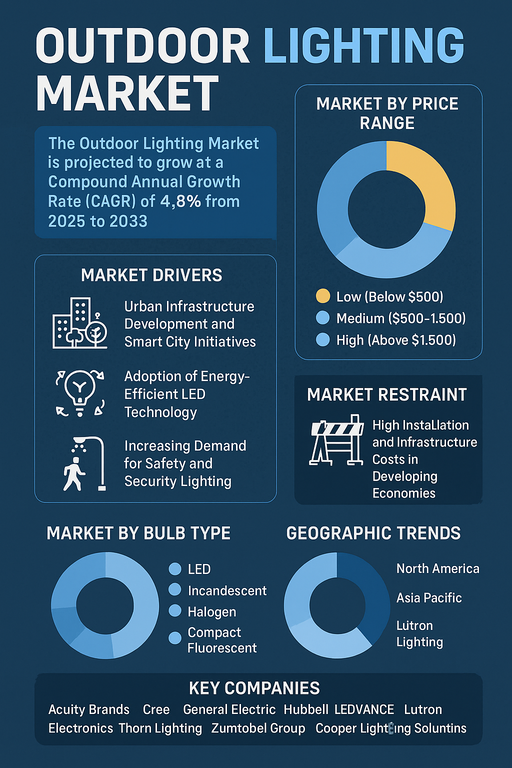
The outdoor lighting market is projected to grow at a Compound Annual Growth Rate (CAGR) of 4.8% from 2026 to 2034, driven by urban expansion, increasing adoption of energy-efficient lighting technologies, and investments in smart infrastructure and public safety. Outdoor lighting is crucial across various applications such as roadway and highway illumination, parking areas, architectural lighting, landscape beautification, and perimeter security. The market is also influenced by rising concerns for sustainable development, the integration of lighting with IoT platforms, and government-led energy conservation programs. As municipalities and commercial entities upgrade aging infrastructure, the shift toward LED and smart outdoor lighting systems is accelerating globally.
Market Drivers
Urban Infrastructure Development and Smart City Initiatives
Continued investment in urbanization, highway expansion, and city beautification programs is stimulating demand for robust and intelligent outdoor lighting systems. Smart city projects across the U.S., China, the EU, and the Middle East are adopting sensor-integrated, remotely controlled lighting networks to optimize energy usage and enhance safety. Applications in public parks, transportation terminals, and commercial campuses are also fueling growth, especially as governments enforce lighting codes and sustainability standards.
Adoption of Energy-Efficient LED Technology
The global push for energy efficiency and carbon reduction has made LED-based lighting systems the dominant technology in outdoor lighting. Compared to incandescent and halogen bulbs, LEDs offer superior lifespan, reduced maintenance, and lower energy consumption. This shift is being supported by financial incentives, public-private partnerships, and awareness programs that are expediting the replacement of outdated luminaires with LED alternatives. Additionally, advancements in adaptive lighting and motion-sensing controls are further enhancing operational cost savings and system reliability.
Increasing Demand for Safety and Security Lighting
Urban and suburban expansion has elevated the demand for well-lit outdoor spaces to improve public security and minimize crime. Institutions such as hospitals, universities, logistics hubs, and gated communities are investing in high-performance, weather-resistant lighting systems with surveillance compatibility. These needs are further supported by government policies promoting crime prevention through environmental design (CPTED), encouraging municipal bodies to deploy lighting in high-risk zones and unlit public areas.
Market Restraint
High Installation and Infrastructure Costs in Developing Economies
Despite long-term cost savings, the initial deployment of smart and LED-based outdoor lighting systems involves significant capital expenditure. These include cost of luminaire hardware, underground wiring, poles, smart controllers, and labor. Municipal budgets, especially in developing countries, often face constraints in upgrading outdated grid infrastructure and integrating modern lighting systems. Furthermore, in remote or low-income areas, inconsistent power supply and lack of maintenance resources pose challenges to adoption, hindering market penetration in cost-sensitive regions.
Market Segmentation by Price Range
The market is segmented into Low (Below $500), Medium ($500–1,500), and High (Above $1,500) price ranges. In 2025, the Medium price range held the highest market share, as it balances cost-effectiveness and performance for residential complexes, commercial plazas, and small municipalities. The High-end segment is expected to grow at the fastest rate during the forecast period, driven by adoption in premium hospitality landscapes, heritage site lighting, and large-scale smart infrastructure projects requiring advanced control systems and aesthetic design. Meanwhile, the Low-cost segment continues to cater to budget-conscious buyers in developing economies and rural areas.
Market Segmentation by Bulb Type
By bulb type, the market is categorized into LED, Incandescent, Halogen, Compact Fluorescent, and Others. LEDs dominated the market in 2025 by revenue, owing to rapid technological advancements, longer service life, and decreasing per-unit cost. LED adoption has been bolstered by global energy efficiency mandates and falling component prices. Halogen and incandescent bulbs have witnessed declining demand due to higher energy consumption and limited lifecycle, while Compact Fluorescent Lamps (CFLs) remain transitional solutions in regions still upgrading legacy systems. The Others category which includes solar-powered lamps and metal halide systems is gaining share with increased focus on off-grid applications and renewable integration.
Geographic Trends
In 2025, North America led the outdoor lighting market in terms of revenue, supported by robust demand from smart city deployments across the U.S. and Canada. Retrofitting of public infrastructure, stringent energy regulations, and commercial property upgrades contributed to sustained growth. However, the Asia Pacific region is projected to record the highest CAGR from 2026 to 2034, fueled by rapid urbanization, road construction, and infrastructure modernization in China, India, and Southeast Asian nations. Initiatives like India’s “Smart Cities Mission” and China’s smart grid expansion are strong tailwinds. Europe remains a mature yet active market driven by EU-wide climate directives and sustainable lighting policies. Latin America and the Middle East & Africa are emerging regions witnessing increased investment in urban infrastructure, particularly in Brazil, Mexico, Saudi Arabia, and the UAE, where tourism, commercial development, and national planning programs are stimulating lighting demand.
Competitive Trends
The competitive landscape features a mix of multinational lighting manufacturers and niche regional providers offering a wide range of luminaires, controllers, poles, and software platforms. In 2025, Signify (Philips), Osram Licht, and Acuity Brands led the market through innovation in smart and adaptive lighting technologies. Cree, Zumtobel Group, LEDVANCE, and Hubbell expanded their portfolios with connected outdoor lighting systems that support remote monitoring, daylight harvesting, and motion detection. Cooper Lighting Solutions, Eaton, General Electric, and Lutron Electronics focused on integrated control systems and solar-compatible lighting fixtures. Thorn Lighting, Kichler Lighting, Lithonia Lighting, and Hinkley Lighting emphasized architectural and landscape aesthetics in residential and commercial segments. As competition intensifies, key strategies include mergers and acquisitions, strategic municipal contracts, software partnerships, and product diversification toward solar and hybrid lighting solutions. Through 2034, market players are expected to capitalize on sustainability goals, energy management regulations, and digitization of urban infrastructure to drive long-term growth.
Historical & Forecast Period
This study report represents analysis of each segment from 2024 to 2034 considering 2025 as the base year. Compounded Annual Growth Rate (CAGR) for each of the respective segments estimated for the forecast period of 2026 to 2034.
The current report comprises of quantitative market estimations for each micro market for every geographical region and qualitative market analysis such as micro and macro environment analysis, market trends, competitive intelligence, segment analysis, porters five force model, top winning strategies, top investment markets, emerging trends and technological analysis, case studies, strategic conclusions and recommendations and other key market insights.
Research Methodology
The complete research study was conducted in three phases, namely: secondary research, primary research, and expert panel review. key data point that enables the estimation of Outdoor Lighting Market By Product, By Price Range, By Bulb Type, By Lumen Output, By Application, By Distribution Channel - Growth, Share, Opportunities & Competitive Analysis, 2026 - 2034 market are as follows:
Market forecast was performed through proprietary software that analyzes various qualitative and quantitative factors. Growth rate and CAGR were estimated through intensive secondary and primary research. Data triangulation across various data points provides accuracy across various analyzed market segments in the report. Application of both top down and bottom-up approach for validation of market estimation assures logical, methodical and mathematical consistency of the quantitative data.
| ATTRIBUTE | DETAILS |
|---|---|
| Research Period | 2024-2034 |
| Base Year | 2025 |
| Forecast Period | 2026-2034 |
| Historical Year | 2024 |
| Unit | USD Million |
| Segmentation | |
Product
|
|
Price Range
|
|
Bulb Type
|
|
Lumen Output
|
|
Application
|
|
Distribution Channel
|
|
|
Region Segment (2024-2034; US$ Million)
|
Key questions answered in this report


