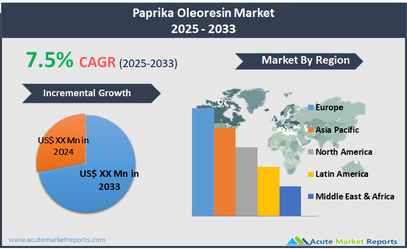
Paprika oleoresin is a natural extract derived from the pods of sweet red pepper or Capsicum annuum, used primarily as a coloring and flavoring agent in the food industry. It contains carotenoids, which provide its vibrant red color, making it a popular choice for imparting color in a variety of food products without altering their flavor profiles significantly. Beyond its use in culinary applications, paprika oleoresin is also utilized in cosmetics for its coloring properties and in the pharmaceutical industry due to its antioxidant benefits. The paprika oleoresin market is experiencing steady growth, with a projected Compound Annual Growth Rate (CAGR) of 7.5%. This growth is fueled by the increasing demand for natural food colorants as consumers continue to move away from synthetic additives, seeking cleaner and more natural ingredients in their food. The trend towards naturalism is driven by heightened health consciousness and more stringent global regulations regarding food safety and ingredient transparency. Paprika oleoresin is especially popular in meat processing, baked goods, seasonings, and snack food, where it is prized not only for its effectiveness as a colorant but also for its minimal impact on flavor. Additionally, the growing cosmetic industry utilizes paprika oleoresin for its natural pigment properties, further expanding its market reach. The demand is also supported by the expansion of the global processed food and fast food markets, particularly in emerging economies where rapid urbanization and changing lifestyles have increased the consumption of ready-to-eat and convenience foods.
Shift Towards Natural Food Additives
A significant driver for the paprika oleoresin market is the global shift towards natural food additives, motivated by consumer demand for clean-label products and stricter regulatory standards on artificial colorants. As health-conscious consumers increasingly opt for products with natural ingredients, manufacturers are adapting by substituting synthetic dyes with natural alternatives like paprika oleoresin. This trend is evident in industries such as meat processing and snacks, where the appeal of natural coloration without the compromise of flavor is particularly valued. The push for natural ingredients is not just a consumer preference but also a response to the growing body of research linking artificial colorants to health risks, which has spurred regulatory bodies in many regions to tighten regulations, further bolstering the demand for natural colorants like paprika oleoresin.
Expanding Applications in Cosmetics and Pharmaceuticals
The paprika oleoresin market finds a promising opportunity in its expanding applications within the cosmetics and pharmaceutical industries. In cosmetics, the drive for natural and organic ingredients is paralleling trends observed in the food sector, with paprika oleoresin being utilized for its vibrant pigment and antioxidant properties. This is particularly appealing in products such as lipsticks and blushes, where synthetic dyes are being replaced in favor of natural alternatives. In the pharmaceutical industry, the antioxidant properties of paprika oleoresin are harnessed in formulations designed to combat oxidative stress, offering a dual benefit as both a health supplement and a coloring agent. This broadening of applications is expected to open new avenues for growth in markets that are increasingly aligning with health and wellness trends.
Volatility in Raw Material Supply
A key restraint in the paprika oleoresin market is the volatility in the supply of raw materials, primarily attributed to agricultural factors such as climate change, pestilence, and fluctuating weather conditions. Since paprika oleoresin is extracted from sweet red peppers, its production is highly susceptible to the yields of these crops, which can vary significantly from year to year based on environmental conditions. Such variability can lead to inconsistencies in production volumes and prices, posing challenges for manufacturers in maintaining stable production lines and cost structures. This issue is compounded by the limited cultivation areas of Capsicum annuum, which are concentrated in specific regions, thereby increasing the risk of supply disruptions.
Regulatory Compliance and International Standards
The paprika oleoresin market faces the challenge of adhering to regulatory compliance and international standards, which vary widely across different countries. As the market for paprika oleoresin grows globally, manufacturers must navigate a complex landscape of food safety regulations, which dictate permissible usage levels and application methods. These regulations are not only diverse but also constantly evolving, as new scientific findings prompt regulatory bodies to update their standards. For manufacturers, this means continuous monitoring and updating of practices to comply with international food safety standards, which involves significant investment in regulatory expertise and testing to ensure that products meet the legal requirements of each market they serve.
Market Segmentation by Nature
The paprika oleoresin market is segmented into organic and conventional types. Conventional paprika oleoresin currently accounts for the highest revenue in the market, owing to its widespread adoption across various industries including food processing, cosmetics, and pharmaceuticals due to its cost-effectiveness and abundant availability. However, the organic segment is anticipated to register the highest Compound Annual Growth Rate (CAGR) over the forecast period. This expected growth is driven by the increasing consumer demand for organic products, reflecting a broader trend towards natural and environmentally friendly ingredients. As consumers become more health-conscious and aware of the impacts of agricultural practices on the environment, the demand for organic paprika oleoresin is expected to surge, supported by the willingness of consumers to pay a premium for products that are certified organic and perceived as healthier.
Market Segmentation by Extraction Method
In terms of extraction methods, the paprika oleoresin market is divided between solvent extraction and supercritical fluid extraction (SFE). Solvent extraction holds the largest share of the market in terms of revenue due to its efficiency and cost-effectiveness in extracting high yields of oleoresin. This method is widely used because of its established technology and scalability, which make it suitable for large-scale production settings. On the other hand, supercritical fluid extraction (SFE), specifically using CO2, is projected to exhibit the highest CAGR. The growth in SFE can be attributed to its ability to produce purer extracts without the residue of harmful solvents, aligning with the increasing regulatory and consumer demands for cleaner and safer food processing methods. SFE is also gaining traction due to its environmental benefits, including lower emissions and reduced solvent usage, making it a preferred method among manufacturers aiming for sustainable production practices.
Geographic and Competitive Trends
In 2024, Europe dominated the paprika oleoresin market in terms of revenue, supported by its stringent food safety regulations which favor the use of natural colorants over synthetic alternatives. The region's strong emphasis on food quality and safety, coupled with high consumer awareness about the benefits of natural ingredients, has bolstered the demand for paprika oleoresin in European markets. Asia Pacific is expected to exhibit the highest Compound Annual Growth Rate (CAGR) from 2025 to 2033, driven by rapid urbanization, growing middle classes, and increasing consumer expenditure on processed foods and natural cosmetics. This growth is particularly notable in countries like China and India, where the expanding food processing and pharmaceutical industries are seeking high-quality, natural ingredients to meet consumer preferences for clean label products.
Top players in the paprika oleoresin market include Universal Oleoresins, Akay Natural Ingredients Pvt. Ltd., Synthite, AVT Natural Products, Paprika Oleo’s, Paras Perfumers, Manohar Botanical Extracts Pvt. Ltd., Ambe Group, Gurjar Phytochem Pvt. Ltd., MRT Organic Green Products, Nature Plus Herbal Cosmetics, Cymbio Pharma Pvt. Ltd., Chenguang Biotech Group Co., Ltd., Sinopaprika Co., Ltd, Plant Lipids, Evesa, and Naturex. These companies focused on expanding their global presence and enhancing their product portfolios in 2024 through strategic initiatives such as partnerships, expansions, and innovations in extraction technologies. From 2025 to 2033, these players are expected to concentrate on advancing sustainable extraction methods, such as supercritical fluid extraction (SFE), to align with global sustainability trends and regulatory demands for environmentally friendly manufacturing processes. Additionally, there will be an emphasis on tapping into new applications within cosmetics and pharmaceuticals, where the antioxidant properties of paprika oleoresin can be marketed not only for coloration but also for health benefits, thus diversifying the uses and increasing the value proposition of paprika oleoresin products in the market.
Historical & Forecast Period
This study report represents analysis of each segment from 2024 to 2034 considering 2025 as the base year. Compounded Annual Growth Rate (CAGR) for each of the respective segments estimated for the forecast period of 2026 to 2034.
The current report comprises of quantitative market estimations for each micro market for every geographical region and qualitative market analysis such as micro and macro environment analysis, market trends, competitive intelligence, segment analysis, porters five force model, top winning strategies, top investment markets, emerging trends and technological analysis, case studies, strategic conclusions and recommendations and other key market insights.
Research Methodology
The complete research study was conducted in three phases, namely: secondary research, primary research, and expert panel review. key data point that enables the estimation of Paprika Oleoresin market are as follows:
Market forecast was performed through proprietary software that analyzes various qualitative and quantitative factors. Growth rate and CAGR were estimated through intensive secondary and primary research. Data triangulation across various data points provides accuracy across various analyzed market segments in the report. Application of both top down and bottom-up approach for validation of market estimation assures logical, methodical and mathematical consistency of the quantitative data.
| ATTRIBUTE | DETAILS |
|---|---|
| Research Period | 2024-2034 |
| Base Year | 2025 |
| Forecast Period | 2026-2034 |
| Historical Year | 2024 |
| Unit | USD Million |
| Segmentation | |
Nature
|
|
Extraction Method
|
|
End-Use
|
|
Distribution Channel
|
|
|
Region Segment (2024-2034; US$ Million)
|
Key questions answered in this report