
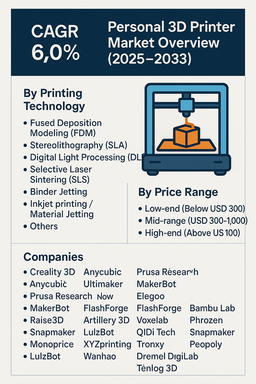
The global personal 3D printer market is projected to grow at a CAGR of 6.0% from 2026 to 2034, driven by increasing consumer interest in do-it-yourself (DIY) fabrication, maker culture expansion, and the affordability of desktop 3D printing technologies. Personal 3D printers, designed for hobbyists, educators, designers, and small-scale creators, enable users to prototype and manufacture products at home or in small workshops. The democratization of 3D printing through open-source designs, easy-to-use software, and low-cost hardware is broadening adoption across both developed and emerging economies.
Expanding Consumer Adoption and Educational Integration
The market growth is strongly influenced by the rising adoption of affordable desktop printers for creative and educational use. Schools, universities, and innovation hubs are integrating 3D printing to promote STEM learning and product design education. The expanding community of hobbyists, small entrepreneurs, and designers is further driving demand for compact and high-performance personal 3D printers. Additionally, continuous improvements in printing accuracy, multi-material compatibility, and plug-and-play functionality are enhancing user experience. The availability of open-source ecosystems and a wide variety of printable materials—such as PLA, ABS, resin, and nylon—has made 3D printing more accessible than ever.
Challenges: High Material Costs and Technical Complexity
Despite the expanding market base, the personal 3D printer industry faces challenges such as limited material diversity, maintenance requirements, and technical learning curves for first-time users. Resin-based and laser technologies, while precise, often involve higher operational costs and complex calibration processes. In addition, fluctuations in filament and resin prices affect the affordability of ongoing use. However, innovation in eco-friendly filaments, AI-powered calibration, and simplified software interfaces is expected to overcome these challenges and promote mainstream adoption.
Market Segmentation by Printing Technology
By printing technology, the market is segmented into Fused Deposition Modeling (FDM), Stereolithography (SLA), Digital Light Processing (DLP), Selective Laser Sintering (SLS), Binder Jetting, Inkjet/Material Jetting, and Others. In 2025, Fused Deposition Modeling (FDM) accounted for the largest market share, as it remains the most widely used technology among hobbyists and entry-level users due to its affordability, simplicity, and compatibility with a variety of thermoplastic filaments. Meanwhile, Stereolithography (SLA) and Digital Light Processing (DLP) are expected to record the highest CAGR during the forecast period, driven by demand for high-resolution resin-based printing in jewelry, dental models, and miniatures. These resin printers are increasingly popular among artists and designers seeking smoother surface finishes and intricate detailing.
Market Segmentation by Price Range
By price range, the market is divided into low-end (below USD 300), mid-range (USD 300–1,000), and high-end (above USD 1,000).
In 2025, mid-range printers dominated the market, offering the best balance between performance and affordability for hobbyists and educators. This segment includes models featuring reliable precision, open material compatibility, and Wi-Fi connectivity. The low-end segment continues to attract entry-level consumers and students, especially in developing markets, due to the growing availability of compact FDM printers under USD 300. The high-end segment is expected to grow steadily, driven by small businesses, design professionals, and educational institutions seeking advanced multi-material or resin-based printing capabilities.
Regional Insights
In 2025, North America led the personal 3D printer market, driven by strong adoption in education, maker communities, and early consumer technology adoption in the U.S. and Canada. Europe followed closely, with countries such as Germany, the UK, and the Netherlands acting as innovation hubs for open-source 3D printing and professional-grade desktop systems. Asia Pacific is expected to register the highest CAGR, fueled by rapidly expanding manufacturing hubs in China, Japan, and South Korea, as well as rising interest in DIY and educational printing. The Latin America and Middle East & Africa (MEA) regions are emerging markets, where increasing internet penetration and falling hardware costs are gradually expanding adoption.
Competitive Landscape
The personal 3D printer market is highly competitive, with a mix of global leaders and emerging brands offering differentiated designs and pricing. Creality 3D, Anycubic, and Prusa Research dominate the consumer segment with strong product ecosystems, community support, and consistent firmware updates. Ultimaker (merged with MakerBot to form UltiMaker) remains a key innovator in educational and semi-professional printing. Elegoo, FlashForge, and Bambu Lab are rapidly expanding through resin and multi-material printers that appeal to prosumer users. Raise3D, Formlabs, and Phrozen are gaining traction with high-precision compact printers suitable for professional and personal use. QIDI Tech, Snapmaker, and Monoprice cater to entry-level users with affordable, user-friendly FDM models. Other notable manufacturers include LulzBot (Aleph Objects), XYZprinting, Tronxy, Wanhao, Peopoly, Dremel DigiLab, Tenlog 3D, and Sindoh, which are broadening product ranges through modular systems and cloud-connected printers.
Historical & Forecast Period
This study report represents analysis of each segment from 2024 to 2034 considering 2025 as the base year. Compounded Annual Growth Rate (CAGR) for each of the respective segments estimated for the forecast period of 2026 to 2034.
The current report comprises of quantitative market estimations for each micro market for every geographical region and qualitative market analysis such as micro and macro environment analysis, market trends, competitive intelligence, segment analysis, porters five force model, top winning strategies, top investment markets, emerging trends and technological analysis, case studies, strategic conclusions and recommendations and other key market insights.
Research Methodology
The complete research study was conducted in three phases, namely: secondary research, primary research, and expert panel review. key data point that enables the estimation of Personal 3D Printers Market By Printing Technology, By Material Type, By Price Range, By Distribution Channel, By End Use - Growth, Share, Opportunities & Competitive Analysis, 2026 - 2034 market are as follows:
Market forecast was performed through proprietary software that analyzes various qualitative and quantitative factors. Growth rate and CAGR were estimated through intensive secondary and primary research. Data triangulation across various data points provides accuracy across various analyzed market segments in the report. Application of both top down and bottom-up approach for validation of market estimation assures logical, methodical and mathematical consistency of the quantitative data.
| ATTRIBUTE | DETAILS |
|---|---|
| Research Period | 2024-2034 |
| Base Year | 2025 |
| Forecast Period | 2026-2034 |
| Historical Year | 2024 |
| Unit | USD Million |
| Segmentation | |
Printing Technology
|
|
Material Type
|
|
Price Range
|
|
Distribution Channel
|
|
End Use
|
|
|
Region Segment (2024-2034; US$ Million)
|
Key questions answered in this report


