
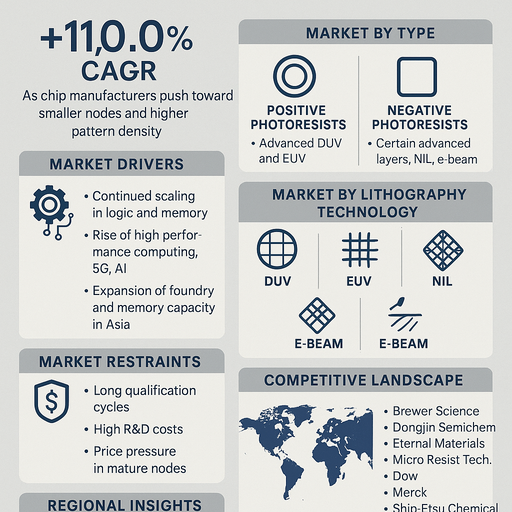
The photoresist chemicals for advanced lithography market is growing at an 11.0% CAGR as chip manufacturers push toward smaller nodes, higher pattern density, and more complex device architectures in logic, memory, and advanced packaging. Advanced lithography flows based on deep ultraviolet (DUV), extreme ultraviolet (EUV), i-line, nanoimprint, and e-beam technologies depend on highly engineered photoresist chemistries that can deliver fine resolution, low line-edge roughness, high sensitivity, and stable performance on modern substrates. Positive and negative photoresists are being optimized for use with high numerical aperture optics, multiple patterning schemes, and new hardmask stacks. The move toward EUV and advanced DUV multi-patterning is driving stronger demand for next-generation resist platforms, while specialty formulations for NIL and e-beam enable development of photonics, compound semiconductor devices, and advanced packaging.
Market Drivers
Growth is driven by continued scaling in logic and memory, rising demand for high-performance computing, 5G, AI accelerators, and advanced consumer electronics. As chip designs move to sub-10 nm and below, wafer fabs require photoresists that can resolve finer features with acceptable yield and throughput. EUV adoption in high-volume manufacturing raises demand for new resist chemistries with higher sensitivity and better stochastic performance to manage line-edge roughness and defectivity. In parallel, DUV lithography still plays a central role in many layers, often in multi-patterning schemes that need optimized positive and negative resists with good etch resistance and process windows. Growth in advanced packaging, 3D integration, and heterogeneous integration requires specialty resists for redistribution layers, through-silicon vias, and wafer-level packaging. Expansion of foundry and memory capacity in Asia, along with government-backed semiconductor programs, further drives demand for advanced lithography materials. Equipment suppliers and resist makers work closely with leading-edge fabs to co-optimize resists, developers, and process conditions, which helps accelerate new product adoption.
Market Restraints
The market faces restraints from long qualification cycles, high R&D costs, and strong performance requirements at advanced nodes. Photoresist chemistries for EUV and high-NA systems must meet tight specifications on defectivity, outgassing, and process stability, which increases development time and testing cost. Once fabs qualify a resist for a given layer, they are slow to change suppliers or formulations because any change can affect yield and reliability, which limits the pace of new product penetration. Raw material costs for specialty monomers, resins, and metal-containing components can be high, and supply chain disruptions for critical intermediates create additional risk. Regulatory pressure on solvents, photoactive compounds, and waste streams used in resist manufacture and application can add compliance costs and restrict certain chemistries. Smaller resist suppliers may struggle to obtain the tool access, metrology, and joint development projects needed to compete at leading nodes. In older lithography nodes and mature applications, price pressure is strong, which can cap margins for some resist grades.
Market by Type
Positive photoresists form the largest segment, widely used in advanced DUV and many EUV applications because they allow exposed regions to become more soluble and be removed during development, enabling finer features and better control of line width. These resists are engineered for high resolution, low line-edge roughness, and good etch resistance across multiple wavelength regimes, and they benefit from decades of process experience in high-volume fabs. Negative photoresists, where exposed regions crosslink and remain after development, are important for specific patterning steps, thicker films, and certain advanced packaging and MEMS applications. In advanced lithography, negative resists are used for particular layers, nanoimprint patterns, and niche structures where high aspect ratios and mechanical robustness are needed. As device architectures diversify and NIL and advanced packaging grow, negative resists are expected to post healthy growth, but positive resists remain the dominant type in volume manufacturing for leading-edge logic and memory.
Market by Lithography Technology
DUV lithography remains a core technology in the market, covering ArF, ArF immersion, and KrF systems used for many front-end and back-end layers. It holds a large share of resist demand, especially for positive resists designed for multi-patterning and etch-intensive flows. Extreme ultraviolet (EUV) lithography is the fastest-growing segment, driven by adoption at leading-edge logic nodes and in advanced memory. EUV resists must balance sensitivity, resolution, and stochastic performance, and the move toward higher NA tools is increasing demand for new chemistries, including metal-oxide resists and hybrid systems. I-line lithography at 365 nm continues to support mature nodes, power devices, analog, MEMS, and some packaging applications, using robust resists that focus on process stability and cost. Nanoimprint lithography (NIL) is used in specialty applications such as photonics, diffractive optics, and some advanced memory and storage structures; it relies on tailor-made resist formulations that can be imprinted and cured with high fidelity. E-beam lithography uses high-resolution resists for mask making, prototyping, and niche device fabrication, with strong emphasis on critical dimension control and low line-edge roughness. While DUV dominates in volume, EUV, NIL, and e-beam segments provide high-value growth opportunities for specialized photoresist suppliers.
Regional Insights
Asia Pacific leads the photoresist chemicals for advanced lithography market due to the concentration of leading foundries, memory manufacturers, and advanced packaging houses in countries such as Taiwan, South Korea, Japan, and China. Ongoing investments in new fabs and process technology upgrades support strong demand for both DUV and EUV resists and related ancillaries. Japan plays a key role as a major producer of photoresists and raw materials, supported by long-standing relationships with global chipmakers and equipment suppliers. North America is important for leading-edge logic, design-intensive nodes, and research in next-generation lithography, supported by large integrated device manufacturers and foundry operations, as well as major equipment and material R&D centers. Europe contributes through specialty device makers, research institutes, and equipment suppliers working on high-NA systems, NIL, and advanced resist concepts, and supports demand for resists in automotive, industrial, and power applications. Growing semiconductor programs in China, India, and parts of Southeast Asia are expected to drive additional capacity for mature and intermediate nodes, increasing regional demand for DUV and i-line resists. Regions that host leading-edge fabs, EUV lines, and strong packaging clusters will see the fastest uptake of advanced photoresist chemistries.
Competitive Landscape
Brewer Science, Inc. supplies advanced lithography materials, including photoresists, underlayers, and ancillary materials that support both DUV and EUV processes. Dongjin Semichem Co., Ltd., Eternal Materials Co., Ltd., Jiangsu Nata Opto-electronic Material Co., Ltd., and Micro Resist Technology GmbH contribute a range of resists and related chemistries tailored to regional fabs and specific lithography platforms. Dow, Merck KGaA, and Shin-Etsu Chemical Co., Ltd. are key global chemical suppliers with strong positions in electronic materials, offering photoresists, developers, and ancillary materials for advanced logic, memory, and packaging lines. Fujifilm Holdings Corporation, JSR Corporation, Kayaku Advanced Materials, Sumitomo Chemical Company, and Tokyo Ohka Kogyo Co., Ltd. are among the leading photoresist producers, closely involved in joint development programs with major chipmakers and equipment suppliers for DUV, EUV, and specialty lithography solutions. Inpria Corporation and Irresistible Materials Ltd. focus on next-generation metal-containing and advanced EUV resist platforms designed to improve resolution, sensitivity, and line-edge roughness at the most advanced nodes. As the market evolves, companies that can deliver stable, high-performance resists for EUV and advanced DUV, provide strong technical support and co-optimization with tools and processes, and secure reliable raw material supply are positioned to lead revenue, while those that innovate in metal-oxide resists, NIL and e-beam formulations, and high-NA compatible chemistries are likely to capture the highest CAGR in the photoresist chemicals for advanced lithography market.
Historical & Forecast Period
This study report represents analysis of each segment from 2024 to 2034 considering 2025 as the base year. Compounded Annual Growth Rate (CAGR) for each of the respective segments estimated for the forecast period of 2026 to 2034.
The current report comprises of quantitative market estimations for each micro market for every geographical region and qualitative market analysis such as micro and macro environment analysis, market trends, competitive intelligence, segment analysis, porters five force model, top winning strategies, top investment markets, emerging trends and technological analysis, case studies, strategic conclusions and recommendations and other key market insights.
Research Methodology
The complete research study was conducted in three phases, namely: secondary research, primary research, and expert panel review. key data point that enables the estimation of Photoresist Chemicals for Advanced Lithography Market By Type, By Lithography Technology, By End use - Global Market Analysis & Forecast, 2025 to 2033 market are as follows:
Market forecast was performed through proprietary software that analyzes various qualitative and quantitative factors. Growth rate and CAGR were estimated through intensive secondary and primary research. Data triangulation across various data points provides accuracy across various analyzed market segments in the report. Application of both top down and bottom-up approach for validation of market estimation assures logical, methodical and mathematical consistency of the quantitative data.
| ATTRIBUTE | DETAILS |
|---|---|
| Research Period | 2024-2034 |
| Base Year | 2025 |
| Forecast Period | 2026-2034 |
| Historical Year | 2024 |
| Unit | USD Million |
| Segmentation | |
Type
|
|
Lithography Technology
|
|
End Use
|
|
|
Region Segment (2024-2034; US$ Million)
|
Key questions answered in this report


