
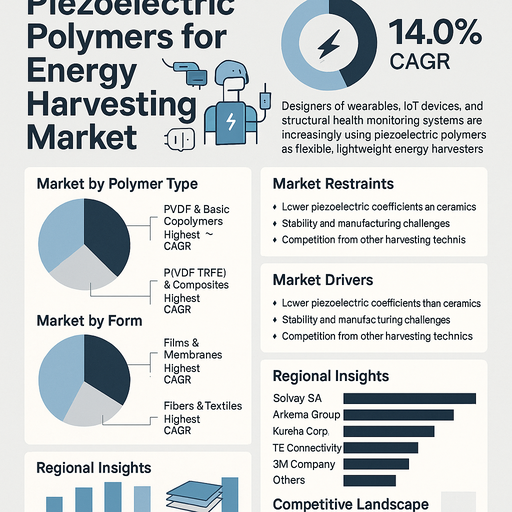
The piezoelectric polymers for energy harvesting market is growing at a 14.0% CAGR as designers of wearables, IoT devices, structural health monitoring systems, and low-power electronics look for flexible, lightweight alternatives to rigid ceramic harvesters and batteries. Piezoelectric polymers convert mechanical vibrations, motion, and pressure into electrical energy while remaining thin, bendable, and easy to integrate into films, textiles, and composite structures. Within polymer types, PVDF and basic copolymers currently generate the highest revenue because they are mature, commercially available in multiple grades, and widely used in films and simple devices, while P(VDF-TrFE) advanced copolymers and polymer-ceramic composites together are expected to post the highest CAGR as next-generation devices demand higher sensitivity, stability, and integration with advanced electronics. By form, films and membranes account for the highest revenue today due to their use in patches, sensors, and surface-mounted harvesters, whereas fibers and textiles are expected to record the highest CAGR as energy-harvesting wearables, smart garments, and flexible IoT form factors scale up.
Market Drivers
Growth is driven by the need to power distributed sensors and wireless devices without relying solely on batteries or wired connections. In smart buildings, industrial assets, and infrastructure, piezoelectric polymer harvesters can capture ambient vibrations and structural movement to power condition-monitoring nodes, reducing maintenance and battery replacement costs. Wearable and medical devices rely on lightweight, flexible materials that can conform to the body; piezoelectric polymers embedded in garments, patches, or insoles can harvest energy from motion and provide self-powered sensing for activity tracking and health monitoring. The rise of low-power electronics, energy-efficient wireless protocols, and edge computing makes it easier to run devices from the small amounts of power harvested from motion. Compared with rigid ceramic harvesters, polymer-based solutions offer easier integration with curved surfaces, lower weight, and better mechanical robustness, which suits consumer, automotive interior, and aerospace applications.
Market Restraints
Adoption is limited by lower piezoelectric coefficients of polymers compared with traditional ceramic materials, which means that achieving the same output often requires larger active areas or optimized mechanical structures. Long-term stability of piezoelectric performance under repeated bending, temperature cycling, and environmental exposure can be a concern in harsh applications. Manufacturing high-quality, highly oriented polymer films or complex fiber structures can add cost and process complexity, especially when tight tolerances are needed for consistent performance. Standardization and design guidelines for integrating piezoelectric polymers into commercial products are still evolving, so many projects remain at pilot or early deployment stages. In some use cases, competing energy-harvesting technologies such as solar, thermal, or RF may offer simpler integration or higher power densities, slowing adoption of mechanical energy harvesting where those options are available.
Market by Polymer Type
PVDF and basic copolymers form the backbone of today’s piezoelectric polymer market. They are available as films, sheets, and coatings, and are widely used in vibration harvesters, simple sensors, and low-power devices. Within polymer types, PVDF and basic copolymers currently generate the highest revenue thanks to established supply chains, proven processing routes, and broad compatibility with existing lamination, printing, and PCB-assembly processes. P(VDF-TrFE) advanced copolymers offer higher piezoelectric performance, better ferroelectric properties, and improved stability, making them attractive for more demanding energy-harvesting and sensing applications where signal strength and reliability are critical; this segment is expected to post one of the highest CAGRs as product designers shift from basic PVDF grades to more advanced formulations. Polymer-ceramic composites combine piezoelectric ceramics with polymers to balance flexibility with higher output, targeting applications that need both mechanical compliance and stronger energy signals, such as structural health monitoring and automotive components; from a small base, these composites are also expected to grow rapidly. Specialty and emerging polymers, including new ferroelectric and electroactive formulations, are at an early stage but aim to deliver higher energy density, broader temperature ranges, and better integration with specific substrates and processes, adding further growth potential as they move from lab to commercial scale.
Market by Form
Films and membranes are the most common form, used as patches, strips, or laminated layers attached to vibrating surfaces, footwear, or machinery. They are easy to process, can be patterned and poled for specific device layouts, and integrate well with electrodes and encapsulation layers; within forms, films and membranes currently generate the highest revenue. Fibers and textiles embed piezoelectric polymers in yarns, woven fabrics, or nonwovens, enabling energy-harvesting clothing, smart seats, and flexible sensor mats. As wearable electronics and soft robotics expand, fibers and textiles are expected to record the highest CAGR, driven by demand for comfortable, washable, and inconspicuous energy-harvesting and sensing elements. Bulk and composite structures incorporate piezoelectric polymers into thicker parts, layered composites, and molded shapes used in structural components, automotive interiors, and aerospace panels, often combining energy harvesting with vibration control or sensing functions. This segment grows as designers use multi-functional materials that combine structural duties with power generation and monitoring.
Regional Insights
North America and Europe lead in R&D and early commercial deployments, supported by strong innovation ecosystems in advanced materials, electronics, and smart infrastructure. These regions host many pilot projects that integrate piezoelectric polymer harvesters into industrial equipment, buildings, automotive systems, and medical devices. Asia Pacific is expected to be a high-growth region, with strong demand from consumer electronics, wearables, and large-scale manufacturing of flexible electronics in countries such as China, Japan, and South Korea. The region’s capabilities in polymer processing, film production, and electronics assembly help scale new products once designs are proven. Other regions, including the Middle East, Latin America, and emerging markets, increasingly adopt smart-city and industrial IoT solutions, creating future opportunities for energy-harvesting components as part of broader digitalization projects. Regions with strong electronics manufacturing, active wearable and medical device industries, and investment in smart infrastructure will see the fastest adoption of piezoelectric polymer energy harvesting.
Competitive Landscape
Solvay S.A., Arkema Group, and Kureha Corporation supply PVDF and advanced copolymer materials used as the base for piezoelectric films, fibers, and composite structures, leveraging experience in fluoropolymers, specialty polymers, and high-performance materials. TE Connectivity and 3M Company act as key solution providers, combining materials, interconnects, laminates, and adhesive technologies to help device manufacturers integrate piezoelectric polymer elements into sensors, patches, connectors, and flexible assemblies. Smaller and emerging players under the “Others” category include specialized film producers, device makers, and module integrators that turn base polymers into energy-harvesting elements, wearable modules, and integrated sensor–harvester units. Companies that can deliver consistent, high-polarization polymer materials, support customers with application engineering and device design, and integrate piezoelectric layers into robust, manufacturable formats are positioned to lead current revenue, while those that develop advanced P(VDF-TrFE) and composite solutions for wearables, automotive interiors, and structural health monitoring are likely to capture the highest CAGR in the piezoelectric polymers for energy harvesting market.
Historical & Forecast Period
This study report represents analysis of each segment from 2024 to 2034 considering 2025 as the base year. Compounded Annual Growth Rate (CAGR) for each of the respective segments estimated for the forecast period of 2026 to 2034.
The current report comprises of quantitative market estimations for each micro market for every geographical region and qualitative market analysis such as micro and macro environment analysis, market trends, competitive intelligence, segment analysis, porters five force model, top winning strategies, top investment markets, emerging trends and technological analysis, case studies, strategic conclusions and recommendations and other key market insights.
Research Methodology
The complete research study was conducted in three phases, namely: secondary research, primary research, and expert panel review. key data point that enables the estimation of Piezoelectric Polymers for Energy Harvesting Market By Polymer Type, By Form, By Application - Global Market Analysis & Forecast, 2025 to 2033 market are as follows:
Market forecast was performed through proprietary software that analyzes various qualitative and quantitative factors. Growth rate and CAGR were estimated through intensive secondary and primary research. Data triangulation across various data points provides accuracy across various analyzed market segments in the report. Application of both top down and bottom-up approach for validation of market estimation assures logical, methodical and mathematical consistency of the quantitative data.
| ATTRIBUTE | DETAILS |
|---|---|
| Research Period | 2024-2034 |
| Base Year | 2025 |
| Forecast Period | 2026-2034 |
| Historical Year | 2024 |
| Unit | USD Million |
| Segmentation | |
Polymer Type
|
|
Form
|
|
Application
|
|
|
Region Segment (2024-2034; US$ Million)
|
Key questions answered in this report


