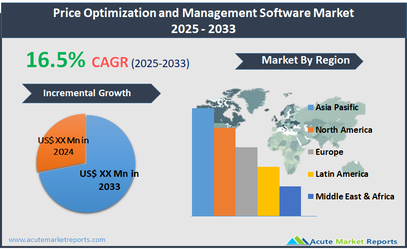
Price optimization and management software is a tool designed to help businesses determine the most effective pricing strategies for their products and services. This software utilizes data analysis, including historical sales data, competitor pricing, customer demand, and market conditions, to recommend prices that maximize revenue and profits. The software often incorporates artificial intelligence and machine learning to continuously refine and optimize pricing strategies based on real-time data inputs. It is commonly used across various industries, including retail, hospitality, tourism, and manufacturing, to dynamically adjust prices in response to market changes. The price optimization and management software market is experiencing rapid growth, with a projected Compound Annual Growth Rate (CAGR) of 16.5%. This significant growth is driven by the increasing need for businesses to adapt quickly to market conditions and consumer behavior changes, especially in highly competitive and dynamic sectors like e-commerce and retail.
Driver: Increased Need for Dynamic Pricing in Competitive Markets
The intensifying competition in retail and e-commerce has significantly driven the adoption of price optimization and management software. Businesses are under constant pressure to offer competitive prices while maintaining profitability, which is challenging in rapidly changing markets where consumer preferences shift quickly and competitors frequently adjust their pricing strategies. The ability to dynamically adjust prices in real-time using advanced software that analyzes multiple data points—such as market demand, competitor prices, and inventory levels—provides a critical advantage. For example, during high-demand periods like holidays, businesses can automatically raise prices to maximize revenue, while during slower periods, they can lower prices to attract more customers. This dynamic pricing strategy, enabled by price optimization software, helps companies stay competitive and can lead to significant increases in revenue and market share.
Opportunity: Expansion into Global Markets
As global trade barriers continue to decrease and digital marketplaces expand, there is a significant opportunity for the price optimization and management software market to grow by aiding businesses in scaling operations internationally. These tools can help companies understand and adapt to pricing strategies that vary by region and customer demographics, considering local economic conditions, average income levels, and competitive landscapes. For businesses looking to enter new markets, price optimization software can analyze local pricing data and consumer behavior to recommend optimal pricing strategies, thus reducing the risk and guesswork involved in international market entry. This capability is especially valuable for small to medium-sized enterprises (SMEs) aiming to expand globally without the extensive resources that larger corporations might possess.
Restraint: High Cost and Complexity of Implementation
One significant restraint in the price optimization and management software market is the high cost and complexity of implementation. Advanced pricing software often requires significant upfront investment in terms of both financial resources and time. Businesses must integrate the software with existing IT infrastructure, which can be complex and costly, especially for smaller businesses with limited technical expertise. Furthermore, to effectively use the software, companies must train staff and possibly hire specialists to manage and interpret the data, adding to ongoing operational costs. This investment can be prohibitive for smaller businesses or those in low-margin industries, limiting the adoption of price optimization tools despite their potential benefits.
Challenge: Balancing Pricing Strategy with Customer Perception
A critical challenge in deploying price optimization and management software is balancing effective pricing strategies with customer perception. While dynamic pricing can maximize profits, it risks alienating customers who may perceive frequent price changes as unfair or exploitative. For instance, customers might notice and react negatively if they see prices fluctuate excessively in a short period, potentially leading to decreased brand loyalty and customer trust. Managing these perceptions requires a delicate balance: businesses must leverage the analytical power of pricing software to adjust prices in a way that responds to market conditions while also maintaining transparency and fairness to preserve customer relationships. This challenge demands not only sophisticated algorithmic pricing models that consider long-term customer value but also careful communication strategies to explain pricing decisions to consumers.
Market Segmentation by Function Type
In the price optimization and management software market, segmentation by function type includes Price Analytics, Price Execution, and Price Optimization. Price Optimization holds the highest revenue share in this segment due to its critical role in determining the most profitable pricing strategies that can adapt dynamically to market changes and consumer behavior. This function uses predictive analytics and machine learning algorithms to simulate various pricing scenarios and their potential impacts on sales and profits, making it indispensable for businesses aiming to maximize their financial outcomes. On the other hand, Price Analytics is expected to witness the highest Compound Annual Growth Rate (CAGR). This growth is driven by the increasing need for detailed insights into pricing trends, competitor pricing strategies, and customer responses. Price Analytics tools provide the foundational data necessary to inform both Price Execution and Optimization strategies, helping businesses understand the why behind price changes and the effects on customer buying behavior, which is crucial for refining pricing strategies over time.
Market Segmentation by Application
Segmentation by application in the price optimization and management software market includes Retail Price Management, Buy-side Price Management, Contract Lifecycle Management, and CPQ (Configure, Price, Quote). Retail Price Management dominates in terms of revenue, as retailers constantly adjust prices in response to competitor actions, supply chain fluctuations, and changing consumer demands. Effective price management in retail not only enhances sales but also improves customer loyalty by offering the right price at the right time. Conversely, CPQ applications are anticipated to have the highest Compound Annual Growth Rate (CAGR) due to their growing importance in B2B environments where sales processes are complex and require configuration of products to customer specifications. CPQ software integrates pricing data with product configuration, allowing companies to streamline the quoting process and ensure pricing accuracy across various configurations and customer segments, thereby reducing errors and improving efficiency in sales operations.
Geographic Segment
In 2024, the price optimization and management software market saw the highest revenue generation in North America, driven by the presence of a large number of retail and e-commerce businesses actively leveraging advanced analytics and machine learning technologies to refine their pricing strategies. The region’s mature market for technology adoption, combined with a competitive business environment, necessitates sophisticated pricing tools to optimize revenue and profit margins. Meanwhile, Asia-Pacific is expected to experience the highest Compound Annual Growth Rate (CAGR) from 2025 to 2033. This growth is anticipated due to the rapid expansion of digital marketplaces and an increase in competition among businesses in countries like China, India, and Southeast Asia, which are becoming increasingly tech-savvy. As these markets continue to develop, there will be a significant rise in demand for tools that can dynamically adjust prices in response to fast-changing consumer preferences and market conditions.
Competitive Trends
In 2024, the competitive landscape of the price optimization and management software market featured a dynamic mix of established players and emerging challengers, including Competera Limited, Flintfox International Limited, Feedvisor LTD., Iris Pricing Solutions, Kloudrac, KBMax, McKinsey & Company (Periscope), Omnia Retail, PriceBeam Ltd., PROS Holdings, Pricefx, Prisync, RoomPriceGenie AG, SPOSEA B.V., Syncron AB, Vendavo, Inc., Vistaar Technologies, Inc., Vistex, and Zilliant. These companies focused on enhancing their product offerings through advanced AI capabilities, aiming to provide more accurate and real-time pricing decisions. They also emphasized expanding their global footprint by entering new markets and strengthening their presence in existing ones through strategic partnerships and acquisitions. The key strategies deployed involved integrating deeper analytics and predictive tools within their software to cater to diverse industries such as retail, manufacturing, and services, where pricing can be a critical lever for competitive advantage. From 2025 to 2033, these players are expected to focus on innovation in AI and machine learning technologies to further refine pricing models that can adapt to global economic changes and shifting market dynamics. Moreover, they will likely enhance their cloud-based solutions to offer more scalable and accessible services to small and medium-sized enterprises globally. The strategic expansion into emerging markets, coupled with continuous investment in technology, will be crucial for maintaining competitive edge and capturing growth in the rapidly evolving price optimization and management software market.
Historical & Forecast Period
This study report represents analysis of each segment from 2024 to 2034 considering 2025 as the base year. Compounded Annual Growth Rate (CAGR) for each of the respective segments estimated for the forecast period of 2026 to 2034.
The current report comprises of quantitative market estimations for each micro market for every geographical region and qualitative market analysis such as micro and macro environment analysis, market trends, competitive intelligence, segment analysis, porters five force model, top winning strategies, top investment markets, emerging trends and technological analysis, case studies, strategic conclusions and recommendations and other key market insights.
Research Methodology
The complete research study was conducted in three phases, namely: secondary research, primary research, and expert panel review. key data point that enables the estimation of Price Optimization and Management Software market are as follows:
Market forecast was performed through proprietary software that analyzes various qualitative and quantitative factors. Growth rate and CAGR were estimated through intensive secondary and primary research. Data triangulation across various data points provides accuracy across various analyzed market segments in the report. Application of both top down and bottom-up approach for validation of market estimation assures logical, methodical and mathematical consistency of the quantitative data.
| ATTRIBUTE | DETAILS |
|---|---|
| Research Period | 2024-2034 |
| Base Year | 2025 |
| Forecast Period | 2026-2034 |
| Historical Year | 2024 |
| Unit | USD Million |
| Segmentation | |
Function Type
|
|
Application
|
|
Enterprise Size
|
|
Industry
|
|
|
Region Segment (2024-2034; US$ Million)
|
Key questions answered in this report