
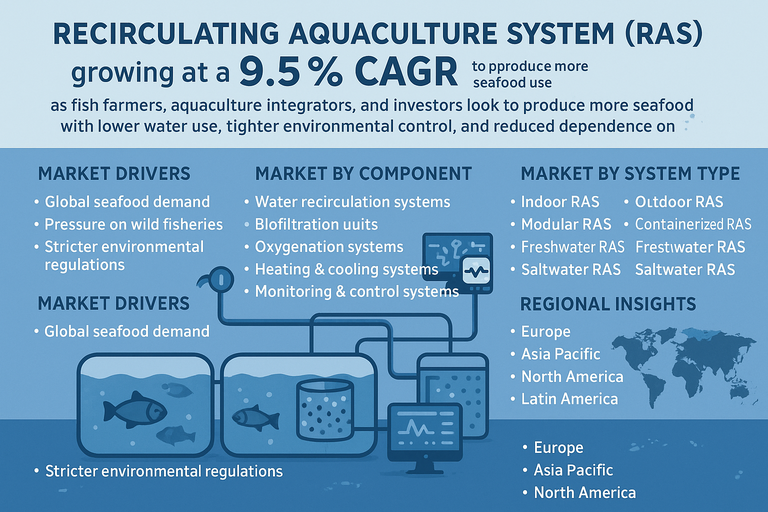
The recirculating aquaculture system (RAS) market is growing at a 9.5% CAGR as fish farmers, aquaculture integrators, and investors look to produce more seafood with lower water use, tighter environmental control, and reduced dependence on coastal sites. RAS enables fish and shrimp production in closed-loop systems where water is continuously treated and reused, supporting land-based and urban aquaculture, stable year-round output, and proximity to consumption centers. Within components, water recirculation systems and biofiltration units generate the highest revenue because they form the core of every RAS facility and represent significant upfront investment, while monitoring and control systems, software, and services are expected to post the highest CAGR as operators focus on automation, real-time optimization, and performance guarantees. By system type, indoor RAS and freshwater RAS represent the largest installed base due to their use in salmon smolt, trout, tilapia, and other finfish, whereas modular, containerized, hybrid, and integrated systems are expected to record the highest CAGR as smaller farms, new species projects, and distributed production models expand.
Market Drivers
Growth is driven by rising global seafood demand, pressure on wild fisheries, and stricter environmental regulations on traditional aquaculture. RAS allows producers to locate farms closer to major markets, lowering transport costs and providing fresher product while reducing exposure to sea lice, harmful algal blooms, and pollution that affect open-net pens and ponds. Closed-loop systems drastically cut water intake and effluent discharge, helping projects comply with discharge limits and water-scarcity constraints and supporting sustainability and ESG objectives. The ability to control temperature, oxygen levels, stocking density, and biosecurity leads to faster growth cycles, lower mortality, and more predictable production, which appeals to investors and retailers looking for reliable supply. Urban and landlocked regions increasingly use RAS for salmon, trout, bass, shrimp, and high-value species, creating new local aquaculture industries. Advancements in pumps, filtration, oxygenation, sensors, and automation, along with falling costs for data analytics and control systems, support better economics and scale-up of large commercial RAS facilities.
Market Restraints
The market faces constraints from high capital and operating costs, technical complexity, and energy use. RAS projects require significant upfront investment in tanks, recirculation systems, biofilters, oxygenation, and automation hardware, which can be difficult to finance without long-term offtake agreements or strong balance sheets. Energy consumption for pumping, aeration, heating and cooling, and oxygenation can be substantial, especially in regions with high electricity prices or large temperature differences between ambient conditions and optimal fish-growing temperatures. Designing and operating RAS facilities demands specialized expertise in water chemistry, biology, engineering, and control systems; shortages of experienced personnel increase operational risk and limit the pace of new project development. Biological risks such as disease outbreaks, biofilter failure, or water quality excursions can have concentrated impact because production is intensive and contained. Regulatory frameworks for land-based aquaculture, water use, discharge, and building codes can be complex and vary by region, stretching project timelines. Competition from traditional coastal aquaculture and offshore systems remains strong in some species and regions where environmental conditions and regulations are more favorable.
Market by Component
Water recirculation systems, including pumps, piping, valves, and hydraulic design, form the backbone of RAS facilities, moving water between tanks, filtration stages, and oxygenation units. This component segment accounts for a major share of capital expenditure and revenue because every facility depends on reliable recirculation to maintain stable conditions and protect animal health. Biofiltration units, which host nitrifying bacteria to convert toxic ammonia and nitrite into less harmful nitrate, are critical for maintaining water quality; demand for compact, high-capacity biofilters grows alongside larger facilities and higher stocking densities. Oxygenation systems, such as oxygen cones, diffusers, and injection systems, ensure adequate dissolved oxygen and are particularly important in high-density finfish and salmonid systems. Heating and cooling systems, including heat exchangers and temperature control units, allow producers to maintain optimal growth temperatures across seasons and locations; their importance is rising in both cold and hot climates and in species with narrow thermal windows. Monitoring and control systems integrate sensors for oxygen, pH, temperature, turbidity, and other parameters with PLCs, SCADA platforms, and control algorithms, enabling real-time management, alarms, and automatic adjustments; this segment is expected to see strong growth as farms digitalize operations. Equipment, including tanks, aerators, feeders, and clarifiers, represents a broad and steady revenue segment as both new builds and retrofit projects require hardware. Software for real-time monitoring and analytics adds a higher-margin layer, providing dashboards, performance modeling, predictive maintenance, and decision support that can improve feed conversion, growth rates, and system stability. Services, including consulting, design, project management, commissioning, training, and ongoing maintenance, are increasingly important as investors seek turnkey solutions and knowledge transfer; this service segment is expected to post one of the highest CAGRs as more clients rely on full-lifecycle support from specialized RAS providers.
Market by System Type
Indoor RAS systems place tanks and treatment units in controlled buildings, allowing tight management of temperature, light, and biosecurity; these systems dominate high-value salmon smolt, trout, and specialty species projects in regions with variable climates. Outdoor RAS systems use partially enclosed or sheltered installations where climate is milder or where cost considerations favor simpler structures; they are often combined with robust filtration and weather-resistant equipment. Modular RAS designs use standardized tank and treatment modules that can be replicated and scaled, reducing design time and enabling phased capacity expansion; modular systems are attractive for growing producers and investors who prefer stepwise investment. Containerized RAS packages integrate tanks, filters, and controls into transportable units, supporting pilot projects, demonstration farms, research facilities, and small-scale production near markets or in remote locations. Freshwater RAS is widely used for salmon smolt, trout, tilapia, catfish, and other finfish, while saltwater RAS enables post-smolt and grow-out phases for marine species and supports integrated operations that combine freshwater and seawater loops. Hybrid RAS combines recirculation with partial flow-through or the use of external water bodies to balance capital costs, energy use, and water quality in certain climates and regulatory environments. Integrated systems connect RAS with other processes such as aquaponics, bioenergy production, or waste treatment, using nutrients and waste streams more efficiently. Specialized systems are designed for niche species, broodstock management, hatcheries, and research centers, tailoring system layouts, salinity, and treatment trains to specific biological requirements. Modular, containerized, integrated, and specialized systems together are expected to post the highest CAGR as operators explore new species, regions, and business models.
Regional Insights
Europe and North America lead early commercial adoption of RAS for salmon, trout, and high-value finfish, supported by strong seafood demand, mature retail channels, and strict environmental standards that favor closed or semi-closed systems. Nordic countries have built significant experience with smolt and post-smolt RAS facilities, while land-based salmon projects in North America and parts of Europe aim to bring full grow-out closer to key markets. Asia Pacific is expected to be one of the fastest-growing regions, driven by rising seafood consumption, urbanization, and interest in localized production of premium species in countries such as China, Japan, South Korea, and Australia. The region also benefits from strong manufacturing capacity for pumps, tanks, filtration equipment, and controls, which supports more cost-effective system deployment. In Latin America, RAS is gaining ground for smolt production, hatcheries, and niche species in countries with established aquaculture industries and export markets. The Middle East and parts of Africa are exploring RAS to produce fish in arid climates and water-scarce regions, using land-based systems to improve food security and reduce dependence on imports. Regions with supportive policies for sustainable aquaculture, reliable power and water infrastructure, and access to technical expertise are likely to see faster RAS adoption.
Competitive Landscape
AKVA Group is a major global aquaculture technology provider, offering complete land-based RAS solutions, feeding systems, digital monitoring platforms, and service support; its portfolio covers design, equipment, and lifecycle services for salmon and other species. Aquacare Environment, Clewer Aquaculture, Eyvi, FRD Japan, Hesy Aquaculture, Nofitech, PR Aqua, Qingdao Haixing, and RADAQUA operate as specialized engineering and system suppliers, delivering tailored RAS designs, biofiltration solutions, and water treatment lines for different scales and species. AquaMaof focuses on integrated, turnkey RAS solutions for land-based fish farming, combining proprietary technology, engineering, and project development to support commercial-scale salmon, grouper, and other species in diverse climates. Blue Planet Ecosystems works on automated, vertically integrated aquaculture systems that leverage ecological design and automation to reduce manual input and environmental impact. Skretting and Xylem play important roles as solution partners: Skretting supplies feed and nutrition programs optimized for RAS conditions, while Xylem provides pumps, filtration, and water treatment equipment central to recirculation and oxygenation.
Historical & Forecast Period
This study report represents analysis of each segment from 2024 to 2034 considering 2025 as the base year. Compounded Annual Growth Rate (CAGR) for each of the respective segments estimated for the forecast period of 2026 to 2034.
The current report comprises of quantitative market estimations for each micro market for every geographical region and qualitative market analysis such as micro and macro environment analysis, market trends, competitive intelligence, segment analysis, porters five force model, top winning strategies, top investment markets, emerging trends and technological analysis, case studies, strategic conclusions and recommendations and other key market insights.
Research Methodology
The complete research study was conducted in three phases, namely: secondary research, primary research, and expert panel review. key data point that enables the estimation of Recirculating Aquaculture System Market By Component, By System Type, By Scale of Operation, By Species, By Application, By End Use, By Distribution Channel - Global Market Analysis & Forecast, 2025 to 2033 market are as follows:
Market forecast was performed through proprietary software that analyzes various qualitative and quantitative factors. Growth rate and CAGR were estimated through intensive secondary and primary research. Data triangulation across various data points provides accuracy across various analyzed market segments in the report. Application of both top down and bottom-up approach for validation of market estimation assures logical, methodical and mathematical consistency of the quantitative data.
| ATTRIBUTE | DETAILS |
|---|---|
| Research Period | 2024-2034 |
| Base Year | 2025 |
| Forecast Period | 2026-2034 |
| Historical Year | 2024 |
| Unit | USD Million |
| Segmentation | |
Component
|
|
System Type
|
|
Scale of Operation
|
|
Species
|
|
Application
|
|
Distribution Channel
|
|
|
Region Segment (2024-2034; US$ Million)
|
Key questions answered in this report


