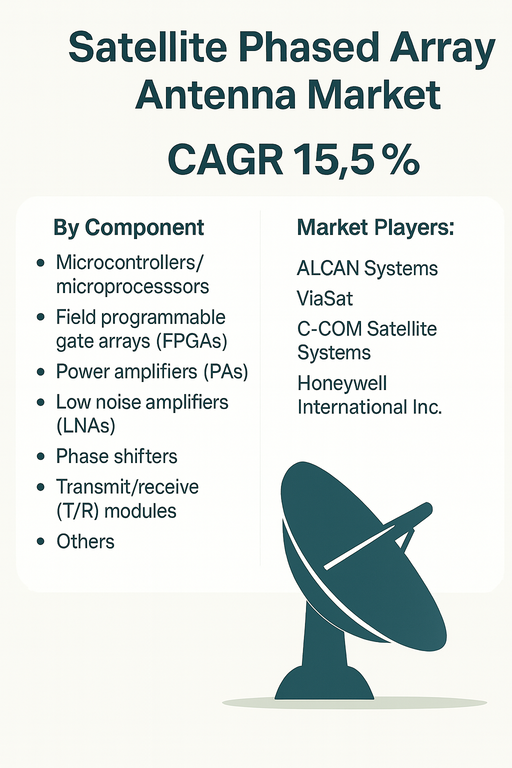
The satellite phased array antenna market is expected to grow at a CAGR of 15.5% during the forecast period of 2026 to 2034. This market is witnessing significant demand growth owing to the rising need for reliable, high-speed satellite communication across aerospace, defense, and commercial applications. Satellite phased array antennas offer superior beamforming capabilities, faster electronic steering, and multi-beam functionalities, making them essential in modern satellite communications. The miniaturization of electronics and increased satellite deployment are expected to accelerate adoption rates across end-user sectors.
Market Drivers
Advancements in Satellite Communication Systems
The increasing reliance on satellite systems for global broadband connectivity, especially in remote and underserved areas, is a key driver. Phased array antennas facilitate beam agility and tracking of multiple satellites, which is critical for low earth orbit (LEO) constellations and high-throughput satellites. These antennas enable real-time reconfiguration without mechanical components, increasing reliability and reducing operational latency.
Military and Defense Modernization Programs
Defense agencies worldwide are rapidly adopting satellite phased array antennas to enhance secure communication, reconnaissance, and electronic warfare capabilities. Countries such as the U.S., China, and members of the EU are significantly investing in satellite modernization programs, which is expected to create robust demand for advanced phased array systems with enhanced tracking and jamming resistance.
Growing Demand for Connected Mobility
The expansion of satellite internet for mobile platforms, including maritime, aerospace, and land transportation, is fostering demand for compact and high-performance phased array antennas. These solutions enable seamless broadband connectivity for commercial airlines, ships, and vehicles in motion, contributing to broader adoption across mobile end-users.
Market Restraint
High Development and Deployment Costs
One of the key restraints in the market is the high initial cost associated with the R&D, fabrication, and integration of phased array systems. The use of specialized semiconductors, heat dissipation systems, and software-defined beam control increases overall system cost, potentially limiting adoption in cost-sensitive sectors and developing markets.
Market Segmentation by Component
The Component segment includes Microcontrollers/Microprocessors, FPGAs, Power Amplifiers (PAs), Low Noise Amplifiers (LNAs), Phase Shifters, Transmit/Receive (T/R) Modules, and Others. Among these, Transmit/Receive (T/R) Modules accounted for the highest revenue in 2025 due to their central role in active electronically scanned arrays (AESA). These modules enable real-time signal processing and beam steering, making them indispensable in both defense and commercial systems. On the other hand, Phase Shifters are expected to register the highest CAGR during 2026–2034, driven by advancements in silicon-based materials and the growing need for precision electronic beamforming in LEO and GEO satellite systems.
Market Segmentation by Array Type
The Array Type segment is divided into Active Phased Array and Passive Phased Array. Active Phased Arrays dominated the market revenue in 2025 owing to their higher performance, dynamic beam control, and adaptability to real-time communication conditions. These arrays are widely adopted in aerospace and defense applications requiring high throughput and multiple beam tracking. Meanwhile, Passive Phased Arrays are expected to grow at a steady CAGR due to their cost-effectiveness and use in less complex communication systems, particularly in earth observation and telemetry.
Geographic Trends
The Asia Pacific region led the Satellite Phased Array Antenna Market in terms of revenue in 2025, fueled by extensive satellite programs in China, India, and Japan. The region also exhibits the highest forecast CAGR from 2026 to 2034, driven by increasing demand for satellite broadband, national defense upgrades, and investments in 5G backhaul via satellite. North America followed closely, backed by aggressive deployment of LEO constellations by companies such as SpaceX and Amazon’s Project Kuiper. Europe is also witnessing accelerated growth due to defense collaborations and EU-sponsored satellite communication initiatives.
Competitive Trends
Leading players in the Satellite Phased Array Antenna Market include ALCAN Systems, ViaSat, C-COM Satellite Systems, Honeywell International Inc., and Boeing. These companies collectively focused on technological innovation, software-defined antennas, and miniaturization of phased arrays in 2025. Over the 2026 to 2034 period, they are expected to enhance their portfolios by developing dual-frequency and reconfigurable antennas for both commercial and military use. Strategies such as forming satellite broadband partnerships, securing defense contracts, and investing in next-gen semiconductor technologies are anticipated to be pivotal for gaining competitive edge. M&A activity aimed at vertically integrating antenna production and communication hardware is also likely to shape the industry landscape.
Historical & Forecast Period
This study report represents analysis of each segment from 2024 to 2034 considering 2025 as the base year. Compounded Annual Growth Rate (CAGR) for each of the respective segments estimated for the forecast period of 2026 to 2034.
The current report comprises of quantitative market estimations for each micro market for every geographical region and qualitative market analysis such as micro and macro environment analysis, market trends, competitive intelligence, segment analysis, porters five force model, top winning strategies, top investment markets, emerging trends and technological analysis, case studies, strategic conclusions and recommendations and other key market insights.
Research Methodology
The complete research study was conducted in three phases, namely: secondary research, primary research, and expert panel review. key data point that enables the estimation of Satellite Phased Array Antenna market are as follows:
Market forecast was performed through proprietary software that analyzes various qualitative and quantitative factors. Growth rate and CAGR were estimated through intensive secondary and primary research. Data triangulation across various data points provides accuracy across various analyzed market segments in the report. Application of both top down and bottom-up approach for validation of market estimation assures logical, methodical and mathematical consistency of the quantitative data.
| ATTRIBUTE | DETAILS |
|---|---|
| Research Period | 2024-2034 |
| Base Year | 2025 |
| Forecast Period | 2026-2034 |
| Historical Year | 2024 |
| Unit | USD Million |
| Segmentation | |
Component
|
|
Array Type
|
|
Application
|
|
End Use
|
|
|
Region Segment (2024-2034; US$ Million)
|
Key questions answered in this report