
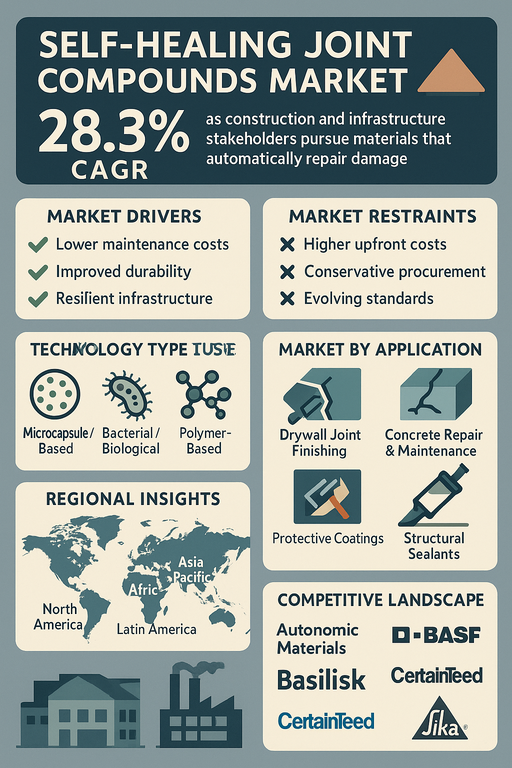
The self-healing joint compounds market is growing at a 28.3% CAGR as construction and infrastructure stakeholders look for materials that can automatically repair microcracks, reduce maintenance cycles, and extend service life in drywall, concrete, coatings, and sealant systems. Self-healing joint compounds use embedded microcapsules, biological agents, tailored polymer chemistries, or vascular networks to release healing agents or trigger intrinsic repair when damage occurs. This supports performance-based specifications in both residential and commercial buildings, as well as in infrastructure upgrades. By technology type, microcapsule-based systems currently generate the highest revenue because they are the most mature and relatively easier to integrate into existing joint compound and coating formulations, while bacterial/biological systems and advanced polymer-based intrinsic healing technologies are expected to post the highest CAGR as they move from pilot to commercial scale. By application, drywall joint finishing and concrete repair and maintenance account for the highest revenue, whereas protective coatings and structural sealants are expected to record the highest CAGR as asset owners focus more on lifecycle cost, durability, and reduced downtime.
Market Drivers
Growth is driven by the need to lower maintenance costs, minimize cracking and aesthetic defects, and improve durability in buildings and infrastructure. Traditional joint compounds and repair materials can crack under thermal movement, vibration, shrinkage, or minor structural shifts, leading to repeated patching, repainting, and customer complaints. Self-healing systems help close microcracks automatically or reduce crack propagation, which cuts labor and material costs over the life of a building or structure. Tighter performance standards, green building certifications, and lifecycle-based procurement are also supporting the shift toward advanced materials that offer extended service intervals and better moisture and crack resistance. In concrete repair and maintenance, self-healing solutions are attractive for bridges, tunnels, parking structures, and industrial facilities where access is difficult and downtime is expensive. Rising urbanization, renovation of aging building stock, and the push for more resilient infrastructure all support market expansion. The growing use of digital design and performance-based specifications makes it easier for self-healing technologies to be evaluated and specified based on measurable benefits like reduced crack width and longer time between repairs.
Market Restraints
Adoption is restrained by higher upfront costs, limited field experience, and conservative procurement practices in construction. Self-healing joint compounds and related systems often carry price premiums over standard materials, and the benefits are mainly visible over the medium to long term rather than at installation. Many contractors and building owners are cautious about new chemistries and healing mechanisms, especially if they fear changes to workability, drying time, sanding performance, or compatibility with paints and finishes. Standard test methods and codes for self-healing behavior are still evolving, which makes it harder to compare products and specify minimum performance levels. In some projects, value engineering decisions push back toward conventional joint compounds or repair mortars, especially where short-term budgets dominate. There is also a need for training and clear installation guidelines so that contractors apply self-healing products correctly and understand where they add value. The biological and vascular systems segments face additional regulatory and technical questions about long-term stability, environmental interaction, and manufacturing complexity, which can slow their move to high-volume commercial use.
Market by Technology Type
Microcapsule-based systems use tiny capsules filled with healing agents embedded in the joint compound matrix. When cracks form, the capsules rupture and release resins, adhesives, or mineralizing agents that fill and seal the damaged area. These systems are closest to traditional formulations from a processing point of view and can be adapted to drywall joint compounds, repair mortars, or coatings, which is why they currently generate the highest revenue. Bacterial/biological systems use selected microorganisms or biological agents that can precipitate minerals or form binding phases when water and nutrients are present, helping to seal microcracks in concrete or cementitious joint compounds; this segment is expected to record one of the highest CAGRs as confidence grows in biological self-healing for infrastructure. Polymer-based intrinsic healing systems rely on reversible chemical bonds or specific polymer architectures that can re-form after damage when triggered by stress, temperature, or other stimuli. These systems are attractive for joint compounds, sealants, and coatings where flexibility and repeated healing cycles are required and are expected to post strong growth as more commercial formulations become available. Vascular network systems incorporate channels or networks that deliver healing agents to damaged zones, similar to capillaries; while more complex to design and manufacture, they offer potential for multiple healing events and are being explored for high-value structural applications and specialized sealant and coating systems.
Market by Application
Drywall joint finishing is a key application where self-healing joint compounds can help reduce visible cracking along joints, corners, and screw heads, improving aesthetic performance and lowering call-backs in residential and commercial interiors. Formulators focus on balancing healing capability with smooth application, sanding, and compatibility with paints and textures, making this segment a major revenue driver. Concrete repair and maintenance uses self-healing compounds and repair mortars to manage microcracking in structural and non-structural elements. In this segment, the main benefits are lower maintenance frequency, better protection of reinforcement, and reduced ingress of water and chlorides, especially in bridges, parking garages, tunnels, and industrial floors. Protective coatings, including elastomeric and high-build coatings for facades, decks, and infrastructure, represent a fast-growing application, as self-healing features can help maintain barrier integrity and appearance after minor damage, thus extending repainting cycles. Structural sealants, used in expansion joints, curtain walls, and movement joints, are another high-growth area, since self-healing chemistries can help seal microcracks and maintain performance in dynamic joints subject to thermal movement and vibration. Protective coatings and structural sealants are expected to show the highest CAGR, supported by demand in high-performance building envelopes and infrastructure with strict durability and warranty requirements.
Regional Insights
North America and Europe lead early adoption of self-healing joint compounds due to higher awareness of advanced construction materials, strong renovation activity, and regulatory emphasis on durability and energy-efficient building envelopes. In these regions, premium drywall systems, high-performance coatings, and concrete repair solutions are often used in commercial buildings, infrastructure, and large residential projects, creating space for self-healing features to be showcased in specifications. Europe’s aging infrastructure and focus on sustainability provides additional opportunities for self-healing concrete and joint systems. Asia Pacific is expected to be the fastest-growing region as construction volumes remain high in China, India, Southeast Asia, and other emerging economies, and as demand increases for premium interior finishes and longer-lasting infrastructure. Large commercial and transport projects in Asia Pacific offer early opportunities for concrete repair and protective coating applications with self-healing behavior. Latin America and the Middle East & Africa offer growing opportunities in infrastructure, industrial projects, and high-end real estate where owners are starting to look beyond basic materials toward solutions that lower lifecycle maintenance costs. Regions with strong presence of global construction chemical suppliers, active standard-setting bodies, and growing interest in performance-based specifications will see faster adoption of self-healing joint compounds.
Competitive Landscape
Applied Nanotech Holdings, Inc. and Autonomic Materials, Inc. focus on advanced self-healing technologies, including microcapsule-based and nanotechnology-enabled systems that can be integrated into coatings, sealants, and joint compounds. BASF SE and Sika AG bring strong experience in construction chemicals and repair materials, working to embed self-healing chemistries into concrete repair systems, grouts, and joint products as part of broader performance portfolios. Basilisk Concrete specializes in biological self-healing technologies for concrete and mortar, offering solutions that can be adapted to repair applications and joint systems in cementitious substrates. DuPont de Nemours, Inc. and ITW Performance Polymers contribute polymer and adhesive expertise, supporting intrinsic healing and high-performance sealant formulations. CertainTeed Gypsum, National Gypsum Company, and United States Gypsum Company (USG) are key players in drywall and gypsum-based joint compounds, and are well positioned to incorporate self-healing mechanisms into next-generation interior finishing systems as demand builds.
Historical & Forecast Period
This study report represents analysis of each segment from 2024 to 2034 considering 2025 as the base year. Compounded Annual Growth Rate (CAGR) for each of the respective segments estimated for the forecast period of 2026 to 2034.
The current report comprises of quantitative market estimations for each micro market for every geographical region and qualitative market analysis such as micro and macro environment analysis, market trends, competitive intelligence, segment analysis, porters five force model, top winning strategies, top investment markets, emerging trends and technological analysis, case studies, strategic conclusions and recommendations and other key market insights.
Research Methodology
The complete research study was conducted in three phases, namely: secondary research, primary research, and expert panel review. key data point that enables the estimation of Self-Healing Joint Compounds Market By Technology Type, By Application, By End Use - Global Market Analysis & Forecast, 2025 to 2033 market are as follows:
Market forecast was performed through proprietary software that analyzes various qualitative and quantitative factors. Growth rate and CAGR were estimated through intensive secondary and primary research. Data triangulation across various data points provides accuracy across various analyzed market segments in the report. Application of both top down and bottom-up approach for validation of market estimation assures logical, methodical and mathematical consistency of the quantitative data.
| ATTRIBUTE | DETAILS |
|---|---|
| Research Period | 2024-2034 |
| Base Year | 2025 |
| Forecast Period | 2026-2034 |
| Historical Year | 2024 |
| Unit | USD Million |
| Segmentation | |
Technology Type
|
|
Application
|
|
End Use Industry
|
|
|
Region Segment (2024-2034; US$ Million)
|
Key questions answered in this report


