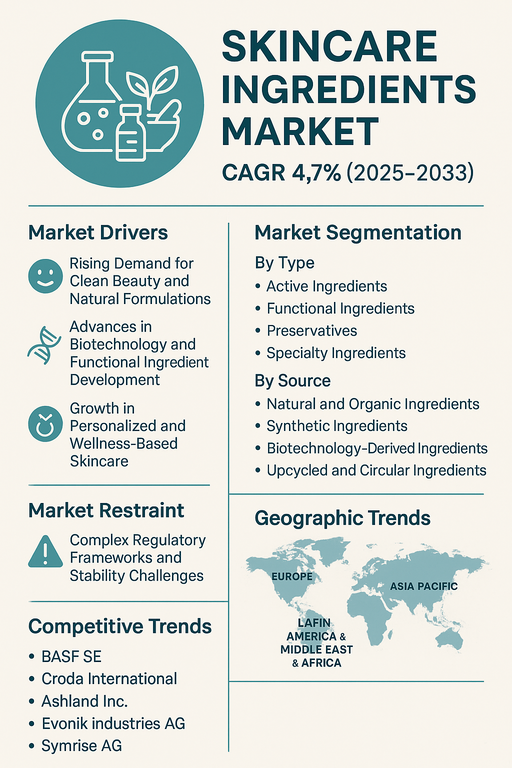
The global skincare ingredients market is projected to grow at a CAGR of 4.7% from 2026 to 2034, driven by rising consumer interest in clean beauty, natural formulations, and functional efficacy in skincare products. Skincare ingredients form the core of cosmetic formulations and are tailored to deliver hydration, anti-aging, UV protection, skin repair, and overall skin health. Innovations in biotechnology, coupled with sustainability-focused ingredient sourcing, are further transforming the landscape of skincare formulation across both premium and mass-market segments.
Market Drivers
Rising Demand for Clean Beauty and Natural Formulations
Increasing awareness about the impact of synthetic chemicals on skin and the environment is boosting demand for natural, organic, and vegan skincare ingredients. Consumers, especially in North America and Europe, are seeking transparency in product labels and opting for brands that use ethically sourced and minimally processed ingredients.
Advances in Biotechnology and Functional Ingredient Development
Biotechnology-derived actives, such as peptides, probiotics, and plant stem cells, are gaining traction due to their targeted efficacy in skin repair, aging, pigmentation, and barrier function. Brands are investing in research-driven ingredient portfolios to deliver measurable skin benefits while complying with evolving safety and performance standards.
Growth in Personalized and Wellness-Based Skincare
The trend toward personalized skincare routines is pushing manufacturers to develop specialty and functional ingredients that cater to individual skin types and conditions. Wellness-driven consumers are increasingly choosing multifunctional skincare solutions infused with botanical actives, vitamins, and adaptogens.
Market Restraint
Complex Regulatory Frameworks and Stability Challenges
The skincare ingredient market is subject to stringent regulations and testing protocols related to safety, efficacy, and environmental impact. Formulators face difficulties in maintaining product stability, compatibility, and shelf life when incorporating novel or upcycled ingredients. Additionally, natural ingredients often suffer from supply inconsistencies and price volatility.
Market Segmentation by Type
The market is segmented into Active Ingredients, Functional Ingredients, Preservatives, and Specialty Ingredients. In 2025, active ingredients dominated the market due to their skin-targeting properties (e.g., anti-aging, brightening, acne control). Functional ingredients such as emollients, humectants, and surfactants held the second-largest share, providing essential formulation support. Specialty ingredients are projected to grow rapidly due to increased innovation in premium and dermatology-backed skincare lines.
Market Segmentation by Source
By source, the market includes Natural and Organic Ingredients, Synthetic Ingredients, Biotechnology-Derived Ingredients, and Upcycled and Circular Ingredients. Natural and organic ingredients held the largest share in 2025, supported by rising clean-label awareness. However, biotechnology-derived ingredients are expected to register the highest CAGR through 2034 due to their precision-targeted effects and scalability. Upcycled ingredients derived from food and agricultural by-products are also gaining attention for their sustainability and waste-reduction value.
Geographic Trends
In 2025, Europe held the largest market share, underpinned by strong regulatory frameworks (e.g., REACH, COSMOS) and consumer inclination toward natural, ethical skincare. North America followed, driven by demand for dermocosmetics and high-performance ingredients. Asia Pacific is projected to register the highest CAGR through 2034, with strong manufacturing capabilities and rising demand for functional skincare in China, Japan, South Korea, and India. Latin America and the Middle East & Africa are emerging regions, supported by expanding cosmetic manufacturing and increasing beauty-conscious middle-class populations.
Competitive Trends
The skincare ingredients market in 2025 was led by chemical and specialty ingredient giants with extensive R&D and global reach. BASF SE maintained leadership in synthetic and biotech-derived actives with a broad portfolio supporting anti-aging, UV protection, and skin hydration. Croda International emphasized sustainable and plant-based ingredient innovations, catering to clean beauty brands. Ashland Inc. developed functional ingredients and bioactives focused on skin firmness, moisturization, and microbiome health. Evonik Industries AG invested in biotech-based peptides, emulsifiers, and smart delivery systems for advanced skincare. Symrise AG focused on natural actives and fragrance-ingredient hybrids to support premium skincare lines. The market continues to see investments in bio-fermentation, AI-led ingredient discovery, and transparent supply chains to align with evolving consumer preferences and regulatory compliance.
Historical & Forecast Period
This study report represents analysis of each segment from 2024 to 2034 considering 2025 as the base year. Compounded Annual Growth Rate (CAGR) for each of the respective segments estimated for the forecast period of 2026 to 2034.
The current report comprises of quantitative market estimations for each micro market for every geographical region and qualitative market analysis such as micro and macro environment analysis, market trends, competitive intelligence, segment analysis, porters five force model, top winning strategies, top investment markets, emerging trends and technological analysis, case studies, strategic conclusions and recommendations and other key market insights.
Research Methodology
The complete research study was conducted in three phases, namely: secondary research, primary research, and expert panel review. key data point that enables the estimation of Skincare Ingredients market are as follows:
Market forecast was performed through proprietary software that analyzes various qualitative and quantitative factors. Growth rate and CAGR were estimated through intensive secondary and primary research. Data triangulation across various data points provides accuracy across various analyzed market segments in the report. Application of both top down and bottom-up approach for validation of market estimation assures logical, methodical and mathematical consistency of the quantitative data.
| ATTRIBUTE | DETAILS |
|---|---|
| Research Period | 2024-2034 |
| Base Year | 2025 |
| Forecast Period | 2026-2034 |
| Historical Year | 2024 |
| Unit | USD Million |
| Segmentation | |
Type
|
|
Source
|
|
Application
|
|
Distribution Channel
|
|
|
Region Segment (2024-2034; US$ Million)
|
Key questions answered in this report