
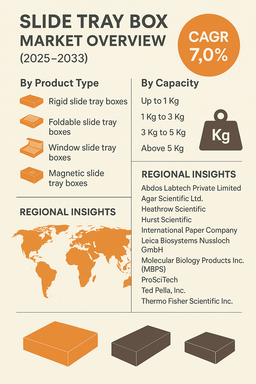
The global slide tray box market is projected to grow at a CAGR of 7.0% between 2026 and 2034, supported by rising demand across laboratory research, pathology, pharmaceuticals, and packaging applications. Slide tray boxes are widely used for the secure storage, transportation, and organization of microscope slides and other sensitive materials. Their utility in research institutions, hospitals, and biotech laboratories is expanding alongside growing investments in life sciences and diagnostic testing. The market is also witnessing increased adoption in premium packaging for consumer goods, where custom-designed slide tray boxes are valued for their durability and aesthetic appeal.
Rising Demand from Life Sciences and Packaging Applications
Growth in the slide tray box market is closely linked to the expansion of the life sciences industry, where research and diagnostics require reliable slide handling and storage solutions. Hospitals and laboratories are investing in higher-quality tray boxes to ensure safety, minimize contamination risks, and improve efficiency in slide management. At the same time, consumer product manufacturers are increasingly using innovative slide tray packaging for premium items such as electronics, jewelry, and luxury goods. Demand is further reinforced by sustainability trends, where paper- and fiber-based tray boxes are replacing plastic alternatives in packaging applications.
Challenges: Costs, Customization, and Standardization
The market faces challenges such as higher costs associated with premium tray box materials and custom manufacturing. While rigid and magnetic slide tray boxes cater to high-end applications, their elevated costs limit penetration in price-sensitive markets. Limited awareness and lack of standardization in slide tray designs also create inefficiencies in laboratory operations, especially when compatibility across different equipment is required. Despite these barriers, innovations in biodegradable materials, increased focus on lightweight yet durable designs, and wider availability through digital sales channels are expected to offset limitations and expand adoption over the forecast period.
Market Segmentation by Product Type
By product type, the market is segmented into rigid slide tray boxes, foldable slide tray boxes, window slide tray boxes, and magnetic slide tray boxes. Rigid slide tray boxes dominate due to their strength, long shelf life, and suitability for laboratory use. Foldable slide tray boxes are growing in demand for their storage efficiency and cost-effectiveness, especially in shipping applications. Window slide tray boxes are preferred in premium consumer packaging for visibility and aesthetic appeal. Magnetic slide tray boxes occupy a niche, providing secure closure systems for delicate or high-value samples and products.
Market Segmentation by Capacity
By capacity, the market is divided into up to 1 Kg, 1 Kg to 3 Kg, 3 Kg to 5 Kg, and above 5 Kg. Small-capacity boxes (up to 1 Kg) are widely used in laboratories and research centers for handling microscope slides and small components. Medium capacities (1 Kg to 3 Kg and 3 Kg to 5 Kg) serve broader research and packaging needs, striking a balance between durability and handling convenience. Large-capacity slide tray boxes (above 5 Kg) are gaining popularity for bulk storage and specialized applications in both laboratory and consumer goods industries.
Regional Insights
In 2025, North America led the global slide tray box market due to strong investments in life sciences research, well-established diagnostic infrastructure, and leading packaging innovations. Europe followed, with significant adoption across Germany, the UK, and France, supported by advanced healthcare systems and demand for eco-friendly packaging. Asia Pacific is the fastest-growing region, driven by rising research activity in India and China, expanding biotech industries, and strong demand for cost-effective packaging alternatives. Latin America and Middle East & Africa (MEA) are emerging markets, where increasing healthcare expenditure and adoption of modern diagnostic practices are gradually boosting slide tray box consumption.
Competitive Landscape
The competitive landscape in 2025 was shaped by a mix of global laboratory supply leaders and specialized packaging firms. Thermo Fisher Scientific Inc., Leica Biosystems Nussloch GmbH, and International Paper Company remain dominant players due to their scale, product innovation, and global distribution networks. Abdos Labtech Private Limited, Agar Scientific Ltd., and Heathrow Scientific are recognized for their contributions to laboratory-focused solutions. Molecular Biology Products Inc. (MBPS), ProSciTech, Ted Pella Inc., and Hurst Scientific occupy strong positions in niche laboratory consumables, catering to research institutions and diagnostic labs worldwide. Competitive differentiation is increasingly being driven by eco-friendly material innovation, customization for specialized laboratory requirements, and advanced packaging solutions for premium consumer goods.
Historical & Forecast Period
This study report represents analysis of each segment from 2024 to 2034 considering 2025 as the base year. Compounded Annual Growth Rate (CAGR) for each of the respective segments estimated for the forecast period of 2026 to 2034.
The current report comprises of quantitative market estimations for each micro market for every geographical region and qualitative market analysis such as micro and macro environment analysis, market trends, competitive intelligence, segment analysis, porters five force model, top winning strategies, top investment markets, emerging trends and technological analysis, case studies, strategic conclusions and recommendations and other key market insights.
Research Methodology
The complete research study was conducted in three phases, namely: secondary research, primary research, and expert panel review. key data point that enables the estimation of Slide Tray Box Market By Product Type, By Material Type, By Capacity, By End Use - Growth, Share, Opportunities & Competitive Analysis, 2026 - 2034 market are as follows:
Market forecast was performed through proprietary software that analyzes various qualitative and quantitative factors. Growth rate and CAGR were estimated through intensive secondary and primary research. Data triangulation across various data points provides accuracy across various analyzed market segments in the report. Application of both top down and bottom-up approach for validation of market estimation assures logical, methodical and mathematical consistency of the quantitative data.
| ATTRIBUTE | DETAILS |
|---|---|
| Research Period | 2024-2034 |
| Base Year | 2025 |
| Forecast Period | 2026-2034 |
| Historical Year | 2024 |
| Unit | USD Million |
| Segmentation | |
Product Type
|
|
Material Type
|
|
Capacity
|
|
End Use Industry
|
|
|
Region Segment (2024-2034; US$ Million)
|
Key questions answered in this report


