
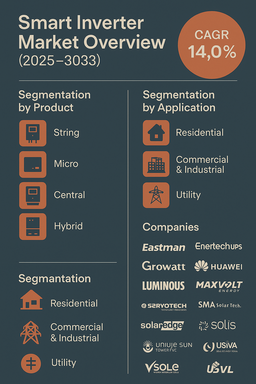
The global smart inverter market is projected to grow at a CAGR of 14.0% from 2026 to 2034, driven by the accelerating integration of solar energy systems, increasing demand for grid stability, and the expansion of smart grids. Smart inverters, unlike traditional inverters, can autonomously communicate with the utility grid, manage voltage fluctuations, and optimize energy distribution. These systems are crucial to improving energy efficiency, supporting distributed power generation, and ensuring reliable renewable energy integration across residential, commercial, and utility-scale applications.
Rising Solar Adoption and Grid Modernization
The growing penetration of renewable energy, particularly solar photovoltaics (PV), is the primary driver for smart inverter demand. Governments across major economies are promoting solar adoption through incentives, net-metering programs, and smart grid initiatives. Smart inverters enhance power quality and provide essential grid services such as frequency regulation, reactive power control, and remote monitoring. The shift toward energy digitization and IoT-enabled grid management is further propelling adoption in both developed and emerging markets.
Challenges: Cybersecurity and Integration Costs
While the benefits of smart inverters are substantial, challenges remain in terms of cybersecurity, interoperability, and cost of deployment. The need for consistent communication standards between distributed energy resources (DERs) and grid operators adds complexity. Additionally, higher upfront investment compared to traditional inverters may hinder small-scale adoption. However, ongoing advancements in AI-based monitoring, edge computing, and blockchain-enabled energy transactions are expected to enhance system resilience and lower integration barriers over the coming decade.
Market Segmentation by Product
By product, the market is segmented into String, Micro, Central, and Hybrid inverters. In 2025, the String inverter segment dominated the market, owing to its widespread use in residential and small commercial solar PV installations due to its simplicity, scalability, and cost-effectiveness. Central inverters held a significant share in utility-scale projects, where high-capacity energy conversion and centralized control are prioritized. The Micro inverter segment is projected to register the highest CAGR, driven by its modular nature, shading resistance, and suitability for distributed rooftop applications. Hybrid inverters, combining solar, battery, and grid input management, are rapidly gaining popularity in regions emphasizing energy storage and self-sufficiency.
Market Segmentation by Application
By application, the market is categorized into Residential, Commercial & Industrial, and Utility. In 2025, the Residential segment held the largest share due to the rising adoption of rooftop solar systems in urban and rural areas. The Commercial & Industrial (C&I) segment is expected to experience strong growth as businesses seek energy independence and power backup through solar-plus-storage systems. The Utility segment remains a vital contributor, particularly in large solar farms and grid-supportive installations, as utilities integrate smart inverters for load balancing and voltage stabilization.
Regional Insights
In 2025, Asia Pacific led the global smart inverter market, fueled by strong solar deployment in China, India, and Japan. Supportive policies for grid-tied PV systems, rapid urbanization, and declining inverter costs drive regional demand. Europe follows closely, supported by stringent renewable integration targets and investments in smart grid technologies. North America continues to advance through net-metering programs and incentives for residential and commercial solar adoption. Meanwhile, Latin America and Middle East & Africa (MEA) are emerging as high-potential markets, driven by growing solar investments and rural electrification initiatives.
Competitive Landscape
The smart inverter market is highly competitive and fragmented, with both global and regional players emphasizing innovation, digital connectivity, and energy efficiency. Huawei, SMA Solar Technology, and SolarEdge dominate the global segment with advanced grid-interactive inverter technologies and strong international distribution networks. Sungrow and Growatt continue to expand across Asia Pacific and Europe with scalable inverter solutions tailored for residential and utility sectors. Indian and regional manufacturers such as Eastman Auto & Power Ltd, Enertechups, Luminous, Servotech Renewable Power System Limited, Ushva Clean Technology Pvt. Ltd, and Vsole Solar Private Limited are strengthening domestic production capacities and focusing on cost-effective, IoT-enabled designs. MaxVolt Energy and Unique Sun Power Pvt. cater to distributed and hybrid installations across emerging solar markets. Strategic alliances, technological integration with energy storage, and smart monitoring platforms are expected to shape competitive dynamics, ensuring that smart inverters remain central to the global renewable energy transformation.
Historical & Forecast Period
This study report represents analysis of each segment from 2024 to 2034 considering 2025 as the base year. Compounded Annual Growth Rate (CAGR) for each of the respective segments estimated for the forecast period of 2026 to 2034.
The current report comprises of quantitative market estimations for each micro market for every geographical region and qualitative market analysis such as micro and macro environment analysis, market trends, competitive intelligence, segment analysis, porters five force model, top winning strategies, top investment markets, emerging trends and technological analysis, case studies, strategic conclusions and recommendations and other key market insights.
Research Methodology
The complete research study was conducted in three phases, namely: secondary research, primary research, and expert panel review. key data point that enables the estimation of Smart Inverter Market By Product, By Communication, By Application - Growth, Share, Opportunities & Competitive Analysis, 2026 - 2034 market are as follows:
Market forecast was performed through proprietary software that analyzes various qualitative and quantitative factors. Growth rate and CAGR were estimated through intensive secondary and primary research. Data triangulation across various data points provides accuracy across various analyzed market segments in the report. Application of both top down and bottom-up approach for validation of market estimation assures logical, methodical and mathematical consistency of the quantitative data.
| ATTRIBUTE | DETAILS |
|---|---|
| Research Period | 2024-2034 |
| Base Year | 2025 |
| Forecast Period | 2026-2034 |
| Historical Year | 2024 |
| Unit | USD Million |
| Segmentation | |
Product
|
|
Application
|
|
Communication
|
|
|
Region Segment (2024-2034; US$ Million)
|
Key questions answered in this report


