
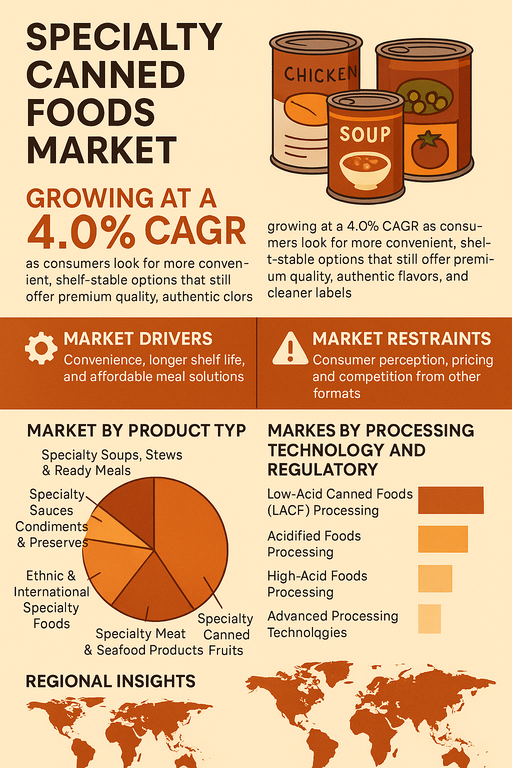
The specialty canned foods market is growing at a 4.0% CAGR as consumers look for more convenient, shelf-stable options that still offer premium quality, authentic flavors, and cleaner labels. Busy households, single-person homes, and on-the-go consumers rely on canned soups, meals, fruits, vegetables, sauces, and meats as easy pantry staples that reduce food waste and extend shelf life. At the same time, brands are adding gourmet recipes, ethnic and international flavors, organic and natural ingredients, and better packaging to reposition canned products as modern, higher-value choices. Within product types, specialty soups, stews and ready meals, along with specialty sauces, condiments and preserves, generate the highest revenue because they fit into everyday meal occasions, while ethnic and international specialty foods and higher-value specialty meat and seafood products are expected to post the highest CAGR as demand grows for premium and global cuisine in a convenient canned format.
Market Drivers
Growth is driven by rising demand for convenience, longer shelf life, and affordable meal solutions that still offer variety and quality. Many consumers keep specialty canned foods as pantry back-up items for quick meals, emergencies, and flexible meal planning, which reduces the risk of food spoilage compared with fresh alternatives. Urbanization, busy work patterns, and smaller households support demand for single-serve and small-format canned items, especially premium soups, ready meals, and portioned vegetables and fruits. Interest in ethnic and global flavors is another key driver, as shoppers look for international recipes, regional sauces, and fusion dishes that are easy to try at home without complex preparation. Improvements in can linings, packaging design, and product formulation, including lower sodium, reduced preservatives, and clean-label ingredients, help improve perception of canned foods. Retailers and e-commerce platforms support growth by featuring canned products in value packs, online grocery baskets, and meal-kit style suggestions, which increases visibility and repeat purchases.
Market Restraints
The market faces restraints linked to consumer perception, pricing, and competition from other formats. Some consumers still associate canned foods with lower freshness or quality compared with chilled, frozen, or fresh products, which can limit uptake of premium canned varieties. Health-conscious buyers may be concerned about sodium levels, sugar content in fruit products, and use of additives, even though many specialty lines are reformulating recipes. Competition from chilled ready meals, frozen entrees, and fresh meal kits is strong, especially in markets with well-developed cold chains and home delivery services. Raw material and packaging costs, including steel and aluminum for cans and energy-intensive processing, can pressure margins and force price increases in a price-sensitive category. Compliance with low-acid canned foods (LACF), acidified foods, and high-acid foods regulations requires strict monitoring, equipment investment, and documentation, which can be a barrier for smaller producers and for frequent line changes. In some channels, private label canned products offer strong value positioning, putting pressure on branded specialty products to justify higher prices through differentiation in taste, ingredients, or branding.
Market by Product Type
Specialty Canned Fruits & Fruit Products include premium fruit mixes, fruit in juices or light syrups, and added-value products such as fruit-based desserts and toppings. This segment benefits from demand for convenient fruit options outside the normal growing season and as ingredients for baking and breakfast dishes, although competition from chilled and frozen fruit is strong. Specialty Canned Vegetables & Vegetable Products cover higher-quality, seasoned, or recipe-based vegetable mixes and plant-based ingredients that can be used as side dishes or in cooking; they benefit from the move toward plant-forward diets and interest in vegetables that are pre-seasoned or blended with grains and legumes. Specialty Soups, Stews & Ready Meals represent one of the largest revenue contributors because they are complete meals in a can, with formats ranging from classic soups to premium stews, chili, and recipe-style dishes; they fit well into quick lunches and dinners and are often used in both retail and foodservice. Specialty Sauces, Condiments & Preserves include cooking sauces, pasta sauces, curry sauces, chutneys, and preserves positioned as premium or ethnic products; this segment also holds a significant revenue share as consumers look for easy ways to add flavor and complexity to home cooking. Specialty Meat & Seafood Products include canned premium tuna, salmon, specialty meats, pâtés, and meat-based meals, offering high-protein, shelf-stable options; as consumers seek convenience and protein-rich diets, this segment has solid growth potential in higher-income markets. Ethnic & International Specialty Foods, such as regional stews, curries, beans, rice dishes, and fusion recipes, are expected to post the highest CAGR as retailers expand world-food aisles and consumers explore global flavors that are easy to store and prepare.
Market by Processing Technology and Regulatory
Low-Acid Canned Foods (LACF) Processing covers products with higher pH that require strict thermal processing and control to ensure safety, including many soups, stews, ready meals, and meat and vegetable products. This segment carries a large share of specialty canned foods volume and value, as many main-meal items fall into this category, and it demands robust retort systems, monitoring, and process validation. Acidified Foods Processing applies to products where acid is added to bring the pH into a safe range, such as pickled vegetables, some sauces, and certain condiments; this processing route is widely used in specialty condiments and vegetables and allows for a broader range of flavor profiles and textures. High-Acid Foods Processing primarily covers products naturally high in acid, such as many fruit products and some tomato-based items, which require less severe heat treatment and can preserve more of the original color and flavor; this segment is important for specialty canned fruits and fruit-based sauces. Advanced Processing Technologies include newer approaches such as improved retort control, aseptic filling for certain sauces and soups, retort pouches and trays, and enhanced can linings designed to protect flavor and reduce concerns about packaging materials. These advanced technologies are expected to record the highest CAGR because they support higher product quality, shorter cook times, better energy efficiency, and new packaging formats that can differentiate specialty canned foods on shelf and online while still complying with LACF, acidified foods, and high-acid regulatory requirements.
Regional Insights
North America is a key market for specialty canned foods, supported by long-established consumption of soups, ready meals, vegetables, fruits, and canned meat and seafood, along with strong retail and e-commerce channels. Consumers in this region are open to both classic canned brands and new specialty lines that focus on organic ingredients, clean labels, and better-for-you recipes. Europe has a mature canned foods market with strong traditions in canned vegetables, sauces, fish, and soups, and steady demand for private label and branded products; growth in specialty segments comes from ethnic and international foods, premium recipes, and sustainability messaging around packaging and food waste reduction. Asia Pacific offers significant growth potential, driven by urbanization, rising middle-class incomes, and interest in Western-style and regional canned foods, including ready meals, soups, and seafood; local tastes and regional cuisine influence the type of specialty products developed. Latin America, the Middle East, and Africa show growing demand for shelf-stable foods due to infrastructure and storage conditions, with specialty canned foods gaining traction as incomes rise and modern retail expands. Regions where modern trade, online grocery, and convenience-driven shopping are strong, and where consumers are increasingly interested in global flavors and premium pantry staples, will see faster growth in specialty canned food segments.
Competitive Landscape
Campbell Company is a major player in canned soups and ready meals, leveraging well-known brands, broad distribution, and ongoing product innovation in flavors, textures, and packaging formats for specialty soups, stews, and meal solutions. Hormel Foods Corporation participates in specialty canned meat, chili, stews, and ethnic dishes, using its expertise in protein-based foods and brand recognition to offer convenient, high-protein meal options. Conagra Brands Inc. has a broad portfolio that includes canned meals, vegetables, sauces, and ethnic products, and focuses on brand renovation, premiumization, and packaging updates to keep canned lines relevant. Kraft Heinz Company brings strong sauce, soup, and meal brands, along with condiments and preserves, and continues to update recipes and product lines to align with cleaner labels and changing taste preferences. Seneca Foods Corporation is an important supplier in canned fruits and vegetables and serves both branded and private label markets, supporting large retailers and foodservice buyers with year-round availability of specialty produce items. Companies grouped under “Others” include regional and niche producers that focus on particular cuisines, organic products, or gourmet recipes, as well as private label manufacturers that develop retailer-specific specialty canned ranges. Producers that can manage regulatory requirements for LACF, acidified, and high-acid foods, maintain consistent quality, and innovate in flavors, nutrition, and packaging are positioned to lead revenue, while brands that expand ethnic, premium, and advanced-processing-based product lines are likely to capture the highest CAGR in the specialty canned foods market.
Historical & Forecast Period
This study report represents analysis of each segment from 2024 to 2034 considering 2025 as the base year. Compounded Annual Growth Rate (CAGR) for each of the respective segments estimated for the forecast period of 2026 to 2034.
The current report comprises of quantitative market estimations for each micro market for every geographical region and qualitative market analysis such as micro and macro environment analysis, market trends, competitive intelligence, segment analysis, porters five force model, top winning strategies, top investment markets, emerging trends and technological analysis, case studies, strategic conclusions and recommendations and other key market insights.
Research Methodology
The complete research study was conducted in three phases, namely: secondary research, primary research, and expert panel review. key data point that enables the estimation of Specialty Canned Foods Market By Product Type, By Processing Technology, By End Use - Global Market Analysis & Forecast, 2025 to 2033 market are as follows:
Market forecast was performed through proprietary software that analyzes various qualitative and quantitative factors. Growth rate and CAGR were estimated through intensive secondary and primary research. Data triangulation across various data points provides accuracy across various analyzed market segments in the report. Application of both top down and bottom-up approach for validation of market estimation assures logical, methodical and mathematical consistency of the quantitative data.
| ATTRIBUTE | DETAILS |
|---|---|
| Research Period | 2024-2034 |
| Base Year | 2025 |
| Forecast Period | 2026-2034 |
| Historical Year | 2024 |
| Unit | USD Million |
| Segmentation | |
Product Type
|
|
Processing Technology and Regulatory
|
|
End Use Application
|
|
|
Region Segment (2024-2034; US$ Million)
|
Key questions answered in this report


