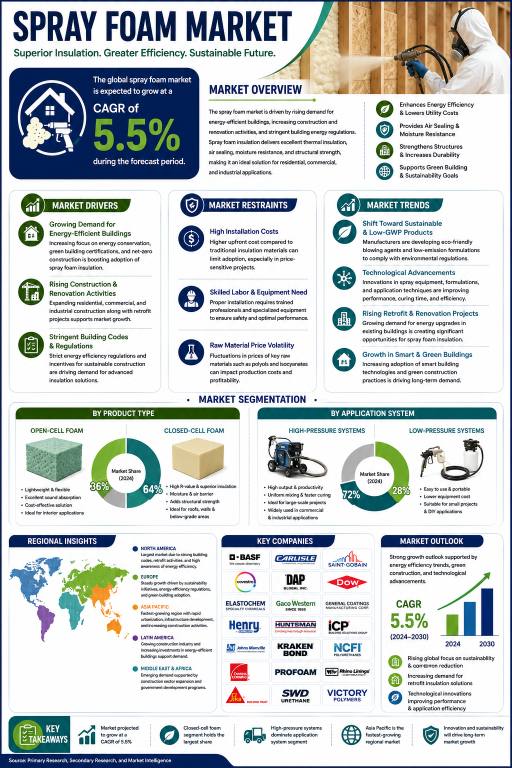
The global spray foam market is expected to grow at a CAGR of 5.5% during the forecast period. Market growth is driven by increasing demand for energy-efficient buildings, rising construction and renovation activities, growing adoption of advanced insulation materials, and stricter building energy regulations. Spray foam provides superior thermal insulation, air sealing, moisture resistance, and structural reinforcement, making it a preferred solution across residential, commercial, and industrial construction projects. The growing focus on reducing energy consumption and carbon emissions is further supporting market expansion.
Market Drivers
Growing Demand for Energy-Efficient Buildings
Governments and building owners are increasingly prioritizing energy efficiency to reduce operational costs and meet sustainability targets. Spray foam insulation helps improve building envelope performance by minimizing air leakage and enhancing thermal resistance. Rising awareness regarding energy conservation, green building certifications, and net-zero construction initiatives is significantly driving demand for spray foam products worldwide.
Market Restraints
High Installation Costs and Skilled Labor Requirements
Spray foam insulation generally requires higher upfront investment compared to traditional insulation materials such as fiberglass and mineral wool. Proper installation requires specialized equipment and trained professionals to ensure optimal performance and safety. Fluctuating raw material costs associated with polyurethane-based chemicals can also impact overall project expenses and market growth.
Spray Foam Market Trends
The market is witnessing increasing adoption of environmentally friendly blowing agents and low-global-warming-potential formulations. Manufacturers are investing in sustainable spray foam technologies that comply with evolving environmental regulations while maintaining insulation performance. Demand for retrofit insulation projects, smart buildings, and energy-efficient commercial facilities is also contributing to market growth. Additionally, technological advancements are improving application efficiency, curing time, and long-term durability of spray foam products.
Market Segmentation
By Product Type
Based on product type, the market is segmented into Open-Cell Foam and Closed-Cell Foam. Closed-cell foam accounts for a significant market share due to its superior insulation performance, moisture resistance, structural strength, and suitability for demanding applications. It is widely used in commercial buildings, industrial facilities, and roofing systems. Open-cell foam continues to maintain strong demand due to its lower cost, excellent sound absorption properties, and suitability for residential insulation applications where moisture exposure is limited.
By Application System
Based on application system, the market is segmented into High-Pressure Systems and Low-Pressure Systems. High-pressure systems hold a major market share due to their extensive use in large-scale residential, commercial, and industrial projects. These systems provide consistent mixing, faster application, and higher productivity. Low-pressure systems are gaining popularity in smaller projects, repair applications, and do-it-yourself installations due to their convenience, portability, and ease of use.
Regional Insights
North America represents a major market for spray foam due to strong adoption of energy-efficient building materials, stringent building codes, and extensive residential renovation activities. The United States continues to lead demand owing to growing investments in insulation upgrades and sustainable construction practices. Europe is witnessing steady growth supported by energy-efficiency directives, green building initiatives, and carbon reduction targets. Asia Pacific is expected to record the fastest growth during the forecast period due to rapid urbanization, infrastructure development, increasing residential construction, and rising awareness of energy-efficient building technologies across China, India, Japan, South Korea, and Southeast Asia. Latin America and the Middle East & Africa are also experiencing growing demand as modern construction practices and energy efficiency standards gain momentum.
Competitive Landscape
The spray foam market is highly competitive, with manufacturers focusing on product innovation, environmental compliance, performance enhancement, and distribution network expansion. Companies are investing in advanced polyurethane technologies, sustainable blowing agents, and improved application systems to strengthen their market positions. Strategic acquisitions, partnerships with contractors, and expansion into emerging construction markets remain key growth strategies. Competitive differentiation increasingly depends on insulation efficiency, environmental performance, ease of application, and long-term durability.
Key companies operating in the market include BASF SE, Carlisle Companies Incorporated, Compagnie de Saint-Gobain S.A., Covestro AG, DAP Global Inc., Dow Inc., Elastochem Specialty Chemicals, Gaco Western LLC, General Coatings Manufacturing Corp., Henry Company LLC, Huntsman Corporation, ICP Building Solutions Group, Johns Manville Corporation, Kraken Bond, NCFI Polyurethanes, Owens Corning, Profoam Corporation, Rhino Linings Corporation, Sika AG, SWD Urethane, and Victory Polymers.
Spray Foam Industry News
The industry is witnessing increasing investment in sustainable insulation technologies and low-emission spray foam formulations. Manufacturers are introducing products that comply with evolving environmental standards while maintaining thermal performance and durability. Growth in green building projects, retrofit insulation demand, and energy-efficient commercial construction continues to create new opportunities for spray foam manufacturers. The adoption of advanced application technologies and environmentally responsible raw materials is expected to remain a key industry focus over the forecast period.
Historical & Forecast Period
This study report represents analysis of each segment from 2024 to 2034 considering 2025 as the base year. Compounded Annual Growth Rate (CAGR) for each of the respective segments estimated for the forecast period of 2026 to 2034.
The current report comprises of quantitative market estimations for each micro market for every geographical region and qualitative market analysis such as micro and macro environment analysis, market trends, competitive intelligence, segment analysis, porters five force model, top winning strategies, top investment markets, emerging trends and technological analysis, case studies, strategic conclusions and recommendations and other key market insights.
Research Methodology
The complete research study was conducted in three phases, namely: secondary research, primary research, and expert panel review. key data point that enables the estimation of Spray Foam market are as follows:
Market forecast was performed through proprietary software that analyzes various qualitative and quantitative factors. Growth rate and CAGR were estimated through intensive secondary and primary research. Data triangulation across various data points provides accuracy across various analyzed market segments in the report. Application of both top down and bottom-up approach for validation of market estimation assures logical, methodical and mathematical consistency of the quantitative data.
| ATTRIBUTE | DETAILS |
|---|---|
| Research Period | 2024-2034 |
| Base Year | 2025 |
| Forecast Period | 2026-2034 |
| Historical Year | 2024 |
| Unit | USD Million |
| Segmentation | |
Product Type
|
|
Application System
|
|
End Use
|
|
Distribution Channel
|
|
|
Region Segment (2024-2034; US$ Million)
|
Frequently Asked Questions
What is the expected growth rate of the spray foam market?
The spray foam market is expected to grow at a CAGR of 5.5% during the forecast period.
Which product type segment holds a significant market share?
Closed-cell foam holds a significant market share due to its superior thermal insulation, moisture resistance, and structural performance.
Which application system dominates the market?
High-pressure systems dominate the market owing to their widespread use in large-scale residential, commercial, and industrial insulation projects.
What are the major growth drivers?
Major growth drivers include rising demand for energy-efficient buildings, stricter building regulations, growing construction activity, and increasing adoption of sustainable insulation materials.
Who are the major companies operating in the market?
Major companies include BASF SE, Carlisle Companies Incorporated, Compagnie de Saint-Gobain S.A., Covestro AG, Dow Inc., Huntsman Corporation, Owens Corning, Johns Manville Corporation, Sika AG, NCFI Polyurethanes, and Rhino Linings Corporation.