
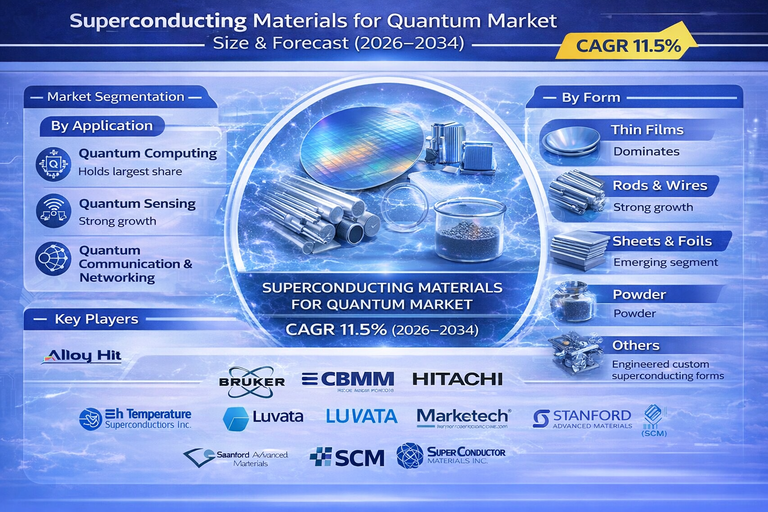
The superconducting materials for quantum market is expected to grow at a CAGR of 11.5% during 2026–2034, driven by rising investment in quantum computing hardware, scaling of cryogenic test infrastructure, and demand for low-loss, ultra-stable materials for quantum devices. Superconductors are core to many quantum technology stacks because they enable near-zero electrical resistance, low signal loss, and stable electromagnetic behavior at cryogenic temperatures. As quantum systems move from lab-scale prototypes toward pilot production, demand is increasing for higher purity, tighter tolerances, improved repeatability, and application-ready forms such as thin films and precision wires.
Market Drivers
Market growth is supported by rapid progress in superconducting-qubit platforms, where superconducting films and patterned circuits are essential for device fabrication and performance stability. Expansion of quantum sensing use cases (e.g., ultra-sensitive magnetometry and measurement systems) is also increasing demand for low-noise superconducting components. Government funding, national quantum programs, and private investment are improving equipment availability and accelerating prototype-to-product cycles. In parallel, improvements in deposition methods, substrate compatibility, and thin-film process control are helping reduce variability and improve yield for quantum-grade superconducting materials.
Market Restraints
The market faces restraints related to high production and qualification cost, limited supplier capacity for quantum-grade specifications, and dependence on specialized cryogenic and fabrication ecosystems. Quality requirements such as purity, defect control, and low microwave loss can increase rejection rates and extend validation timelines. Supply risks can arise from constrained access to select raw materials and long lead times for precision forms. In addition, performance sensitivity to processing steps (surface treatment, deposition conditions, and interface control) can limit standardization across fabs and research environments.
Market Segmentation
By Application
By application, the market is segmented into quantum computing, quantum sensing, and quantum communication & networking. Quantum computing holds the major share as superconducting materials are widely used in qubit circuits, resonators, interconnects, and packaging elements designed for cryogenic operation. Quantum sensing is witnessing strong growth due to increased use of superconducting-based detectors and measurement systems where ultra-low noise and high sensitivity are required. Quantum communication & networking represents a developing segment, supported by growth in quantum network testbeds and cryogenic signal-chain components, where low-loss materials help improve transmission and readout performance.
By Form
By form, the market is segmented into thin films, rods & wires, sheets & foils, powder, and others. Thin films hold the largest share because they are central to fabricating superconducting quantum circuits, resonators, and device layers, and they directly impact coherence and loss performance. Rods & wires are important for cryogenic interconnects, magnet systems, and specialized components used in quantum test setups and supporting infrastructure. Sheets & foils are used in shielding, packaging, and thermal or electromagnetic management where material uniformity and handling matter. Powder is used for R&D, custom material development, and specialized processing routes, while others include application-specific custom forms and engineered composites used in niche quantum hardware builds.
Regional Insights
North America leads the superconducting materials for quantum market due to strong quantum R&D ecosystems, early commercialization activity, and a high concentration of quantum hardware labs and startups. Europe follows, supported by coordinated national and EU-level quantum programs, strong materials science capabilities, and established cryogenic and precision manufacturing value chains. Asia Pacific shows fast growth driven by expanding quantum initiatives, scaling of advanced manufacturing, and increasing domestic capability building in quantum hardware supply chains. Latin America and the Middle East & Africa remain emerging markets, mainly supported by academic research expansion and gradual adoption of quantum sensing and enabling infrastructure.
Competitive Landscape
The market is moderately concentrated around specialized suppliers that can meet strict quantum-grade requirements, with competition shaped by material purity, thin-film performance, consistency, and the ability to deliver fabrication-ready formats. Key strategies include investment in advanced deposition and processing control, tighter QA/QC and certification workflows, partnerships with quantum hardware developers, and expansion of application-specific product lines. Suppliers that can offer repeatable low-loss performance, stable lead times, and customization for different quantum device stacks are better positioned as the market moves toward pilot-scale production.
Key companies operating in the market include Alloy Hit, Bruker EAS (BEST), CBMM, Hitachi, Goodfellow, High Temperature Superconductors Inc., Luvata, Marketech International, Stanford Advanced Materials, and Super Conductor Materials Inc. (SCM).
Historical & Forecast Period
This study report represents analysis of each segment from 2024 to 2034 considering 2025 as the base year. Compounded Annual Growth Rate (CAGR) for each of the respective segments estimated for the forecast period of 2026 to 2034.
The current report comprises of quantitative market estimations for each micro market for every geographical region and qualitative market analysis such as micro and macro environment analysis, market trends, competitive intelligence, segment analysis, porters five force model, top winning strategies, top investment markets, emerging trends and technological analysis, case studies, strategic conclusions and recommendations and other key market insights.
Research Methodology
The complete research study was conducted in three phases, namely: secondary research, primary research, and expert panel review. key data point that enables the estimation of Superconducting Materials for Quantum Market By Material Type, By Application, By Form, By End Use - Growth, Share, Opportunities & Competitive Analysis, 2026 - 2034 market are as follows:
Market forecast was performed through proprietary software that analyzes various qualitative and quantitative factors. Growth rate and CAGR were estimated through intensive secondary and primary research. Data triangulation across various data points provides accuracy across various analyzed market segments in the report. Application of both top down and bottom-up approach for validation of market estimation assures logical, methodical and mathematical consistency of the quantitative data.
| ATTRIBUTE | DETAILS |
|---|---|
| Research Period | 2024-2034 |
| Base Year | 2025 |
| Forecast Period | 2026-2034 |
| Historical Year | 2024 |
| Unit | USD Million |
| Segmentation | |
Material Type
|
|
By Application
|
|
By Form
|
|
End Use
|
|
|
Region Segment (2024-2034; US$ Million)
|
Frequently Asked Questions
What is the growth outlook for the superconducting materials for quantum market?
The market is expected to grow at a CAGR of 11.5% during 2026–2034, supported by scaling quantum hardware programs and expanding cryogenic infrastructure.
Which application segment is largest?
Quantum computing is the largest segment due to heavy use of superconducting materials in qubit circuits, resonators, and cryogenic signal chains.
Which form segment dominates the market?
Thin films dominate because they are essential for superconducting quantum circuit fabrication and strongly influence device performance and yield.
Which region leads the market?
North America leads, followed by Europe and Asia Pacific, driven by strong quantum R&D ecosystems and accelerating commercialization efforts.
What are the key challenges in this market?
Key challenges include high qualification cost, tight purity and defect requirements, long lead times for precision formats, and process sensitivity that makes standardization difficult across different quantum fabrication routes.


