
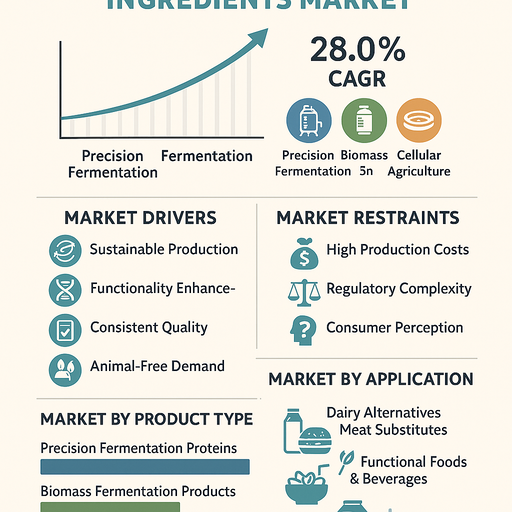
The synthetic biology food ingredients market is growing at a 28.0% CAGR as food and beverage manufacturers look for new ways to deliver sustainable, high-performance proteins, enzymes, and specialty ingredients without relying only on traditional animal or crop supply chains. Synthetic biology allows companies to engineer microbes or cells to produce targeted food ingredients through precision fermentation, biomass fermentation, and cellular agriculture. These processes can deliver consistent quality, lower environmental impact, and new functionalities in dairy alternatives, meat substitutes, beverages, infant nutrition, functional foods, and bakery and confectionery products. Within product types, precision fermentation proteins currently generate the highest revenue because they are already used in next-generation dairy and egg alternatives, while cellular agriculture products and biomass fermentation products are expected to post the highest CAGR as scale-up improves and regulations become clearer. By application, dairy alternatives and meat substitutes together account for the highest revenue in 2025, while functional foods and beverages enriched with synthetic biology ingredients are expected to record the highest CAGR as brands push for cleaner labels, targeted nutrition, and better texture and taste.
Market Drivers
Growth is driven by the need to reduce dependence on volatile animal and crop-based supply chains while still providing high-quality protein, clean-label formulations, and more sustainable production methods. Precision fermentation proteins and enzymes can match or improve the functionality of animal-derived dairy and egg ingredients with lower land, water, and greenhouse gas footprints, helping food companies meet their sustainability and ESG targets. Synthetic biology allows very precise control over ingredient structure, so producers can design proteins, vitamins, flavors, and enzymes that improve taste, texture, stability, and nutritional value in dairy alternatives, meat substitutes, and fortified foods. Food and beverage manufacturers also benefit from consistent quality and reliable supply because fermentation-based ingredients are made in controlled bioreactors rather than exposed to weather, disease, or feed price swings. At the same time, consumer demand is rising for animal-free, lactose-free, and cholesterol-conscious products, which supports adoption of animal-free dairy proteins, egg proteins, and fungi-based proteins made through synthetic biology. Falling DNA synthesis costs, better strain engineering tools, and new biofoundry infrastructure further support a faster pipeline of new synthetic biology food ingredients.
Market Restraints
Adoption is limited by high production costs, scale-up risks, and regulatory complexity. Precision fermentation plants require large capital investments, advanced bioprocess control, and strict food-grade standards, which can make early products more expensive than conventional animal or plant ingredients. Achieving competitive cost per kilogram needs high productivity strains, optimized media, and large bioreactors, which take time, expertise, and funding. Regulatory approval processes for novel food ingredients, especially those produced by genetically modified microbes, can be long and differ across regions, slowing product launches. Consumer perception is another barrier, as some consumers remain cautious about “lab-grown” or “engineered” foods; companies need clear communication, safety data, and branding to build trust. Supply chains, formulation know-how, and design guidelines for synthetic biology ingredients in high-volume food production are still developing, so many projects remain at pilot or limited commercial scale. In some cost-sensitive applications, traditional plant-based proteins or standard additives can still meet performance requirements at lower cost, delaying the switch to synthetic biology-derived solutions.
Market by Product Type
Precision fermentation proteins form the core of the current synthetic biology food ingredients market. These include animal-identical dairy and egg proteins produced by engineered microbes and used in dairy alternatives, hybrid dairy products, and bakery and beverage formulations. They currently generate the highest revenue because they can be used as drop-in or near drop-in replacements in existing recipes, providing familiar functionality and nutritional profiles. Precision fermentation enzymes support a wide range of processing steps in baking, brewing, dairy, and plant-based products by improving yield, texture, and shelf life, while precision fermentation vitamins and nutrients provide reliable and high-purity fortification options for beverages, infant nutrition, and functional foods. Precision fermentation flavors and aromas enable production of specific flavor molecules without relying on limited or seasonal natural sources, supporting stable supply and cleaner labels in beverages, confectionery, and bakery products. Biomass fermentation products, including fungi-based and microbial biomass proteins, provide whole-food-like ingredients with good amino-acid profiles and fiber content for meat and dairy alternatives, spreads, and ready meals; from a smaller base, these products are expected to grow rapidly as companies scale fermentation and improve taste and texture. Cellular agriculture products, such as cultivated fats, dairy components, and future hybrid meat or milk ingredients, are still at an early stage but are expected to post the highest CAGR as more regulatory approvals are granted and production costs fall, allowing their use as high-value functional inputs in meat substitutes, dairy alternatives, and nutrition-focused products.
Market by Application
Dairy alternatives are currently the most advanced application for synthetic biology food ingredients, using precision fermentation proteins, enzymes, and flavors to improve creaminess, foaming, melting, and nutritional value in milk, cheese, ice cream, and yogurt alternatives. This segment, together with meat substitutes and alternatives, accounts for the highest revenue in 2025 as brands work to close the sensory and nutritional gap with conventional dairy and meat. In meat substitutes, synthetic biology enables heme-like components, flavor precursors, and structured proteins that improve juiciness, browning, mouthfeel, and protein density in burgers, sausages, nuggets, and ready meals. Beverages are emerging as a strong growth area, with precision fermentation vitamins, nutrients, and specialty proteins used in performance drinks, nutrition shakes, functional waters, and coffee beverages; this segment is expected to show one of the highest CAGRs due to fast product cycles and high consumer interest in convenient functional drinks. Infant nutrition and specialized medical nutrition can adopt synthetic biology ingredients to deliver specific proteins, human-identical oligosaccharides, and micronutrients with tight quality and safety control, although adoption is gradual because regulatory and clinical evidence requirements are high. Functional foods and bakery and confectionery products offer broad opportunities for synthetic biology-derived flavors, enzymes, and proteins that support sugar reduction, protein enrichment, texture improvement, and shelf-life extension; functional foods in particular are expected to record the highest CAGR as brands add precision fermentation-based nutrients and bioactive compounds into everyday products.
Regional Insights
North America and Europe lead the synthetic biology food ingredients market in terms of R&D intensity, startup activity, and early commercial launches. The United States hosts many leading precision fermentation and cellular agriculture companies, along with venture capital, accelerator programs, and pilot facilities that support partnerships with large food brands. Europe has strong enzyme, vitamin, and specialty ingredient suppliers and a growing base of precision fermentation and biomass fermentation companies, although novel food approval processes can slow market entry in some countries. Asia Pacific is expected to be a high-growth region as demand rises for high-quality proteins, dairy alternatives, and convenient functional foods in markets such as China, Japan, South Korea, Singapore, and Australia. The region also offers large fermentation capacity, ingredient production infrastructure, and government-backed bioeconomy and food security programs, which support rapid scaling once products gain approval. Latin America and the Middle East & Africa are currently smaller markets but are showing interest in new protein sources and sustainable ingredient production to improve resilience and reduce dependence on imports. Regions that combine supportive regulatory frameworks, strong fermentation infrastructure, and active innovation in food and beverage brands will see the fastest uptake of synthetic biology food ingredients.
Competitive Landscape
Perfect Day focuses on precision fermentation dairy proteins, producing animal-free whey and related ingredients that help manufacturers create dairy-style products with lower environmental footprint and strong functional performance in milk, yogurt, ice cream, and baked goods. Impossible Foods is an important player in meat alternatives, using synthetic biology and precision fermentation to create heme-style ingredients and other components that bring meat-like flavor, color, and cooking behavior to plant-based burgers and other products. Ginkgo Bioworks Holdings operates as a cell programming and strain development platform, designing microbes for multiple partners across food, nutrition, and agriculture, and positioning itself as an enabler for many synthetic biology food ingredient brands. The EVERY Company specializes in precision fermentation egg proteins, offering animal-free egg white ingredients for beverages, baked goods, and other products where foaming, binding, and clarity are important. Novozymes (now part of a combined enzyme and ingredient group) brings long experience in industrial enzymes and precision fermentation and is expanding advanced enzyme and protein solutions for food and nutrition. DSM-Firmenich combines strengths in vitamins, nutrition, and flavors, using biotechnology to deliver tailored functional and nutritional ingredients for a wide range of food and beverage applications. Nature’s Fynd develops biomass fermentation products based on fungi-derived protein for meatless and dairy-free foods, showing the potential of fermentation-based whole food ingredients as an alternative to animal sources. Companies that can deliver high-purity, cost-effective precision fermentation proteins and enzymes, prove clear sustainability and performance benefits, and support customers with formulation and regulatory expertise are likely to lead current revenue, while those that successfully scale cellular agriculture fats and dairy components and biomass fermentation proteins for use in meat substitutes, beverages, and functional foods are positioned to capture the highest CAGR in the synthetic biology food ingredients market.
Historical & Forecast Period
This study report represents analysis of each segment from 2024 to 2034 considering 2025 as the base year. Compounded Annual Growth Rate (CAGR) for each of the respective segments estimated for the forecast period of 2026 to 2034.
The current report comprises of quantitative market estimations for each micro market for every geographical region and qualitative market analysis such as micro and macro environment analysis, market trends, competitive intelligence, segment analysis, porters five force model, top winning strategies, top investment markets, emerging trends and technological analysis, case studies, strategic conclusions and recommendations and other key market insights.
Research Methodology
The complete research study was conducted in three phases, namely: secondary research, primary research, and expert panel review. key data point that enables the estimation of Synthetic Biology Food Ingredients Market By Product, By Application, By End User - Global Market Analysis & Forecast, 2025 to 2033 market are as follows:
Market forecast was performed through proprietary software that analyzes various qualitative and quantitative factors. Growth rate and CAGR were estimated through intensive secondary and primary research. Data triangulation across various data points provides accuracy across various analyzed market segments in the report. Application of both top down and bottom-up approach for validation of market estimation assures logical, methodical and mathematical consistency of the quantitative data.
| ATTRIBUTE | DETAILS |
|---|---|
| Research Period | 2024-2034 |
| Base Year | 2025 |
| Forecast Period | 2026-2034 |
| Historical Year | 2024 |
| Unit | USD Million |
| Segmentation | |
Product Type
|
|
Application
|
|
End Use
|
|
|
Region Segment (2024-2034; US$ Million)
|
Key questions answered in this report


