
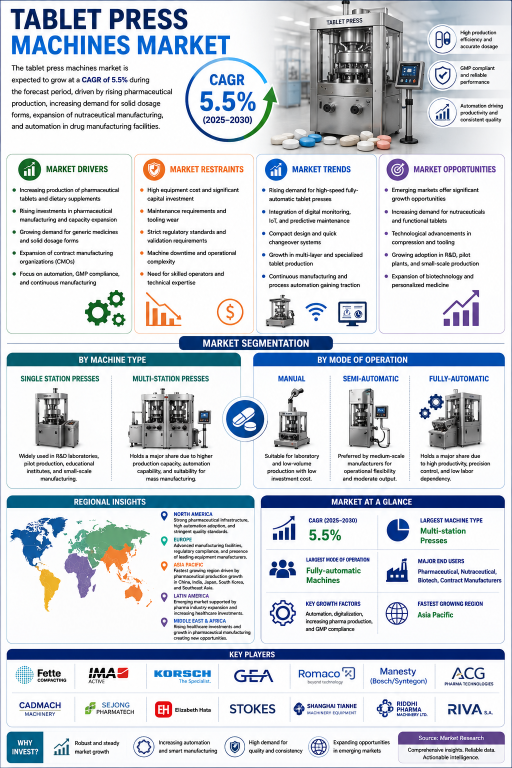
The tablet press machines market is expected to grow at a CAGR of 5.5% during the forecast period, driven by rising pharmaceutical production, increasing demand for solid dosage forms, expansion of nutraceutical manufacturing, and automation in drug manufacturing facilities.
Market Drivers
The market is mainly driven by increasing production of pharmaceutical tablets, dietary supplements, and healthcare products worldwide. Tablet press machines are widely used due to high production efficiency, dosage accuracy, and suitability for large-scale manufacturing.
Growing demand for generic medicines, rising investments in pharmaceutical manufacturing, and expansion of contract manufacturing organizations are supporting market growth. Increasing focus on GMP compliance, automation, and continuous manufacturing is also boosting adoption.
Market Restraints
The market faces challenges related to high equipment cost, maintenance requirements, and strict regulatory standards. Advanced fully-automatic systems require significant capital investment and skilled operators.
Machine downtime, tooling wear, validation requirements, and production complexity for specialized tablets may also affect operational efficiency.
Tablet Press Machines Market Trends
The market is witnessing strong demand for high-speed fully-automatic tablet press systems integrated with digital monitoring, predictive maintenance, and process automation.
Manufacturers are focusing on compact machine design, energy efficiency, quick changeover systems, and multi-layer tablet production. Demand for pharmaceutical-grade precision equipment and continuous manufacturing systems is increasing globally.
Market Segmentation
By Machine Type
By machine type, the market is segmented into single station presses and multi-station presses. Multi-station presses hold a major share due to higher production capacity, automation capability, and suitability for mass pharmaceutical manufacturing.
Single station presses are widely used in R&D laboratories, pilot production, educational institutes, and small-scale manufacturing applications.
By Mode of Operation
By mode of operation, the market is segmented into manual, semi-automatic, and fully-automatic. Fully-automatic machines hold a major share due to higher productivity, precision control, lower labor dependency, and suitability for large pharmaceutical plants.
Semi-automatic machines are witnessing demand among medium-scale manufacturers due to lower investment cost and operational flexibility. Manual machines remain relevant for laboratory and low-volume production applications.
Regional Insights
North America holds a significant share of the tablet press machines market due to strong pharmaceutical manufacturing infrastructure, high automation adoption, and stringent quality standards.
Europe is driven by advanced pharmaceutical production facilities, regulatory compliance requirements, and strong presence of equipment manufacturers. Asia Pacific is expected to witness strong growth due to increasing pharmaceutical production, rising generic drug manufacturing, and expanding healthcare industries in China, India, South Korea, and Southeast Asia.
Latin America and the Middle East & Africa are emerging markets supported by pharmaceutical industry expansion and increasing healthcare investments.
Competitive Landscape
The tablet press machines market is competitive, with companies focusing on production speed, precision, automation, GMP compliance, and operational efficiency. Competition is based on machine reliability, tooling flexibility, tablet quality, energy efficiency, and after-sales service support.
Key companies operating in the market include Fette Compacting, IMA Active, Korsch AG, GEA Group, Romaco, Manesty (Bosch/Syntegon), ACG Pharma Technologies, Cadmach Machinery, Sejong Pharmatech, Elizabeth Hata, Stokes, Shanghai Tianhe, Riddhi Pharma, and Riva S.A.
Tablet Press Machines Industry News
The industry is witnessing increasing investment in automated pharmaceutical production lines, continuous manufacturing technologies, and AI-enabled process monitoring systems.
Manufacturers are focusing on smart machine interfaces, remote diagnostics, predictive maintenance, and improved compression technologies to increase production efficiency and reduce downtime.
Historical & Forecast Period
This study report represents analysis of each segment from 2024 to 2034 considering 2025 as the base year. Compounded Annual Growth Rate (CAGR) for each of the respective segments estimated for the forecast period of 2026 to 2034.
The current report comprises of quantitative market estimations for each micro market for every geographical region and qualitative market analysis such as micro and macro environment analysis, market trends, competitive intelligence, segment analysis, porters five force model, top winning strategies, top investment markets, emerging trends and technological analysis, case studies, strategic conclusions and recommendations and other key market insights.
Research Methodology
The complete research study was conducted in three phases, namely: secondary research, primary research, and expert panel review. key data point that enables the estimation of Tablet Press Machines Market - Growth, Share, Opportunities & Competitive Analysis, 2026 - 2034 market are as follows:
Market forecast was performed through proprietary software that analyzes various qualitative and quantitative factors. Growth rate and CAGR were estimated through intensive secondary and primary research. Data triangulation across various data points provides accuracy across various analyzed market segments in the report. Application of both top down and bottom-up approach for validation of market estimation assures logical, methodical and mathematical consistency of the quantitative data.
| ATTRIBUTE | DETAILS |
|---|---|
| Research Period | 2024-2034 |
| Base Year | 2025 |
| Forecast Period | 2026-2034 |
| Historical Year | 2024 |
| Unit | USD Million |
| Segmentation | |
Machine Type
|
|
Mode of Operation
|
|
Production Capacity
|
|
End Use Industry
|
|
Distribution Channel
|
|
|
Region Segment (2024-2034; US$ Million)
|
Frequently Asked Questions
What is the growth outlook for the tablet press machines market?
The market is expected to grow at a CAGR of 5.5% during the forecast period.
Which machine type holds a major share?
Multi-station presses hold a major share due to high production capacity and automation capability.
Which mode of operation dominates the market?
Fully-automatic machines dominate due to higher productivity, precision, and suitability for large-scale pharmaceutical manufacturing.
What are the major challenges?
High equipment cost, maintenance requirements, tooling wear, regulatory compliance, and production complexity are major challenges.
Who are the key players?
Major companies include Fette Compacting, IMA Active, Korsch AG, GEA Group, Romaco, ACG Pharma Technologies, Cadmach Machinery, Elizabeth Hata, and Riva S.A.


