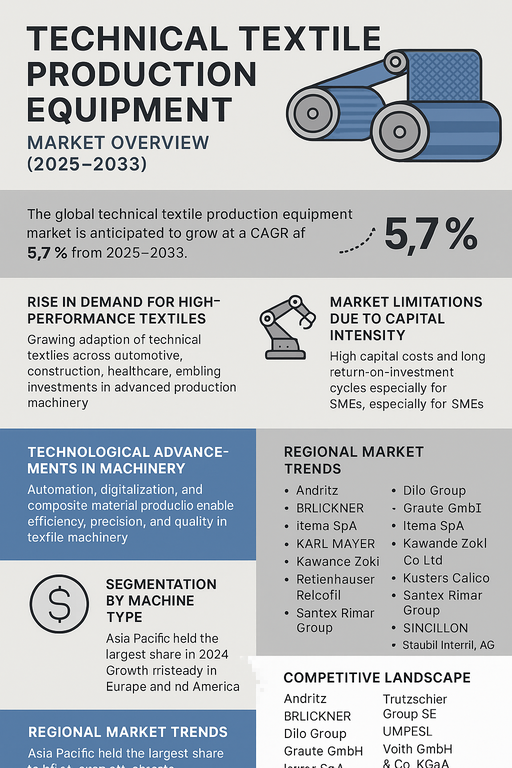
The global technical textile production equipment market is anticipated to grow at a CAGR of 5.7% between 2026 and 2034, fueled by increasing demand for high-performance textiles across industries such as automotive, healthcare, construction, defense, and filtration. Technical textiles require specialized machinery capable of producing fabrics with unique functional properties such as durability, elasticity, thermal resistance, and chemical resistance. As the end-use sectors continue to expand, investment in advanced production equipment is rising to meet diverse application requirements and production efficiency standards.
Rise in Demand for High-Performance Textiles
Technical textiles are engineered to perform specific functions rather than simply serve aesthetic purposes. The growing adoption of these materials in automotive seatbelts, geotextiles for infrastructure, fire-resistant clothing, and medical implants is accelerating demand for high-precision production machinery. Manufacturers are increasingly upgrading their equipment to cater to complex designs, flexible materials, and multi-layered textile structures. This is driving strong demand for versatile and efficient production systems, particularly in Asia Pacific and Europe.
Technological Advancements in Machinery
Ongoing technological innovation is enhancing the capabilities of textile manufacturing equipment. Automation, digitization, and IoT-enabled controls are being integrated into spinning, weaving, and nonwoven machines to reduce manual intervention, improve energy efficiency, and optimize throughput. Modern coating and laminating machines now offer seamless surface treatment for technical textiles with increased consistency and precision. Additionally, composite and bonding machines are playing a crucial role in producing hybrid technical textiles used in aerospace, wind energy, and sportswear industries. These trends are making machinery upgrades a key competitive necessity for textile producers.
Market Limitations Due to Capital Intensity
Despite strong growth prospects, the market faces challenges linked to high capital expenditure and long return-on-investment cycles. The cost of acquiring, installing, and maintaining technical textile machinery especially composite and digital nonwoven systems is substantial, which can be a barrier for small and medium-sized enterprises. Additionally, the need for skilled operators, high setup times, and integration complexities across different textile processes may limit broader adoption in price-sensitive markets. However, rising outsourcing of manufacturing and government support for textile modernization in emerging economies are helping to partially offset these constraints.
Segmentation by Machine Type
By machine type, the market includes extrusion machines, spinning machines, knitting machines, weaving machines, nonwoven machinery, coating machines, laminating machines, composite and bonding equipment, and others. In 2025, nonwoven machinery and coating equipment accounted for significant revenue share due to their growing use in medical, hygiene, and filtration textile applications. Weaving and knitting machines continue to remain relevant, particularly for industrial and geotextile fabric manufacturing. Composite and bonding equipment is expected to register the fastest CAGR, driven by increasing demand for multi-material solutions in defense and transportation sectors.
Segmentation by Process Type
Based on process type, the market is segmented into woven, knitted, nonwoven, composite, and others. Woven processes dominated the market in 2025, favored for their structural strength and flexibility in industrial applications. However, nonwoven and composite processes are projected to grow rapidly during the forecast period, owing to rising demand for lightweight and customizable materials. Nonwoven textiles are particularly gaining traction in hygiene products, automotive interiors, and medical consumables. Composite processes, on the other hand, are increasingly being used in technical applications requiring advanced thermal and mechanical properties.
Regional Market Dynamics
Asia Pacific held the largest share of the technical textile production equipment market in 2025, driven by strong manufacturing bases in China, India, Japan, and South Korea. Government initiatives to promote technical textile clusters, particularly in India under the National Technical Textiles Mission, are boosting machinery demand. Europe followed, led by Germany and Italy, where automation and high-end textile machinery are being adopted by established technical fabric producers. North America showed steady demand with a focus on military-grade and industrial technical textiles. Latin America and the Middle East & Africa are emerging as potential markets, supported by increasing investments in textile manufacturing and industrial development projects.
Competitive Landscape
The competitive environment in the technical textile production equipment market is marked by the presence of both global machinery conglomerates and specialized solution providers. Leading players such as Andritz, Dilo Group, Trutzschler Group SE, and Reifenhauser Reicofil dominate the nonwoven and composite machinery segments. KARL MAYER, BRÜCKNER, Staubli International AG, and Santex Rimar Group are recognized for their weaving, knitting, and finishing solutions. Voith GmbH & Co. KGaA and UMPESL provide custom solutions for industrial textile applications. Itema SpA, Kusters Calico, and Kawanoe Zoki Co Ltd maintain strong positions in spinning and processing systems. Companies like Scinilon and Graute GmbH are investing in automation technologies and digital controls to gain competitive advantage. Strategic priorities across the market include enhancing equipment flexibility, reducing energy usage, increasing precision, and integrating smart monitoring systems to ensure quality and operational visibility.
Historical & Forecast Period
This study report represents analysis of each segment from 2024 to 2034 considering 2025 as the base year. Compounded Annual Growth Rate (CAGR) for each of the respective segments estimated for the forecast period of 2026 to 2034.
The current report comprises of quantitative market estimations for each micro market for every geographical region and qualitative market analysis such as micro and macro environment analysis, market trends, competitive intelligence, segment analysis, porters five force model, top winning strategies, top investment markets, emerging trends and technological analysis, case studies, strategic conclusions and recommendations and other key market insights.
Research Methodology
The complete research study was conducted in three phases, namely: secondary research, primary research, and expert panel review. key data point that enables the estimation of Technical Textile Production Equipment market are as follows:
Market forecast was performed through proprietary software that analyzes various qualitative and quantitative factors. Growth rate and CAGR were estimated through intensive secondary and primary research. Data triangulation across various data points provides accuracy across various analyzed market segments in the report. Application of both top down and bottom-up approach for validation of market estimation assures logical, methodical and mathematical consistency of the quantitative data.
| ATTRIBUTE | DETAILS |
|---|---|
| Research Period | 2024-2034 |
| Base Year | 2025 |
| Forecast Period | 2026-2034 |
| Historical Year | 2024 |
| Unit | USD Million |
| Segmentation | |
Machine Type
|
|
Process Type
|
|
Application
|
|
Distribution Channel
|
|
|
Region Segment (2024-2034; US$ Million)
|
Key questions answered in this report