
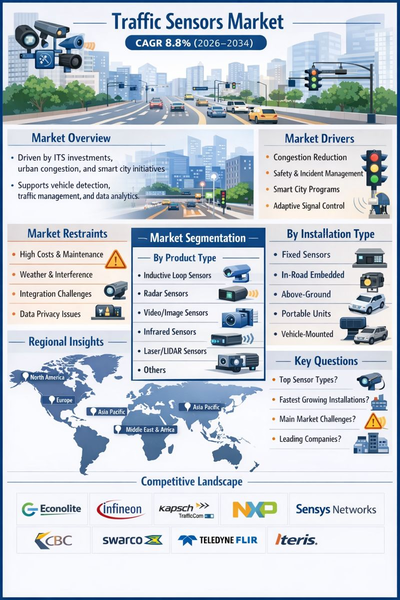
The traffic sensors market is expected to grow at a CAGR of 8.8% during 2026–2034, driven by higher investment in intelligent transportation systems (ITS), rising urban congestion, and increasing demand for safer and more efficient road operations. Traffic sensors support real-time vehicle detection, counting, speed measurement, occupancy estimation, incident detection, and signal optimization across highways, urban corridors, tunnels, and work zones. Adoption is also supported by smart city programs, expansion of adaptive signal control, increased deployment of connected roadside infrastructure, and growing use of analytics platforms that convert sensor data into actionable traffic management decisions.
Market Drivers
Market growth is driven by the need to reduce congestion and improve travel-time reliability through data-driven signal control, corridor management, and dynamic traffic operations. Governments and municipalities are expanding ITS deployments for intersection management, highway monitoring, and safety improvements, which increases demand for multi-sensor configurations and upgrades from legacy detection to higher accuracy solutions. Growing adoption of automated enforcement, incident management, and road safety initiatives supports demand for radar, video/image processing, and LiDAR-based systems in specific use cases. In parallel, the push for better asset utilization is increasing demand for sensors that integrate with central traffic management platforms, support remote diagnostics, and provide continuous performance monitoring. Demand is also supported by roadwork and temporary traffic management needs, where portable and temporary roadside units enable quick deployment and flexible coverage.
Market Restraints
The market faces restraints due to high deployment and maintenance costs, especially for solutions requiring civil works, lane closures, and specialized calibration. Sensor performance can be affected by weather, lighting, occlusion, road surface conditions, electromagnetic interference, and site geometry, which can raise total cost of ownership through re-tuning and periodic verification. Integration with existing signal controllers, ITS software, and communication networks can be complex when standards and interfaces vary across regions and legacy systems. Cybersecurity, data privacy, and video governance requirements can increase compliance burden for video/image processing deployments. Procurement cycles for public infrastructure can also be lengthy, and project timing can be impacted by budget approvals and multi-agency coordination.
Market Segmentation
By Product Type
By product type, the market is segmented into inductive loop sensors, magnetic sensors, radar sensors, infrared sensors, video/image processing sensors, laser/LiDAR sensors, and others. Inductive loop sensors remain widely used in fixed intersection detection because of their established performance in many road environments, but they require in-road installation and ongoing maintenance where road cuts and resurfacing occur. Magnetic sensors are used for in-road detection with relatively compact form factors and are common in applications where embedded sensing is preferred. Radar sensors are gaining share in above-ground deployments due to multi-lane coverage potential, strong performance in varied lighting, and reduced need for pavement cuts. Infrared sensors are used in specific detection and counting setups, but can be sensitive to environmental conditions depending on configuration. Video/image processing sensors are expanding with the need for richer traffic insights such as classification, queue length, near-miss indicators, and intersection performance metrics, though governance and privacy requirements can be higher. Laser/LiDAR sensors are growing in applications requiring higher-resolution tracking and detailed object detection, especially in complex intersections and safety-focused deployments, but pricing and integration can influence adoption. Others include acoustic and hybrid sensing approaches used for niche or specialized requirements.
By Installation Type
By installation type, the market is segmented into fixed sensors, embedded (in-road), above-ground (pole/gantry mounted), portable/mobile sensors, temporary roadside units, and vehicle-mounted systems. Fixed sensors account for steady demand due to long-term intersection and corridor monitoring requirements tied to traffic signal operations and road authority performance targets. Embedded (in-road) solutions are commonly used where precise point detection is needed, but they can be impacted by roadworks and lifecycle maintenance. Above-ground deployments are gaining traction because they reduce civil work, speed up installation, and can support multi-lane detection from a single mounting location in many sites. Portable/mobile sensors and temporary roadside units are used for work zones, short-duration studies, event traffic, and rapid deployments where flexibility and speed are critical. Vehicle-mounted systems support mobile data collection for surveys and network assessment, especially where continuous fixed coverage is not economical.
Regional Insights
North America shows steady demand supported by ITS modernization, adaptive signal control deployments, and upgrades to detection infrastructure at intersections and highways. Europe is supported by smart mobility programs, corridor management, and safety-oriented deployments, with emphasis on interoperability and compliance requirements in public procurement. Asia Pacific represents strong growth potential due to urbanization, large-scale road infrastructure expansion in selected countries, and increasing investment in smart city and traffic management programs. Latin America is supported by city-level congestion management initiatives and selective ITS upgrades, where funding cycles and procurement processes influence rollout speed. The Middle East & Africa shows selective growth tied to major infrastructure projects, smart city developments, and highway modernization, with adoption shaped by standards selection, system integration capacity, and long-term maintenance planning.
Competitive Landscape
The market is competitive and solution-driven, with differentiation based on detection accuracy, reliability across road and weather conditions, ease of integration with signal controllers and traffic management platforms, and lifecycle service capability. Vendors compete through product breadth across sensing modalities, software integration, edge processing capability, and ability to deliver complete detection packages for intersections and corridors. Partnerships are common between sensor manufacturers, ITS platform providers, system integrators, and traffic signal companies to deliver end-to-end deployments. Key strategies include expanding radar and video analytics portfolios, improving cybersecurity and remote monitoring, supporting open interfaces and standards-based integration, and offering service models that include installation, calibration, and ongoing performance maintenance. Key companies operating in the market include Econolite, Infineon Technologies AG, International Road Dynamics Inc., Kapsch TrafficCom AG, Kistler Group, Kyosan Electric Mfg. Co., Ltd., Microchip Technology Inc., NXP Semiconductors, Q-Free ASA, Sensys Networks, Sick AG, Smart Microwave Sensors GmbH, ST Engineering, SWARCO, TE Connectivity, Teledyne FLIR LLC, and Iteris, Inc.
Historical & Forecast Period
This study report represents analysis of each segment from 2024 to 2034 considering 2025 as the base year. Compounded Annual Growth Rate (CAGR) for each of the respective segments estimated for the forecast period of 2026 to 2034.
The current report comprises of quantitative market estimations for each micro market for every geographical region and qualitative market analysis such as micro and macro environment analysis, market trends, competitive intelligence, segment analysis, porters five force model, top winning strategies, top investment markets, emerging trends and technological analysis, case studies, strategic conclusions and recommendations and other key market insights.
Research Methodology
The complete research study was conducted in three phases, namely: secondary research, primary research, and expert panel review. key data point that enables the estimation of Traffic Sensors Market By Product Type, By Installation Type, By Connectivity, By Application - Growth, Share, Opportunities & Competitive Analysis, 2026 - 2034 market are as follows:
Market forecast was performed through proprietary software that analyzes various qualitative and quantitative factors. Growth rate and CAGR were estimated through intensive secondary and primary research. Data triangulation across various data points provides accuracy across various analyzed market segments in the report. Application of both top down and bottom-up approach for validation of market estimation assures logical, methodical and mathematical consistency of the quantitative data.
| ATTRIBUTE | DETAILS |
|---|---|
| Research Period | 2024-2034 |
| Base Year | 2025 |
| Forecast Period | 2026-2034 |
| Historical Year | 2024 |
| Unit | USD Million |
| Segmentation | |
Product Type
|
|
Installation Type
|
|
Connectivity
|
|
Application
|
|
|
Region Segment (2024-2034; US$ Million)
|
Frequently Asked Questions
What is the growth outlook for the traffic sensors market?
The market is expected to grow at a CAGR of 8.8% during 2026–2034, supported by ITS upgrades, smart city programs, and demand for data-driven traffic operations.
Which product types are widely adopted today?
Inductive loop and magnetic sensors remain common in many intersection deployments, while radar and video/image processing are increasingly adopted where above-ground installation and richer analytics are needed.
Which installation type is expanding fastest in many projects?
Above-ground (pole/gantry mounted) and portable/temporary deployments are expanding in many programs because they can reduce civil work, speed up installation, and support flexible coverage.
What are the key challenges in this market?
Major challenges include installation and maintenance cost, performance variability by site and environment, integration with legacy traffic systems, cybersecurity and data governance needs, and long public procurement cycles.
Who are the key players in this market?
Key participants include Econolite, Kapsch TrafficCom, SWARCO, Iteris, Sensys Networks, Sick AG, TE Connectivity, Teledyne FLIR, NXP Semiconductors, and Microchip Technology, among others.


