"Increasing adoption of artificial intelligence in the automotive industry is fueling the growth of Valet Robot Market"
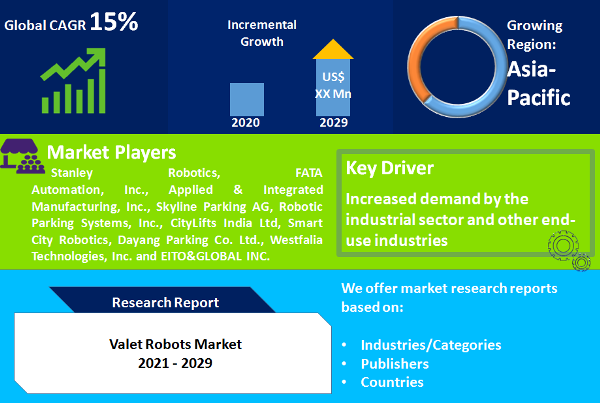
Globally, the valet robot market is expected to grow with a CAGR of more than 15% during the forecast period from 2022 to 2030. Globally, robots have been introduced to conduct various regular tasks such as security, cleaning and many more. As the demand for additional help increases, the adoption of robots in also increasing with time. Advancements with the help of artificial intelligence have made it's easy to develop and modify machines in a way that is needed. In this case, machines a.k.a robots are used to perform the activity of valet parking in public areas. Increasing implementation of artificial intelligence in every step of life, valet parking is also witnessing the effect of automation and AI.
At areas such as airports, these valet robots are helping airport officials interact with passengers and provide them assistance at the airport. Valet robots scan the vehicle and conduct a security check, and then lifts up the vehicle and parks it at a suitable space. Studies have concluded that, these robots can fit 50% more cars in the same parking space, reducing the inconvenience caused usually. Such advantages of valet robots have increased their adoption and thus results in increasing market size in various regions. Moreover, increasing urbanization, growing influx of people in central locations of major cities, and growing venture capital investments, are also driving the growth of valet robots market during the forecast period. However, technical issues such as malfunctioning of the robots and upcoming self-driven vehicles are likely to have a negative impact on the valet robots market.
"Airports segment is expected to Continue Dominating the Market"
In 2021, the airports end-user segment led the market by contributing the maximum market share in the global valet robot market. Valet Robot is a new concept, which increases the efficiency of parking as many cars in possible space. This concept is highly adopted at the airports, as these places deal with large number of vehicles. The integration of artificial intelligence within airports have mainly resulted in the implementation of valet robotic services.
Introduction of advanced technology machines at the airports mainly focus on improving the airport services and is expected to lead to enhanced customer experience, in the coming few years. This has increased the demand for robots to perform the parking activities at the airport parking lots along with security checks. European countries such as France, UK, Netherlands and others have already established the automated robotic valet system. Along with this, many other developed countries are now initiating in introducing the valet robots at their major airports. This increasing adoption at the airports is fueling the growth of valet robots market during the forecast period.
"Asia Pacific to Register the Fastest Growth"
Europe dominates the valet robot market. In 2021, the regional market accounted for nearly 31% of the total revenue generated worldwide. Increasing adoption of advanced technologies to make human work easy is the major factor attributed to this high market size. As the rate of adoption of valet robots parking is high in Europe compared to other countries, this region holds the maximum market share. As many of the European airports are in the list of busiest airports in the world, robotic valet parking helps in smoothing the process and releasing the pressure from the passengers. Moreover, airports apart from France, UK and Netherlands have also taking initiatives to undergo trial runs on the valet robots and make a decision on the installation of this system.
Furthermore, in North America and Asia-Pacific, significant activities have been observed based on factors such as emerging economic conditions, increasing number of financial districts, investments in smart city development, and rising urbanization in metropolitan cities. These factors are likely to drive the growth of valet robots market in these regions.
Some of the prominent players operating in the Valet Robot Market include Stanley Robotics, FATA Automation, Inc., Applied & Integrated Manufacturing, Inc., Skyline Parking AG, Robotic Parking Systems, Inc., CityLifts India Ltd, Smart City Robotics, Dayang Parking Co. Ltd., Westfalia Technologies, Inc. and EITO&GLOBAL INC.
Historical & Forecast Period
This study report represents analysis of each segment from 2024 to 2034 considering 2025 as the base year. Compounded Annual Growth Rate (CAGR) for each of the respective segments estimated for the forecast period of 2026 to 2034.
The current report comprises of quantitative market estimations for each micro market for every geographical region and qualitative market analysis such as micro and macro environment analysis, market trends, competitive intelligence, segment analysis, porters five force model, top winning strategies, top investment markets, emerging trends and technological analysis, case studies, strategic conclusions and recommendations and other key market insights.
Research Methodology
The complete research study was conducted in three phases, namely: secondary research, primary research, and expert panel review. key data point that enables the estimation of Valet Robots market are as follows:
Market forecast was performed through proprietary software that analyzes various qualitative and quantitative factors. Growth rate and CAGR were estimated through intensive secondary and primary research. Data triangulation across various data points provides accuracy across various analyzed market segments in the report. Application of both top down and bottom-up approach for validation of market estimation assures logical, methodical and mathematical consistency of the quantitative data.
| ATTRIBUTE | DETAILS |
|---|---|
| Research Period | 2024-2034 |
| Base Year | 2025 |
| Forecast Period | 2026-2034 |
| Historical Year | 2024 |
| Unit | USD Billion |
| Segmentation | |
Component
|
|
Technology
|
|
End User
|
|
|
Region Segment (2024-2034; US$ Billion)
|
Key questions answered in this report