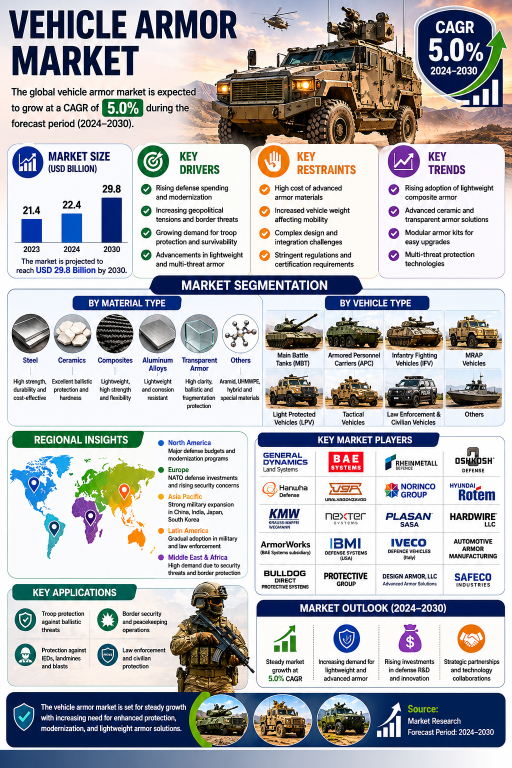
The global vehicle armor market is expected to grow at a CAGR of 5.0% during the forecast period. Market growth is being driven by rising defense modernization programs, increasing geopolitical tensions, growing demand for troop protection, and continuous investments in military vehicle upgrades. Vehicle armor systems are essential for protecting personnel and equipment against ballistic threats, improvised explosive devices (IEDs), landmines, rocket-propelled grenades (RPGs), and other battlefield hazards. The market is also benefiting from increased procurement of armored vehicles by military, homeland security, and law enforcement agencies worldwide.
Market Drivers
Rising Military Modernization and Defense Spending
Governments across major economies are investing heavily in armored combat vehicles, tactical vehicles, and next-generation military platforms to strengthen national security capabilities. The growing focus on soldier survivability, battlefield mobility, and protection against evolving threats is driving demand for advanced armor materials and lightweight protection systems. Increasing procurement of armored personnel carriers, infantry fighting vehicles, and mine-resistant vehicles is further supporting market expansion.
Market Restraints
High Cost and Weight Challenges
Advanced vehicle armor systems require specialized materials such as ceramics, composites, and transparent armor, resulting in higher production costs. Additional armor protection can increase vehicle weight, potentially affecting mobility, fuel efficiency, payload capacity, and operational performance. Balancing protection levels with mobility remains a key challenge for vehicle manufacturers and defense agencies.
Vehicle Armor Market Trends
The market is witnessing increasing adoption of lightweight composite armor systems designed to provide enhanced protection while minimizing vehicle weight. Advanced ceramic armor, transparent armor technologies, modular armor kits, and hybrid protection solutions are gaining traction across military and law enforcement applications. Manufacturers are also focusing on multi-threat protection systems capable of resisting ballistic, blast, and fragmentation threats simultaneously.
Market Segmentation
By Material Type
Based on material type, the market is segmented into Steel, Ceramics, Composites, Aluminum Alloys, Transparent Armor, and Others. Steel continues to hold a significant market share due to its proven ballistic protection, durability, and cost-effectiveness across military vehicle applications. Composites are expected to witness the fastest growth owing to their lightweight characteristics and superior protection-to-weight ratio. Ceramics are increasingly used in advanced armor systems due to their ability to defeat high-velocity projectiles while reducing overall vehicle weight. Transparent armor remains critical for armored windows, windshields, and observation systems.
By Vehicle Type
Based on vehicle type, the market is segmented into Main Battle Tanks (MBT), Armored Personnel Carriers (APC), Infantry Fighting Vehicles (IFV), Mine-Resistant Ambush Protected (MRAP) Vehicles, Light Protected Vehicles (LPV), Tactical Vehicles, Law Enforcement & Civilian Vehicles, and Others. Main Battle Tanks account for a significant market share due to their extensive armor requirements and modernization programs. MRAP vehicles continue to witness strong demand because of increasing focus on blast protection and troop survivability. Tactical vehicles and light protected vehicles are expected to grow steadily due to rising deployment in border security, peacekeeping, and rapid response operations.
Regional Insights
North America represents a major market for vehicle armor due to substantial defense budgets, military modernization initiatives, and ongoing armored vehicle procurement programs. Europe is supported by increasing defense spending, NATO modernization efforts, and rising security concerns. Asia Pacific is expected to witness strong growth due to military expansion programs in China, India, South Korea, Japan, and other regional economies. The Middle East remains an important market driven by security challenges and armored vehicle procurement, while Latin America is witnessing gradual adoption across military and law enforcement sectors.
Competitive Landscape
The vehicle armor market is highly competitive, with manufacturers focusing on advanced armor materials, lightweight protection systems, modular armor solutions, and enhanced survivability technologies. Strategic partnerships, defense contracts, research and development investments, and vehicle modernization programs remain key competitive strategies.
Key companies operating in the market include General Dynamics Corporation, BAE Systems, Rheinmetall AG, Oshkosh Corporation, Hanwha Defense, Uralvagonzavod, NORINCO Group, Hyundai Rotem, Krauss-Maffei Wegmann, Nexter Systems, Plasan Sasa, Hardwire LLC, ArmorWorks, BMI Defense Systems, Iveco Defense Vehicles, Automotive Armor Manufacturing, Bulldog Direct Protective Systems, Protective Group, Design Armor, LLC, and Safeco Industries.
Vehicle Armor Industry News
Defense agencies worldwide are increasingly investing in lightweight armor technologies to improve vehicle mobility without compromising protection levels. Manufacturers are developing modular armor kits that enable rapid upgrades based on mission requirements. Research activities are also focused on next-generation composite materials, transparent armor systems, and multi-threat protection technologies to address evolving battlefield challenges.
Historical & Forecast Period
This study report represents analysis of each segment from 2024 to 2034 considering 2025 as the base year. Compounded Annual Growth Rate (CAGR) for each of the respective segments estimated for the forecast period of 2026 to 2034.
The current report comprises of quantitative market estimations for each micro market for every geographical region and qualitative market analysis such as micro and macro environment analysis, market trends, competitive intelligence, segment analysis, porters five force model, top winning strategies, top investment markets, emerging trends and technological analysis, case studies, strategic conclusions and recommendations and other key market insights.
Research Methodology
The complete research study was conducted in three phases, namely: secondary research, primary research, and expert panel review. key data point that enables the estimation of Vehicle Armor market are as follows:
Market forecast was performed through proprietary software that analyzes various qualitative and quantitative factors. Growth rate and CAGR were estimated through intensive secondary and primary research. Data triangulation across various data points provides accuracy across various analyzed market segments in the report. Application of both top down and bottom-up approach for validation of market estimation assures logical, methodical and mathematical consistency of the quantitative data.
| ATTRIBUTE | DETAILS |
|---|---|
| Research Period | 2024-2034 |
| Base Year | 2025 |
| Forecast Period | 2026-2034 |
| Historical Year | 2024 |
| Unit | USD Million |
| Segmentation | |
Material Type
|
|
Vehicle Type
|
|
Application
|
|
Point of Sale
|
|
|
Region Segment (2024-2034; US$ Million)
|
Frequently Asked Questions
What is the expected growth rate of the vehicle armor market?
The market is expected to grow at a CAGR of 5.0% during the forecast period.
Which material segment holds a significant market share?
Steel holds a significant share due to its durability, ballistic protection capabilities, and cost-effectiveness.
Which vehicle type dominates the market?
Main Battle Tanks (MBTs) account for a significant market share due to extensive armor requirements and ongoing modernization programs.
What are the major growth drivers?
Key growth drivers include increasing defense spending, military modernization programs, rising geopolitical tensions, and growing demand for troop protection.
Who are the major companies operating in the market?
Major companies include General Dynamics Corporation, BAE Systems, Rheinmetall AG, Oshkosh Defense, Hanwha Defense, NORINCO Group, Hyundai Rotem, Krauss-Maffei Wegmann, Nexter Systems, and Plasan Sasa.