
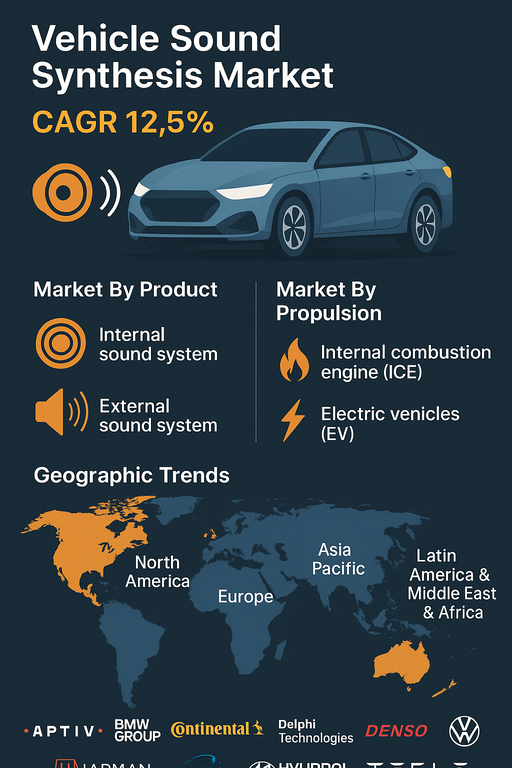
The vehicle sound synthesis market is projected to grow at a Compound Annual Growth Rate (CAGR) of 12% from 2026 to 2034, driven by increasing regulatory mandates for acoustic vehicle alerting systems (AVAS) in electric vehicles, rising adoption of sound design for brand identity, and advancements in acoustic engineering. With the global shift toward electric mobility and silent powertrains, sound synthesis is becoming essential for safety and brand differentiation in both internal combustion engine (ICE) and electric vehicles (EVs).
Market Drivers
Government Mandates on Acoustic Warning Systems
Global regulations, including UNECE R138 and U.S. FMVSS 141, require electric and hybrid vehicles to emit specific sound levels to alert pedestrians at low speeds. These mandates have accelerated the deployment of external sound synthesis systems, particularly in electric vehicles, to ensure safety in urban environments.
Rise of EVs and Sound Branding
With EVs becoming quieter, OEMs are using internal sound synthesis to enhance driving experience and to create unique brand signatures. Synthetic acceleration tones, customizable engine sounds, and immersive cabin acoustics are being integrated to reflect performance, luxury, or futuristic themes, helping differentiate vehicle brands in a competitive market.
Integration of Advanced DSP and AI Technologies
The evolution of digital signal processing (DSP) and AI has enabled real-time audio customization, adaptive sound profiles based on driving modes, and seamless blending with infotainment systems. These innovations enhance the sophistication of both internal and external sound synthesis platforms, supporting new product development and market scalability.
Market Restraint
High Integration and Customization Costs
Customizing synthesized sounds for each vehicle model requires collaboration between OEMs, audio engineers, and compliance experts. The process involves hardware (speakers, amplifiers) and software (DSP, control units), increasing production costs. This can limit adoption among budget vehicle segments or in markets with less stringent sound regulations.
Market Segmentation by Product
In 2025, External Sound Systems accounted for the larger revenue share, driven by regulatory mandates for pedestrian safety in EVs. These systems are critical for alerting nearby pedestrians, especially at speeds under 30 km/h. Internal Sound Systems are expected to register faster growth through 2034, particularly in premium and performance EVs where brands aim to enhance driving experience and differentiate themselves acoustically. This includes synthetic engine growls, start-up sounds, and mode-based acoustic feedback.
Market Segmentation by Propulsion
Electric Vehicles (EVs) led the market in 2025 and will continue to dominate due to silent powertrains requiring both internal and external sound enhancement. The growing EV fleet, government subsidies, and evolving safety norms worldwide are further supporting this trend. ICE vehicles, although naturally loud, are incorporating synthesized sound for branding, especially in turbocharged and hybrid engines where traditional exhaust noise is suppressed. ICE-based sound synthesis is also used to enhance perceived performance in some models.
Geographic Trends
Europe led the vehicle sound synthesis market in 2025 due to stringent AVAS regulations and strong EV penetration in countries like Germany, France, and the Netherlands. European OEMs such as BMW, VW, and Audi are actively investing in acoustic signature development. North America followed, supported by NHTSA regulations and demand for high-performance and luxury EVs. Asia Pacific is expected to register the highest CAGR from 2026 to 2034, driven by rapid EV adoption, urbanization, and government-led safety initiatives in China, Japan, and South Korea. Latin America and Middle East & Africa are nascent markets with future growth potential as EVs become more mainstream and safety standards evolve.
Competitive Trends
The vehicle sound synthesis market is competitive with strong participation from OEMs, Tier-1 suppliers, and audio specialists.
In 2025, Tesla, BMW Group, and Volkswagen led the market in acoustic design for EVs, focusing on external pedestrian safety sounds and in-cabin driving modes. Aptiv, Continental, and Denso offered scalable AVAS solutions with integrated sensors, software, and speaker systems tailored for global regulatory compliance.
Harman International and Delphi Technologies specialized in digital sound synthesis, working with OEMs to develop brand-unique internal soundscapes. General Motors and Hyundai Motor Company focused on cross-segment implementation, bringing premium acoustic features to mid-range EV offerings. The market is witnessing increasing partnerships between automakers, acoustic consultants, and AI sound designers to co-develop next-gen vehicle acoustics aligned with brand identity and safety regulations.
Historical & Forecast Period
This study report represents analysis of each segment from 2024 to 2034 considering 2025 as the base year. Compounded Annual Growth Rate (CAGR) for each of the respective segments estimated for the forecast period of 2026 to 2034.
The current report comprises of quantitative market estimations for each micro market for every geographical region and qualitative market analysis such as micro and macro environment analysis, market trends, competitive intelligence, segment analysis, porters five force model, top winning strategies, top investment markets, emerging trends and technological analysis, case studies, strategic conclusions and recommendations and other key market insights.
Research Methodology
The complete research study was conducted in three phases, namely: secondary research, primary research, and expert panel review. key data point that enables the estimation of Vehicle Sound Synthesis Technology Market By Product, By Propulsion, By Component, By Application, By Sales Channel, By Growth - Growth, Share, Opportunities & Competitive Analysis, 2026 - 2034 market are as follows:
Market forecast was performed through proprietary software that analyzes various qualitative and quantitative factors. Growth rate and CAGR were estimated through intensive secondary and primary research. Data triangulation across various data points provides accuracy across various analyzed market segments in the report. Application of both top down and bottom-up approach for validation of market estimation assures logical, methodical and mathematical consistency of the quantitative data.
| ATTRIBUTE | DETAILS |
|---|---|
| Research Period | 2024-2034 |
| Base Year | 2025 |
| Forecast Period | 2026-2034 |
| Historical Year | 2024 |
| Unit | USD Million |
| Segmentation | |
Product
|
|
Propulsion
|
|
Component
|
|
Application
|
|
Sales Channel
|
|
|
Region Segment (2024-2034; US$ Million)
|
Key questions answered in this report


