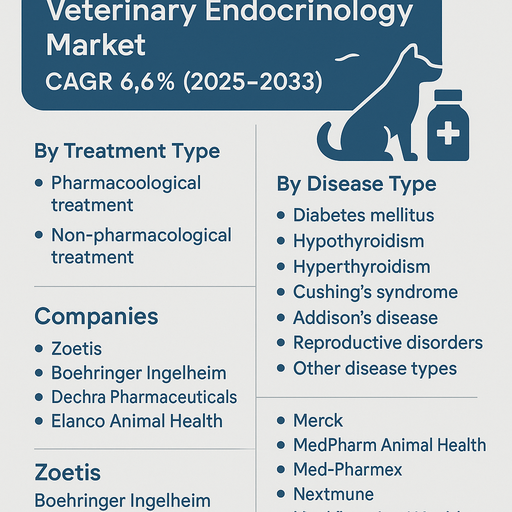
The global veterinary endocrinology market is projected to grow at a CAGR of 6.6% between 2026 and 2034, driven by rising awareness of hormonal disorders in companion and livestock animals, increasing veterinary diagnostic capabilities, and expanding availability of treatment options. Endocrine disorders such as diabetes, thyroid dysfunctions, and adrenal abnormalities are increasingly diagnosed among pets and farm animals due to improved routine screening, better owner compliance, and the rising standard of veterinary care. The shift toward preventive animal healthcare, pet humanization, and tailored therapeutic protocols are accelerating demand for both pharmacological and non-pharmacological treatment options in veterinary endocrinology.
Market Drivers
Increasing Prevalence of Hormonal Disorders in Companion Animals
The global rise in pet ownership, especially in urban centers, is accompanied by a surge in diagnosis of endocrine diseases like diabetes mellitus, hypothyroidism, and Cushing’s syndrome among dogs and cats. Sedentary lifestyles, obesity, and aging animal populations are key contributors to endocrine imbalances. As veterinary clinics become more equipped with diagnostic imaging, hormone assays, and point-of-care tests, more cases are being identified and managed earlier. Pet owners are increasingly opting for long-term, hormone-regulating treatments to improve their animals’ quality of life, boosting market growth.
Advances in Veterinary Therapeutics and Hormone Delivery Systems
The veterinary endocrinology field is witnessing continuous innovation in drug formulation, hormone replacement therapies, and treatment delivery. The development of long-acting insulin analogs, transdermal gels for thyroid regulation, and sustained-release corticosteroids has improved compliance and therapeutic outcomes. Moreover, veterinary pharmaceutical companies are investing in species-specific endocrinology drugs, enabling more targeted and safer treatment options. These advancements are encouraging both general and specialty veterinarians to adopt pharmacological solutions at scale.
Market Restraint
Cost and Duration of Treatment for Chronic Conditions
Managing endocrine disorders in animals often requires lifelong treatment, which includes regular diagnostic testing, continuous medication, and clinical monitoring. The cost burden associated with managing chronic conditions like diabetes and Addison’s disease can discourage long-term adherence, particularly among owners in cost-sensitive regions. Additionally, specialized endocrinology services are concentrated in urban centers, limiting access to advanced treatments in rural or low-income areas. These barriers can delay diagnosis, limit therapy coverage, and impact market expansion, especially in developing economies.
Market Segmentation by Treatment Type
The market is segmented into Pharmacological Treatment and Non-pharmacological Treatment. In 2025, pharmacological treatments held the largest share due to the widespread use of hormone replacement therapies, insulin injections, thyroid hormone supplements, and glucocorticoids. These treatments are vital for managing chronic disorders and ensuring hormonal balance in animals with endocrine dysfunctions. Non-pharmacological treatments, including dietary modifications, weight management programs, and environmental enrichment, are gaining ground as adjunct therapies, especially in early-stage or mild conditions. From 2026 to 2034, the integration of personalized nutrition and digital monitoring in non-pharmacological approaches is expected to drive steady segment growth.
Market Segmentation by Disease Type
By disease type, the market includes Diabetes Mellitus, Hypothyroidism, Hyperthyroidism, Cushing's Syndrome, Addison's Disease, Reproductive Disorders, and Other Disease Types. In 2025, diabetes mellitus emerged as the leading disease segment, primarily affecting older and obese pets, requiring consistent insulin therapy and glucose monitoring. Hypothyroidism and Cushing’s syndrome followed, driven by better diagnostic awareness and the availability of effective hormone-based medications. Reproductive disorders, such as hormonal imbalances in breeding animals, are a growing focus in veterinary reproductive health. Addison’s disease and hyperthyroidism represent niche but high-treatment-value categories. Over the forecast period, endocrine reproductive and adrenal conditions are expected to gain attention due to advancements in veterinary diagnostics and research.
Geographic Trends
In 2025, North America led the veterinary endocrinology market, fueled by high pet adoption rates, access to advanced veterinary infrastructure, and widespread awareness of pet health. The U.S. accounted for the largest share due to its well-established veterinary pharma ecosystem and pet insurance coverage. Europe followed, especially in Western European countries like Germany, France, and the UK, where regulatory support and companion animal spending are high. Asia Pacific is expected to register the highest CAGR from 2026 to 2034, supported by rising pet ownership, emerging veterinary healthcare systems, and growing investments in companion animal therapeutics across India, China, and Southeast Asia. Latin America and the Middle East & Africa are emerging markets with increasing veterinary service penetration and growing interest in chronic disease management for livestock and pets.
Competitive Trends
In 2025, the veterinary endocrinology market was led by a combination of multinational veterinary pharmaceutical companies and regionally active players. Zoetis, Elanco Animal Health, and Boehringer Ingelheim led the global market with broad endocrinology portfolios targeting diabetes, adrenal disorders, and thyroid dysfunctions. Merck and Virbac offered hormone therapies and veterinary insulin products with a strong presence in North America and Europe. Dechra Pharmaceuticals specialized in niche endocrinology solutions and compounded medications for hormone imbalances. Vivaldis Animal Health and Kela Health provided species-specific hormonal therapies, especially across India and Europe. MedPharm Animal Health, Med-Pharmex, and Nextmune focused on diversified therapeutic portfolios, including endocrine-related immune and allergy conditions. Forthcoming trends include AI-driven endocrine diagnostics, smart drug delivery systems, and combination therapies integrating pharmacological and lifestyle approaches for managing chronic endocrine diseases in veterinary medicine.
Historical & Forecast Period
This study report represents analysis of each segment from 2024 to 2034 considering 2025 as the base year. Compounded Annual Growth Rate (CAGR) for each of the respective segments estimated for the forecast period of 2026 to 2034.
The current report comprises of quantitative market estimations for each micro market for every geographical region and qualitative market analysis such as micro and macro environment analysis, market trends, competitive intelligence, segment analysis, porters five force model, top winning strategies, top investment markets, emerging trends and technological analysis, case studies, strategic conclusions and recommendations and other key market insights.
Research Methodology
The complete research study was conducted in three phases, namely: secondary research, primary research, and expert panel review. key data point that enables the estimation of Veterinary Endocrinology market are as follows:
Market forecast was performed through proprietary software that analyzes various qualitative and quantitative factors. Growth rate and CAGR were estimated through intensive secondary and primary research. Data triangulation across various data points provides accuracy across various analyzed market segments in the report. Application of both top down and bottom-up approach for validation of market estimation assures logical, methodical and mathematical consistency of the quantitative data.
| ATTRIBUTE | DETAILS |
|---|---|
| Research Period | 2024-2034 |
| Base Year | 2025 |
| Forecast Period | 2026-2034 |
| Historical Year | 2024 |
| Unit | USD Million |
| Segmentation | |
Treatment Type
|
|
Disease Type
|
|
Animal Type
|
|
End Use
|
|
|
Region Segment (2024-2034; US$ Million)
|
Key questions answered in this report