"Replacement of Battery-powered Sensors by Autonomous Energy Harvesting Wireless Sensors to Stimulate the Demand for Vibration Energy Harvesting Systems Market"
Vibration energy harvesting systems market reached market value of US$ 398.68 Mn in 2021, with a promising CAGR during the forecast period from 2022 to 2030. Essentially directed by North America, vibration energy harvesting systems market is majorly driven by its penetration across electronic systems. Rising adoption of Internet of Things (IoT) applications in industrial as well as in consumer electronics are aiming for enhanced smartness of such devices. Numerous sensors are required to make IoT process work and such sensors need continuous power supply for functionality without breakage. Typically, batteries are used to power the sensing equipment although they possess limited lifetime with complex system structure due to thousands of wireless devices, thus significant efforts are required to replace the batteries. On the other hand, energy harvesting powered sensors are autonomous and require less maintenance enabling easier installation than conventional batteries. Further, vibration energy harvesting systems are relevant to greater extent for remote or hostile environments for complex and costly battery changes. Currently, applications of vibration energy harvesting are limited due to its small conversion efficiency (around 5%) and its low power storage capacities; however, with continuous technological advancements aiming its penetration across several applications, consequently, market expected to witness promising growth throughout the forecast period.
"Consumer Electronics Segment to Cement the Dominating Position in Vibration Harvesting Systems Market"
Consumer electronics segment represented the lion share of overall vibration energy harvesting systems market value generated worldwide. Electronic hardware circuitries have become cheaper & smaller making wireless communication more competent. This stimulated technologies such as Wireless Sensor Networks (WSN) or the Internet of Things (IoT) to play vital role in real-time application. Many of these devices embedded and need continuous run, making it inefficient to use the connected power grids, as it would require proper maintenance. Vibration energy harvesting systems for small-scale electronics are used in portable forms. In case of low power applications such as nodes in WSN could not only decrease the reliance on conventional batteries but even capable to replace them. Vibration energy harvesting has key economic and technological impacts as it facilitates the swift spread of IoT applications enabling them with an autonomous power supply and by reducing the installation & maintenance costs pertaining to conventional batteries. Therefore, vibration energy harvesting is enabling the development of technologies that would have been uneconomical without it. Growing penetration of such energy harvesting systems in consumer electronics expected to grow with rapid rate across the forecast period.
Although the market value of vibration energy harvesting in healthcare appear as marginal, it is expected to grow with higher CAGR compared to other applications. Vibration energy harvesting technologies present valuable social benefits when applied to the healthcare sector. Several organizations are currently working on creating an automated pacemaker that will convert kinetic energy from the beating of the human heart into electrical energy. The device would enable self-charging mechanism by the body’s vibration.
"Growing Penetration of Vibration Energy Harvesting Systems across Wide Application Areas to Ensure Fastest Growth in Asia Pacific Market"
Presently, North America leads the vibration energy harvesting systems market with lion share of the overall market value worldwide. The U.S. with strong adaptive market to new technologies across the nation primarily backs the market here. Market potential of each region depends on combination of energy resources, electricity market structure, regulatory framework, population demographics, energy-demand patterns & trends and general grid architecture. North America, as well as Europe, possess the presence of majority leading market players. Honeywell International Inc., Cymbet Corporation, Powercast Corporation, Texas Instruments Incorporation, Convergence Wireless, and Microchip Technology are U.S. based manufacturers. Similarly, ABB Ltd., Arveni and EnOcean GmbH are Europe based companies. Furthermore, Asia Pacific expected to witness highest growth rate across the forecast period. Increasing focus on use of renewable energy expected to drive the market here. Japan announced its aim to become leader in renewable energy usages by 2034. Similarly, China is the main manufacturer of vibration energy harvesting systems across Asia Pacific market. Rapid growth of end-use applications such as consumer electronics, industrial, transportation and others expected to drive the market here.
"Technological Advancement of Harvesting Systems to Remain Key Strategy for Vibration Energy Harvesting Systems Manufacturers"
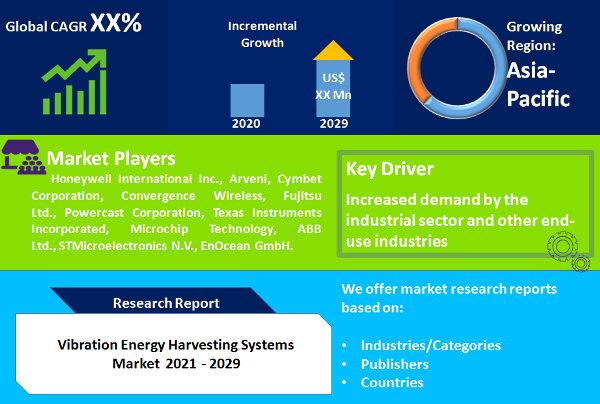
Vibration energy harvesting systems market accounted highly competitive in nature with appearance of both domestic as well as international players. Number of players are concentrating on technological advancement of product to specialize explicit application areas. Numerous players and startups expected to massively penetrate the market despite the heavy investments required to enter in the market, owing to the attractive growth opportunities. Key players of global vibration energy harvesting systems market include Honeywell International Inc., Arveni, Cymbet Corporation, Convergence Wireless, Fujitsu Ltd., Powercast Corporation, Texas Instruments Incorporated, Microchip Technology, ABB Ltd., STMicroelectronics N.V., EnOcean GmbH, and others.
Historical & Forecast Period
This study report represents analysis of each segment from 2024 to 2034 considering 2025 as the base year. Compounded Annual Growth Rate (CAGR) for each of the respective segments estimated for the forecast period of 2026 to 2034.
The current report comprises of quantitative market estimations for each micro market for every geographical region and qualitative market analysis such as micro and macro environment analysis, market trends, competitive intelligence, segment analysis, porters five force model, top winning strategies, top investment markets, emerging trends and technological analysis, case studies, strategic conclusions and recommendations and other key market insights.
Research Methodology
The complete research study was conducted in three phases, namely: secondary research, primary research, and expert panel review. key data point that enables the estimation of Vibration Energy Harvesting Systems market are as follows:
Market forecast was performed through proprietary software that analyzes various qualitative and quantitative factors. Growth rate and CAGR were estimated through intensive secondary and primary research. Data triangulation across various data points provides accuracy across various analyzed market segments in the report. Application of both top down and bottom-up approach for validation of market estimation assures logical, methodical and mathematical consistency of the quantitative data.
| ATTRIBUTE | DETAILS |
|---|---|
| Research Period | 2024-2034 |
| Base Year | 2025 |
| Forecast Period | 2026-2034 |
| Historical Year | 2024 |
| Unit | USD Million |
| Segmentation | |
Product
|
|
Application
|
|
|
Region Segment (2024-2034; US$ Million)
|
Key questions answered in this report