
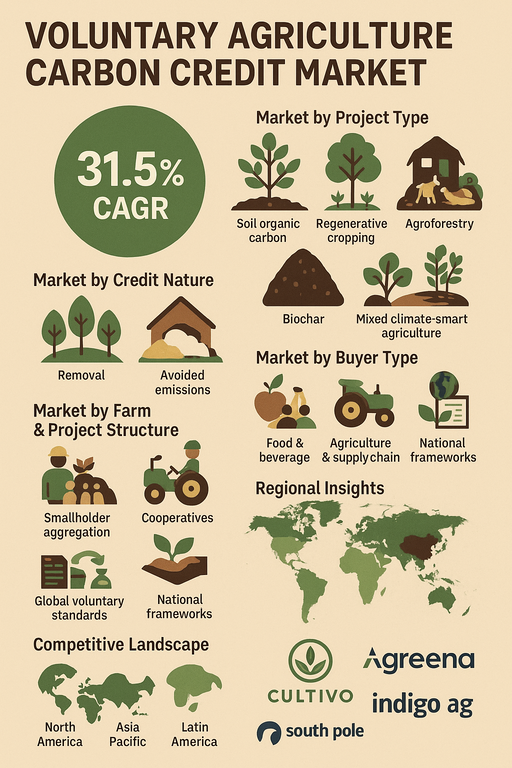
The voluntary agriculture carbon credit market is growing at a 31.5% CAGR as food systems, corporates, and investors look to use climate-smart farming as a source of verified carbon reductions and removals. Agriculture offers large-scale, relatively low-cost opportunities to store carbon in soils and biomass or to cut emissions from rice, livestock, and fertilizer use. Voluntary schemes reward farmers for practices such as regenerative cropping, agroforestry, rice methane reduction, improved manure management, and biochar use, turning climate outcomes into tradable credits for corporate buyers. By project type, soil organic carbon and regenerative cropping projects currently generate the highest volume of credits, while agroforestry, biochar, and mixed climate-smart agriculture packages are expected to record the highest CAGR as methodologies expand and buyers seek more diversified, resilient portfolios. By credit nature, removal credits are emerging as the preferred segment for long-term climate commitments, while avoided emissions credits still represent a significant share of traded volume and near-term mitigation.
Market Drivers
Growth is driven by rising corporate net-zero commitments, stronger scrutiny of Scope 3 emissions, and the search for nature-based solutions that can be deployed at farm level. Food, beverage, and consumer goods companies are under pressure to reduce emissions across their supply chains, especially from agricultural raw materials, and view voluntary agriculture carbon credits as a bridge between current practices and future low-carbon systems. Agriculture offers multiple mitigation levers in one landscape, including soil carbon sequestration, reduced methane and nitrous oxide emissions, and improved biomass management, which helps create scalable project pipelines. Advances in remote sensing, soil sampling protocols, digital farm management tools, and modeling platforms allow more accurate measurement and monitoring of farm-level climate outcomes, reducing transaction costs and making aggregation models more practical. Policy and investor interest in nature-based solutions and climate-smart agriculture also supports the market by directing technical assistance and blended finance toward project development. At the farm level, payments from carbon programs can supplement crop income and help de-risk the adoption of regenerative practices and new inputs.
Market Restraints
The market faces restraints linked to measurement uncertainty, additionality concerns, and complex program design. Quantifying soil carbon changes, nitrous oxide reductions, or methane cuts over large and diverse landscapes remains technically challenging, and results depend on sampling design, modeling assumptions, and management stability. Buyers and civil society groups increasingly question the permanence and additionality of agricultural credits, especially where baseline practices are not clearly defined or where reversals can occur due to drought, fire, or management change. Methodologies across standards can differ, making it hard to compare credits and leading to fragmentation. Smallholder farmers may find participation difficult due to data requirements, contract complexity, and delayed payments, which can limit project scalability in some regions. Price volatility and periods of low demand in the broader voluntary carbon market can reduce revenue visibility for project developers and farmers. Regulatory uncertainty around how voluntary agriculture credits will interact with compliance markets and emerging national carbon frameworks also creates hesitation for some investors and buyers.
Market by Project Type (Agriculture Practice)
Soil organic carbon and regenerative cropping projects focus on conservation tillage or no-till, cover crops, diversified rotations, and optimized fertilizer use to build carbon in soils and reduce emissions from crop production. These projects form the backbone of the voluntary agriculture carbon credit market and generate the highest volume of credits due to broad applicability across major grain, oilseed, and row-crop regions. Agroforestry and tree-based farming systems combine trees with crops or pasture to increase above-ground and below-ground biomass, improve resilience, and generate both removal and, in some cases, avoided emissions credits. This segment is expected to show strong growth, especially in regions where tree-crop systems align with livelihood goals. Rice methane reduction projects focus on water management (such as alternate wetting and drying), improved straw management, and input optimization to cut methane from flooded rice fields; these projects are important in regions with large rice areas and can create significant reductions per hectare. Livestock and manure management projects target enteric methane reduction through feed strategies and herd management, as well as improved manure storage and treatment that reduce methane and nitrous oxide emissions. Biochar and crop residue management projects produce stable carbon materials from biomass and crop residues and apply them to soils, delivering long-lived removals alongside agronomic benefits; this segment is expected to post one of the highest CAGRs as biochar supply chains and methodologies mature. Mixed climate-smart agriculture packages and other practices bundle several interventions such as improved seeds, nutrient management, water efficiency, and residue handling under integrated methodologies, giving developers more flexibility and helping farmers implement whole-farm climate strategies.
Market by Credit Nature
Removal credits, based on carbon sequestration in soils, biomass, or long-lived materials such as biochar, are gaining prominence as corporate buyers look for durable outcomes that align with long-term net-zero and neutralization goals. These credits are often associated with higher scrutiny, tighter monitoring requirements, and the potential for price premiums where durability and verifiable storage can be demonstrated. Avoided emissions credits arise from practices that reduce future emissions relative to a baseline, such as lower methane from rice or livestock, improved fertilizer use, or better manure management. They remain important for near-term mitigation and for sectors that need scalable, relatively low-cost options. As market expectations evolve, many buyers construct portfolios that mix removals and avoided emissions credits, with a gradual shift in emphasis toward removals for long-term commitments and continued use of avoided emissions credits for interim targets and broader risk management.
Market by Farm and Project Structure
Smallholder aggregation programs collect many small farms into a single project, using standardized practices, digital tools, and intermediaries to spread transaction costs. These programs are essential in regions dominated by small farms and can deliver strong social co-benefits, but they require robust monitoring and farmer engagement models. Medium and large commercial farms often have better record-keeping, machinery, and digital infrastructure, making them suitable for projects that rely on detailed field-level data and precision management; this segment provides relatively lower per-hectare transaction costs and can scale quickly once practices are adopted. Farmer cooperatives and producer organizations serve as intermediaries that can coordinate data, implement training, and negotiate carbon contracts on behalf of members, which strengthens bargaining power and reduces complexity for individual farmers. Agri-corporate and input-company-led programs are built around seed, fertilizer, crop protection, and equipment companies that integrate carbon outcomes into their value-added services and advisory offerings. These programs are expected to record one of the highest CAGRs as large input and agribusiness firms use their networks, agronomic platforms, and financing tools to scale climate-smart projects across multiple regions and crops.
Market by Buyer Type
Food, beverage, consumer packaged goods, and retail companies are major buyers in the voluntary agriculture carbon credit market because a large part of their Scope 3 emissions comes from agricultural supply chains. They often prefer credits linked to crops and regions that align with their sourcing footprints and may combine credit purchases with in-setting programs. Agriculture and food supply chain companies, including traders, processors, and input suppliers, buy credits linked to their sourcing regions and farming partners to meet their own climate targets and support resilient supply chains. Corporate buyers outside food, including technology, finance, manufacturing, and services, use agriculture credits as part of broader voluntary portfolios, often seeking nature-based solutions that deliver co-benefits such as biodiversity and water outcomes. Financial institutions, carbon funds, and intermediaries purchase or pre-finance credits as part of investment products, structured funds, or brokerage portfolios, helping to provide upfront capital for project development. Public and quasi-public buyers, including NGOs, development agencies, and individual buyers, sometimes support agriculture carbon projects for their rural development and ecosystem benefits, although their share of total volume is smaller compared with large corporate buyers.
Market by Standard / Registry
Projects under major global voluntary standards rely on well-established methodologies and registries, which can increase buyer confidence and ease secondary trading. These standards often provide methodologies for soil carbon, rice methane, livestock, agroforestry, and biochar, and are widely recognized by large corporate buyers and financial intermediaries. Projects under other recognized standards or regional frameworks cover region-specific practices or pilot methodologies that align with local agronomy and policy contexts, and can be important in markets where national authorities or regional alliances support tailored approaches. Projects under national voluntary frameworks or pilot schemes are emerging as countries develop their own carbon market architecture and seek to align voluntary agriculture projects with national climate strategies and future compliance markets. Over time, alignment and interoperability between global and national frameworks will be important to avoid double counting and to enable agriculture projects to serve both corporate buyers and national climate goals.
Regional Insights
North America and Europe are leading regions in voluntary agriculture carbon credit development, supported by strong corporate net-zero commitments, advanced agritech, and robust advisory networks. Large row-crop farms in North America and mixed farming systems in Europe provide substantial potential for soil carbon, nutrient management, and livestock projects, and there is growing integration between carbon programs and supply chain initiatives led by food and beverage brands. In Europe, links between agriculture carbon initiatives and broader climate and biodiversity policies influence project design and co-benefits. Asia Pacific, including India, Southeast Asia, and parts of East Asia, is expected to record strong growth, driven by smallholder aggregation programs in rice, mixed cropping systems, and agroforestry, often supported by development partners and digital platforms that reduce data and monitoring barriers. Latin America has significant potential in grazing systems, agroforestry, and row-crop production, and is seeing rising interest from global buyers that source commodities from the region and want to combine emissions reductions with deforestation-free supply chains. Africa offers large scope for soil carbon, agroforestry, and mixed climate-smart agriculture projects, with many initiatives focusing on smallholder livelihoods, though transaction costs and capacity constraints must be addressed. Regions with strong digital infrastructure, supportive policy environments, and established relationships between agribusinesses, standards, and project developers are likely to see faster market expansion.
Competitive Landscape
AgriCapture, Agoro Carbon Alliance, Agreena, Boomitra, Carbon Asset Solutions, CIBO Technologies, eAgronom, Indigo Ag, Landbanking Group, Loam Bio, Nori, Varaha ClimateAg Private Limited, and others act as project developers and platforms focused on agriculture carbon, working with farmers to design practices, monitor outcomes, and generate verified credits. Their models often combine agronomy advisory, digital tools, and financing schemes to de-risk practice changes and manage data requirements. CarbonSink, TerraCarbon, South Pole, and GreenCollar bring broader carbon project development and advisory expertise, extending experience from forestry and other nature-based solutions into agriculture-focused portfolios and offering structuring, methodology selection, and market access. Climate Action Reserve and similar organizations operate as standards or registries in some cases, helping to develop methodologies and provide oversight for project registration and credit issuance. Cultivo and Green Carbon Inc. focus on structuring nature-based solutions as investable assets, connecting institutional capital with agriculture and land-based projects. EverCarbon and related players work on integrating monitoring technologies, remote sensing, and data science into verification workflows. As the market grows, companies that can combine robust methodologies, credible monitoring and reporting, strong farmer value propositions, and direct links to large corporate buyers and financial institutions are expected to lead revenue, while those that integrate soil science, biological innovations, and scalable digital platforms across multiple regions are likely to capture the highest CAGR in the voluntary agriculture carbon credit market.
Historical & Forecast Period
This study report represents analysis of each segment from 2024 to 2034 considering 2025 as the base year. Compounded Annual Growth Rate (CAGR) for each of the respective segments estimated for the forecast period of 2026 to 2034.
The current report comprises of quantitative market estimations for each micro market for every geographical region and qualitative market analysis such as micro and macro environment analysis, market trends, competitive intelligence, segment analysis, porters five force model, top winning strategies, top investment markets, emerging trends and technological analysis, case studies, strategic conclusions and recommendations and other key market insights.
Research Methodology
The complete research study was conducted in three phases, namely: secondary research, primary research, and expert panel review. key data point that enables the estimation of Voluntary Agriculture Carbon Credit Market By Project Type, By Credit Nature, By Farm and Project Structure, By Buyer Type, By Standard, By region - Global Market Analysis & Forecast, 2025 to 2033 market are as follows:
Market forecast was performed through proprietary software that analyzes various qualitative and quantitative factors. Growth rate and CAGR were estimated through intensive secondary and primary research. Data triangulation across various data points provides accuracy across various analyzed market segments in the report. Application of both top down and bottom-up approach for validation of market estimation assures logical, methodical and mathematical consistency of the quantitative data.
| ATTRIBUTE | DETAILS |
|---|---|
| Research Period | 2024-2034 |
| Base Year | 2025 |
| Forecast Period | 2026-2034 |
| Historical Year | 2024 |
| Unit | USD Million |
| Segmentation | |
Project Type (Agriculture Practice)
|
|
Credit Nature
|
|
Farm and Project Structure
|
|
Buyer Type
|
|
Standard
|
|
|
Region Segment (2024-2034; US$ Million)
|
Key questions answered in this report


