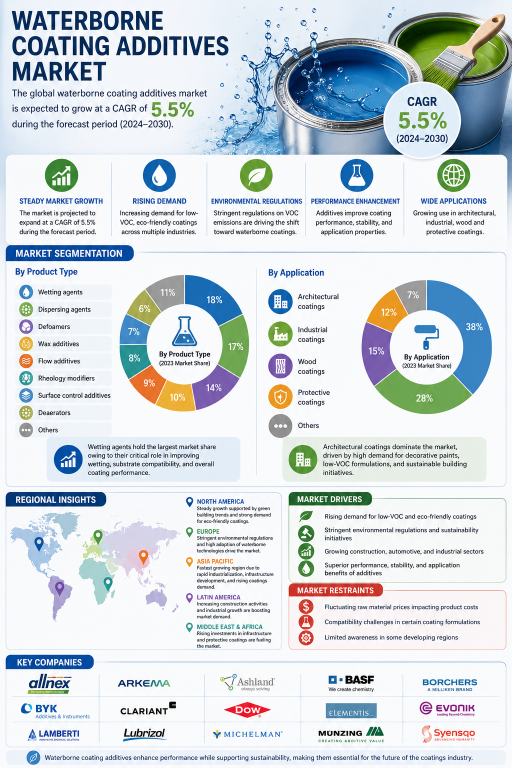
The global waterborne coating additives market is expected to grow at a CAGR of 5.5% during the forecast period. Market growth is being driven by increasing demand for environmentally friendly coatings, stringent regulations on volatile organic compound (VOC) emissions, and growing adoption of sustainable coating technologies across construction, industrial, automotive, and wood finishing applications. Waterborne coating additives play a critical role in improving coating performance, appearance, stability, durability, and application properties while supporting low-emission formulations. Rising investments in green building projects and sustainable manufacturing practices are further contributing to market expansion.
Market Drivers
Growing Demand for Low-VOC and Sustainable Coatings
Governments and regulatory agencies worldwide are implementing strict environmental regulations aimed at reducing VOC emissions from paints and coatings. As a result, manufacturers are increasingly shifting toward waterborne coating systems that offer lower environmental impact compared to solvent-based alternatives. Waterborne coating additives are essential for achieving desired coating performance, driving demand across architectural, industrial, and protective coating applications.
Market Restraints
Raw Material Price Volatility
The production of coating additives relies on specialty chemicals and raw materials whose prices can fluctuate due to supply chain disruptions, energy costs, and geopolitical factors. These price variations can impact manufacturing costs and profit margins for additive producers. In addition, performance requirements in demanding applications may sometimes necessitate more expensive additive formulations.
Waterborne Coating Additives Market Trends
The market is witnessing increasing adoption of multifunctional additives that provide wetting, dispersing, defoaming, and rheology modification capabilities within a single formulation. Manufacturers are focusing on bio-based additives, silicone-free technologies, and advanced surface control solutions to meet sustainability targets. Innovations in nano-enabled additives and high-performance waterborne formulations are also gaining momentum across industrial and protective coating segments.
Market Segmentation
By Product Type
Based on product type, the market is segmented into Wetting Agents, Dispersing Agents, Defoamers, Wax Additives, Flow Additives, Rheology Modifiers, Surface Control Additives, Deaerators, and Others. Wetting agents account for a significant market share due to their critical role in improving substrate wetting, pigment acceptance, and coating uniformity. Dispersing agents are widely used to stabilize pigments and fillers, while rheology modifiers continue to witness strong demand owing to their ability to control viscosity and application performance. Surface control additives and defoamers are increasingly utilized to enhance finish quality and eliminate coating defects.
By Application
Based on application, the market is segmented into Architectural Coatings, Industrial Coatings, Wood Coatings, Protective Coatings, and Others. Architectural coatings hold a major market share due to growing construction activities and rising demand for low-VOC decorative paints. Industrial coatings represent a significant segment supported by manufacturing growth and equipment protection requirements. Protective coatings are expected to witness strong growth owing to increasing infrastructure investments and demand for corrosion-resistant coating systems. Wood coatings continue to benefit from growth in furniture and interior finishing applications.
Regional Insights
North America remains a major market due to strict environmental regulations, high adoption of sustainable coating technologies, and strong demand from construction and industrial sectors. Europe continues to be a key market driven by advanced environmental standards and strong focus on green chemistry solutions. Asia Pacific is expected to witness the fastest growth owing to rapid urbanization, industrialization, infrastructure development, and expanding coatings manufacturing in China, India, Japan, and Southeast Asia. Latin America and the Middle East & Africa are also experiencing steady growth supported by increasing construction activities and industrial expansion.
Competitive Landscape
The waterborne coating additives market is characterized by continuous product innovation, sustainability-focused development, and strategic collaborations. Leading manufacturers are investing in advanced additive technologies that improve coating performance while meeting evolving environmental regulations. Companies are also expanding production capacities and strengthening regional distribution networks to enhance market presence.
Key companies operating in the market include Allnex, Arkema, Ashland, BASF, Borchers (Milliken), BYK (ALTANA), Clariant, Dow, Elementis, Evonik, Lamberti, Lubrizol, Michelman, Münzing Chemie, and Syensqo.
Waterborne Coating Additives Industry News
The industry is witnessing increased investments in sustainable additive technologies designed for next-generation waterborne coatings. Manufacturers are launching new wetting agents, dispersants, and rheology modifiers that improve coating efficiency while reducing environmental impact. Strategic partnerships between additive suppliers and coating manufacturers are also accelerating the development of high-performance, low-emission coating formulations.
Historical & Forecast Period
This study report represents analysis of each segment from 2024 to 2034 considering 2025 as the base year. Compounded Annual Growth Rate (CAGR) for each of the respective segments estimated for the forecast period of 2026 to 2034.
The current report comprises of quantitative market estimations for each micro market for every geographical region and qualitative market analysis such as micro and macro environment analysis, market trends, competitive intelligence, segment analysis, porters five force model, top winning strategies, top investment markets, emerging trends and technological analysis, case studies, strategic conclusions and recommendations and other key market insights.
Research Methodology
The complete research study was conducted in three phases, namely: secondary research, primary research, and expert panel review. key data point that enables the estimation of Waterborne Coating Additives market are as follows:
Market forecast was performed through proprietary software that analyzes various qualitative and quantitative factors. Growth rate and CAGR were estimated through intensive secondary and primary research. Data triangulation across various data points provides accuracy across various analyzed market segments in the report. Application of both top down and bottom-up approach for validation of market estimation assures logical, methodical and mathematical consistency of the quantitative data.
| ATTRIBUTE | DETAILS |
|---|---|
| Research Period | 2024-2034 |
| Base Year | 2025 |
| Forecast Period | 2026-2034 |
| Historical Year | 2024 |
| Unit | USD Million |
| Segmentation | |
Product Type
|
|
Application
|
|
End User Industry
|
|
Distribution Channel
|
|
|
Region Segment (2024-2034; US$ Million)
|
Frequently Asked Questions
What is the expected growth rate of the waterborne coating additives market?
The market is expected to grow at a CAGR of 5.5% during the forecast period.
Which product segment holds a significant market share?
Wetting agents hold a significant share due to their importance in improving coating application and substrate coverage.
Which application dominates the market?
Architectural coatings account for a major share due to growing construction activities and demand for environmentally friendly paints.
What is driving market growth?
Major growth drivers include increasing adoption of low-VOC coatings, stringent environmental regulations, and growing demand for sustainable coating technologies.
Who are the major companies operating in the market?
Major companies include Allnex, Arkema, Ashland, BASF, Borchers (Milliken), BYK (ALTANA), Clariant, Dow, Elementis, Evonik, Lamberti, Lubrizol, Michelman, Münzing Chemie, and Syensqo.