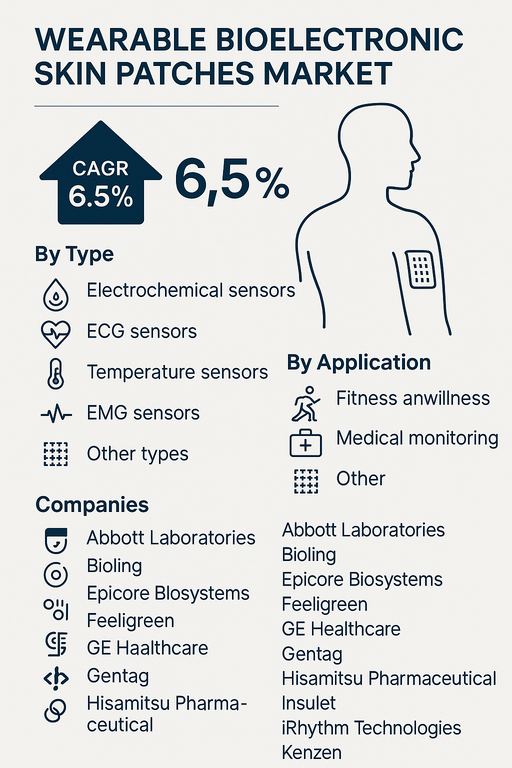
The global wearable bioelectronic skin patches market is expected to grow at a CAGR of 6.5% from 2026 to 2034, driven by increasing adoption of real-time health monitoring technologies, the growth of telemedicine, and advancements in flexible electronics and biosensing materials. These patches, worn directly on the skin, provide continuous and non-invasive monitoring of physiological parameters such as glucose levels, heart rate, temperature, hydration, and muscle activity. Their integration into digital health ecosystems is transforming both preventive healthcare and chronic disease management.
Growing Demand for Continuous, Non-Invasive Monitoring
The increasing prevalence of chronic diseases, such as diabetes and cardiovascular disorders, is driving demand for solutions that offer continuous and remote health monitoring. Bioelectronic skin patches provide a user-friendly interface for real-time data collection without the need for invasive procedures or bulky equipment. In wellness and sports settings, these patches help users monitor hydration, muscle activity, and sleep quality, contributing to performance optimization and injury prevention. The ability to gather accurate biometric data over extended periods makes these patches a cornerstone in the evolution of personalized medicine.
Technological Advancements in Sensor Design and Materials
The market is benefiting from rapid developments in stretchable electronics, flexible substrates, and skin-compatible adhesives. Modern bioelectronic patches are lightweight, breathable, and capable of conforming to body movements, ensuring long wearability and comfort. Advanced electrochemical and electrophysiological sensors enable the measurement of various biomarkers, including sweat composition, body temperature, and muscle signals. Integration with Bluetooth and IoT platforms allows seamless data transmission to mobile devices and healthcare provider portals. These innovations are improving diagnostic accuracy and patient compliance while expanding the range of measurable parameters.
Challenges in Data Privacy, Power Supply, and Standardization
Despite promising growth, the market faces several challenges. Data privacy and security are major concerns as patches continuously collect sensitive health information, often transmitted over wireless networks. Additionally, battery life and energy efficiency remain technical hurdles, particularly for multi-sensor and long-duration use cases. Regulatory standardization is still evolving, which affects product development timelines and market entry strategies, especially in medical-grade applications. However, ongoing R&D in energy harvesting, closed-loop systems, and biocompatible materials is expected to address these issues progressively.
Market Segmentation by Type
By type, the market is segmented into electrochemical sensors, ECG sensors, temperature sensors, EMG sensors, and other types. In 2025, ECG sensors accounted for a significant share of the market due to their widespread application in cardiac monitoring, including arrhythmia detection and remote post-surgical surveillance. Electrochemical sensors are gaining popularity for non-invasive glucose and lactate monitoring through sweat analysis. EMG sensors are being increasingly used in fitness, rehabilitation, and neuro-muscular applications. Temperature sensors remain vital for fever screening, metabolic analysis, and thermal comfort assessments.
Market Segmentation by Application
By application, the market is segmented into fitness and wellness, medical monitoring, and other applications. Fitness and wellness led the market in 2025, supported by consumer demand for wearable health insights and performance analytics. However, medical monitoring is expected to grow at a faster pace during the forecast period, driven by chronic disease management, hospital-at-home care models, and post-operative recovery tracking. Other applications, including clinical trials, drug delivery feedback, and workplace health management, are gradually expanding the scope of wearable bioelectronic patch usage.
Regional Market Insights
North America held the largest market share in 2025 due to strong healthcare infrastructure, high wearable adoption rates, and significant investments in digital health startups. The presence of major players such as Abbott, Medtronic, and iRhythm Technologies further supports innovation and adoption. Europe followed closely, with countries like Germany, the UK, and the Netherlands embracing remote monitoring solutions through supportive regulatory frameworks. Asia Pacific is anticipated to witness the highest CAGR through 2034, fueled by increasing health awareness, mobile health adoption, and expanding healthcare access in countries like China, Japan, and India. Latin America and the Middle East & Africa are emerging markets where lifestyle-related health issues and the proliferation of consumer electronics are encouraging growth in wearable health technologies.
Competitive Landscape
The wearable bioelectronic skin patches market in 2025 featured a dynamic mix of medical device companies, health tech startups, and consumer electronics firms. Abbott Laboratories, Medtronic, and GE Healthcare led the regulated medical-grade segment with strong R&D pipelines and established healthcare provider networks. Biolinq, Epicore Biosystems, and Feeligreen focused on sweat analytics and continuous biomarker detection through electrochemical sensors. iRhythm Technologies and Nemaura Medical specialized in cardiac and metabolic monitoring patches, respectively. Koninklijke Philips and 3M contributed to the development of diagnostic and adhesive sensor technologies. Other notable players like VivaLNK, Insulet, Gentag, Kenzen, and Hisamitsu Pharmaceutical continue to invest in skin-compatible patch technologies for both clinical and consumer health markets. Key strategies across the board include miniaturization, multifunctional sensing, cloud-based data integration, and compliance with evolving global regulatory standards.
Historical & Forecast Period
This study report represents analysis of each segment from 2024 to 2034 considering 2025 as the base year. Compounded Annual Growth Rate (CAGR) for each of the respective segments estimated for the forecast period of 2026 to 2034.
The current report comprises of quantitative market estimations for each micro market for every geographical region and qualitative market analysis such as micro and macro environment analysis, market trends, competitive intelligence, segment analysis, porters five force model, top winning strategies, top investment markets, emerging trends and technological analysis, case studies, strategic conclusions and recommendations and other key market insights.
Research Methodology
The complete research study was conducted in three phases, namely: secondary research, primary research, and expert panel review. key data point that enables the estimation of Wearable Bioelectronic Skin Patches market are as follows:
Market forecast was performed through proprietary software that analyzes various qualitative and quantitative factors. Growth rate and CAGR were estimated through intensive secondary and primary research. Data triangulation across various data points provides accuracy across various analyzed market segments in the report. Application of both top down and bottom-up approach for validation of market estimation assures logical, methodical and mathematical consistency of the quantitative data.
| ATTRIBUTE | DETAILS |
|---|---|
| Research Period | 2024-2034 |
| Base Year | 2025 |
| Forecast Period | 2026-2034 |
| Historical Year | 2024 |
| Unit | USD Million |
| Segmentation | |
Type
|
|
Application
|
|
End Use
|
|
|
Region Segment (2024-2034; US$ Million)
|
Key questions answered in this report