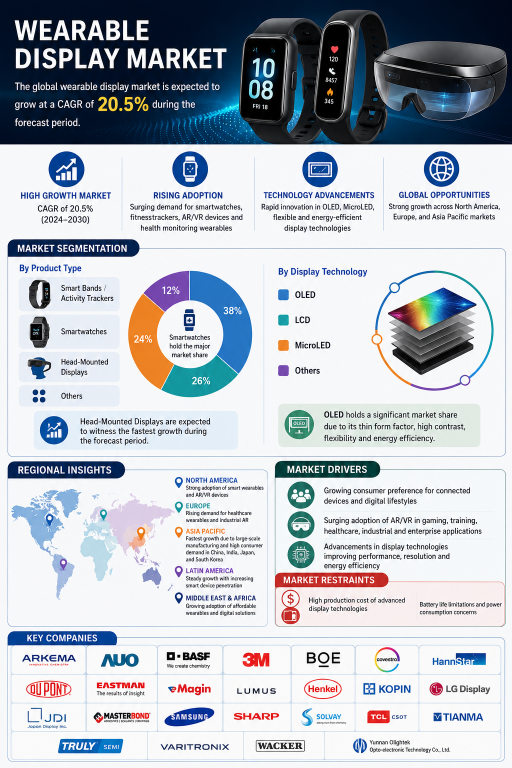
The global wearable display market is expected to grow at a CAGR of 20.5% during the forecast period. Market growth is driven by rising adoption of smartwatches, fitness trackers, augmented reality devices, virtual reality headsets, and healthcare monitoring wearables. Increasing demand for compact, lightweight, high-resolution, and energy-efficient display solutions is supporting strong market expansion. The market is also benefiting from growth in consumer electronics, digital health, enterprise AR applications, sports tracking, and immersive entertainment.
Market Drivers
Rising Adoption of Smart Wearables and AR Devices
Growing consumer preference for connected devices is driving demand for wearable displays. Smartwatches and activity trackers are widely used for health monitoring, fitness tracking, notifications, and lifestyle management. Head-mounted displays are gaining traction in gaming, industrial training, healthcare, defense, and enterprise visualization. The shift toward OLED, MicroLED, and flexible display technologies is further improving product performance and user experience.
Market Restraints
High Cost and Battery Life Limitations
Advanced wearable displays require compact design, high brightness, low power consumption, and durable materials, which increase production costs. Battery life remains a major concern, especially for smartwatches and head-mounted displays with high-resolution screens. Limited comfort, heat generation, and design complexity may also restrict adoption in price-sensitive markets.
Wearable Display Market Trends
The market is witnessing strong growth in OLED-based wearable displays due to better contrast, flexibility, thinner structure, and lower power consumption. MicroLED technology is gaining attention for future premium wearables because of high brightness, improved efficiency, and longer lifespan. Manufacturers are also focusing on flexible displays, transparent displays, miniaturized components, and lightweight AR/VR optics to improve comfort and performance.
Market Segmentation
By Product Type
Based on product type, the market is segmented into Smart Bands/Activity Trackers, Smartwatches, Head-Mounted Displays, and Others. Smartwatches hold a major market share due to high consumer adoption, frequent product upgrades, and growing use in health and fitness monitoring. Smart bands continue to remain popular in budget and mid-range wearable categories. Head-mounted displays are expected to witness the fastest growth due to rising demand from AR, VR, gaming, industrial, healthcare, and defense applications.
By Display Technology
Based on display technology, the market is segmented into OLED, LCD, MicroLED, and Others. OLED holds a significant market share due to its thin form factor, high contrast, flexible design capability, and energy efficiency. LCD remains relevant in cost-sensitive wearable devices. MicroLED is expected to record strong growth due to its high brightness, low power consumption, long operating life, and suitability for next-generation AR and premium wearable devices.
Regional Insights
North America represents a major market due to strong adoption of smartwatches, fitness devices, AR/VR headsets, and digital health technologies. Europe is supported by rising demand for healthcare wearables, sports tracking devices, and industrial AR solutions. Asia Pacific is expected to witness the fastest growth due to large-scale electronics manufacturing, strong consumer demand in China, India, Japan, and South Korea, and the presence of major display manufacturers. Latin America and the Middle East & Africa are expected to grow steadily with increasing smartphone penetration and rising adoption of affordable wearable devices.
Competitive Landscape
The wearable display market is competitive, with companies focusing on OLED displays, flexible panels, MicroLED innovation, optical components, advanced polymers, adhesives, and coating materials. Key strategies include product innovation, display miniaturization, partnerships with wearable device makers, and investment in high-resolution and low-power display technologies.
Key companies operating in the market include Arkema S.A., AUO Corporation, BASF SE, 3M Company, BOE Technology Group Co., Ltd., Covestro AG, Hannstar Display Corporation, DowDuPont, Eastman Chemical Company, Emagin Corporation, Lumus Ltd., Henkel AG & Co. KGaA, Kopin Corporation, LG Display Co., Ltd., Japan Display Inc., Master Bond Inc., Samsung Electronics Co., Ltd., Sharp Corporation, Solvay, TCL Display Technology Holdings Limited, Tianma Microelectronics Co., Ltd., Truly Semiconductors Ltd., Varitronix International Limited, Wacker Chemie AG, and Yunnan Olightek Opto-electronic Technology Co., Ltd.
Wearable Display Industry News
Companies are increasing investments in OLED, MicroLED, flexible displays, and AR optical technologies to support next-generation wearable devices. Display manufacturers are focusing on thinner, brighter, and more energy-efficient screens for smartwatches and head-mounted displays. Material suppliers are also developing advanced films, coatings, adhesives, and polymers to improve durability, flexibility, and device performance.
Historical & Forecast Period
This study report represents analysis of each segment from 2024 to 2034 considering 2025 as the base year. Compounded Annual Growth Rate (CAGR) for each of the respective segments estimated for the forecast period of 2026 to 2034.
The current report comprises of quantitative market estimations for each micro market for every geographical region and qualitative market analysis such as micro and macro environment analysis, market trends, competitive intelligence, segment analysis, porters five force model, top winning strategies, top investment markets, emerging trends and technological analysis, case studies, strategic conclusions and recommendations and other key market insights.
Research Methodology
The complete research study was conducted in three phases, namely: secondary research, primary research, and expert panel review. key data point that enables the estimation of Wearable Display market are as follows:
Market forecast was performed through proprietary software that analyzes various qualitative and quantitative factors. Growth rate and CAGR were estimated through intensive secondary and primary research. Data triangulation across various data points provides accuracy across various analyzed market segments in the report. Application of both top down and bottom-up approach for validation of market estimation assures logical, methodical and mathematical consistency of the quantitative data.
| ATTRIBUTE | DETAILS |
|---|---|
| Research Period | 2024-2034 |
| Base Year | 2025 |
| Forecast Period | 2026-2034 |
| Historical Year | 2024 |
| Unit | USD Million |
| Segmentation | |
Product Type
|
|
Display Technology
|
|
Panel Type
|
|
Display Size
|
|
End use
|
|
|
Region Segment (2024-2034; US$ Million)
|
Frequently Asked Questions
What is the expected growth rate of the wearable display market?
The market is expected to grow at a CAGR of 20.5% during the forecast period.
Which product type holds a major market share?
Smartwatches hold a major share due to strong consumer adoption and growing use in health, fitness, and communication applications.
Which display technology is widely used?
OLED is widely used due to its high contrast, thin design, flexibility, and energy efficiency.
Which technology is expected to grow strongly?
MicroLED is expected to grow strongly due to high brightness, low power consumption, and suitability for premium wearable and AR devices.
Who are the major companies operating in the market?
Major companies include Samsung Electronics, LG Display, BOE Technology Group, AUO Corporation, Japan Display, Sharp Corporation, Kopin Corporation, Lumus Ltd., Tianma Microelectronics, and TCL Display Technology Holdings