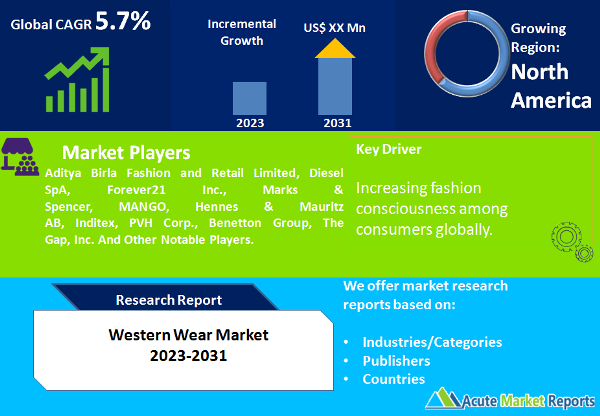
The western wear market is projected to experience robust growth, with a CAGR of 5.7% during the forecast period from 2026 to 2034. The Western wear market has experienced remarkable growth over the years, fueled by several key drivers while navigating through specific restraints. This comprehensive analysis aims to delve into the market drivers and restraints, followed by an in-depth examination of its performance across different product types, applications, and geographies. Additionally, we will explore the prevailing competitive trends, key players, and their strategies that significantly shape the Western wear market landscape.
Growing Fashion Consciousness and Western Influence
The Western wear market has witnessed robust expansion due to the increasing fashion consciousness among consumers globally. Western fashion trends, marked by denim, leather jackets, cowboy hats, and boots, have transcended geographical boundaries, captivating fashion enthusiasts worldwide. Consumers are keen on adopting Western-style clothing to showcase their unique individuality and sense of style, boosting the demand for Western wear.
Rising Disposable Income and Urbanization
The surging disposable income in both developed and developing countries, coupled with the rapid pace of urbanization, has propelled the Western wear market forward. As urban populations burgeon, consumer spending on fashion and clothing, including Western wear, has experienced an upward trajectory. Furthermore, the aspirational allure linked to Western fashion has motivated consumers to invest in Western-style apparel.
E-commerce and Omnichannel Retailing
The proliferation of e-commerce platforms and the increasing adoption of omnichannel retailing have played instrumental roles in the expansion of the Western wear market. Online retail provides consumers with unparalleled convenience, allowing them to access Western-style clothing from the comfort of their homes. Moreover, the seamless integration of various sales channels through omnichannel retailing enhances the overall customer experience, driving the demand for Western wear.
Impact of COVID-19 Pandemic
The Western wear market encountered significant challenges during the COVID-19 pandemic, akin to the overall global apparel industry. Temporary closures of retail outlets and disruptions in supply chains resulted in a decline in sales and revenue. The pandemic-induced uncertainty and economic adversities posed a restraint to the Western wear market in the short term. However, with the gradual easing of restrictions and economic recovery underway, the market is anticipated to rebound.
Market by Product Type
In 2025, Denim jeans emerge as a dominant product category within the Western wear market, securing the highest revenue and expected to register an impressive Compound Annual Growth Rate (CAGR). The timeless appeal of denim jeans, renowned for their durability, versatility, and enduring style, contributes significantly to their preeminent position in the Western wear market.
Market by Application
In 2025, Casual wear stands as the dominant application segment in the Western wear market. The unparalleled comfort and versatility of Western-style casual wear have made it a favored choice among consumers across diverse age groups. The growing acceptance of Western casual wear even in office settings, particularly among the millennial workforce, further fuels its highest revenue and notable CAGR.
Market by Geography
In 2025, North America occupies a prominent position in the Western wear market, generating the highest revenue and exhibiting a significant CAGR. The region's pervasive Western culture influence and well-established retail infrastructure have played pivotal roles in driving the demand for Western wear.
Competitive Trends
The Western wear market boasts fierce competition, featuring numerous established players and emerging brands all vying for a larger market share. Companies continually innovate in design, blending modern trends with traditional Western aesthetics. Advancements in materials and sustainable practices are gaining traction to appeal to environmentally-conscious consumers. Key players focus on expanding their e-commerce presence to tap into the growing online consumer base. E-commerce platforms offer enhanced accessibility and reach, enabling companies to cater to a broader global audience. Collaborations with renowned fashion designers, celebrities, and influencers have become a popular strategy for Western wear brands. Such collaborations enhance brand visibility and create a unique appeal, attracting a wider consumer base.
The Western wear market comprises a diverse array of key players, each adopting distinct strategies to maintain a competitive edge. Although specific strategies may vary among companies, some common approaches include:
Product Diversification: Key players expand their product portfolios to offer a comprehensive range of Western wear products, catering to different consumer preferences and occasions.
Geographic Expansion: Many key players focus on expanding their presence in new geographical markets, leveraging regional trends and preferences to gain a competitive advantage.
Brand Image and Marketing: Establishing a strong brand image and investing in marketing and promotional activities play pivotal roles in key players' strategies. Brand loyalty and perception significantly influence consumer preferences.
Sustainability Initiatives: With a growing environmental consciousness among consumers, key players are increasingly adopting sustainable practices in their supply chain and manufacturing processes, aligning with consumer values.
Historical & Forecast Period
This study report represents analysis of each segment from 2024 to 2034 considering 2025 as the base year. Compounded Annual Growth Rate (CAGR) for each of the respective segments estimated for the forecast period of 2026 to 2034.
The current report comprises of quantitative market estimations for each micro market for every geographical region and qualitative market analysis such as micro and macro environment analysis, market trends, competitive intelligence, segment analysis, porters five force model, top winning strategies, top investment markets, emerging trends and technological analysis, case studies, strategic conclusions and recommendations and other key market insights.
Research Methodology
The complete research study was conducted in three phases, namely: secondary research, primary research, and expert panel review. key data point that enables the estimation of Western Wear market are as follows:
Market forecast was performed through proprietary software that analyzes various qualitative and quantitative factors. Growth rate and CAGR were estimated through intensive secondary and primary research. Data triangulation across various data points provides accuracy across various analyzed market segments in the report. Application of both top down and bottom-up approach for validation of market estimation assures logical, methodical and mathematical consistency of the quantitative data.
| ATTRIBUTE | DETAILS |
|---|---|
| Research Period | 2024-2034 |
| Base Year | 2025 |
| Forecast Period | 2026-2034 |
| Historical Year | 2024 |
| Unit | USD Million |
| Segmentation | |
Product
|
|
Category
|
|
End-User
|
|
Generation
|
|
Application
|
|
Distribution Channel
|
|
|
Region Segment (2024-2034; US$ Million)
|
Key questions answered in this report